A few minutes before seven in the morning this Monday, a slender and not excessively tall man, even small, ran across one of the side streets of the Republic Square of Yerevan. Flanked by a few younger, stronger, and taller individuals who followed his pace quite easily at a certain distance.
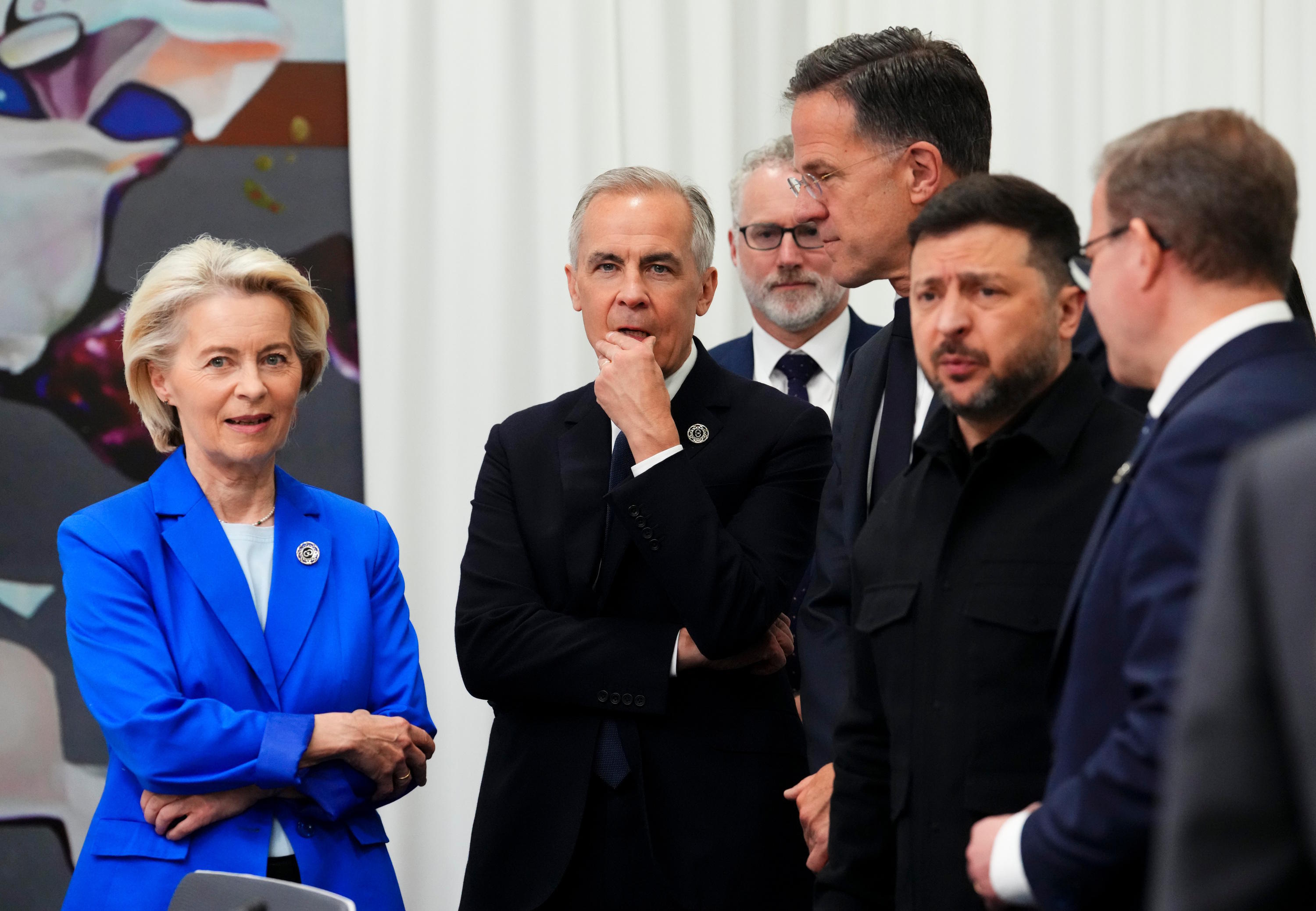
The man checked his watch, lowered his head, and, in the rain, quickened his pace as if he wanted to leave them behind. It wouldn't happen, but Mark Carney's pace was not bad at all. Those who accompanied him were, of course, part of the security team of the Canadian Prime Minister, who had traveled to the capital of Armenia to participate in the European Political Community meeting. He is the first non-European leader to participate in one of these summits, and the milestone signifies a clear rapprochement between the North American country and the European Union.
"Welcome Mark! You are among friends here," was the greeting from the President of the European Council, António Costa. "It is logical for Canada to be the first non-European state to join this forum since we are the most European of the non-European countries," Carney stated upon his arrival at the meeting held this Monday, amid the growing and repetitive threats from the U.S. President, Donald Trump, which are beginning to wear out European leaders. Even Italy's Prime Minister, Giorgia Meloni, who until recently was his staunchest ally in Europe.
"Obviously, this is a decision that does not depend on me and one that I personally would not share," the Italian pointed out regarding the possibility that, after announcing the withdrawal of troops from Germany, Trump may do the same in Italy. But she did want to make it clear that her country "has always respected the commitments and agreements it has signed," even when its direct interests were not at stake.
"We were in Afghanistan and Iraq... therefore, let's say that some things that have been said about us I do not consider correct," she added. Meloni does not seem very pleased, as she will receive U.S. Secretary of State Marco Rubio in Rome on Friday.
Giorgia Meloni talks with Keir Starmer during the summit held in the capital of Armenia.AFP
"We will mainly discuss the issue of an independent Europe. We need to reduce our excessive dependence in three specific areas," stated the President of the European Commission, Ursula von der Leyen, upon her arrival at the meeting. And one of those areas is, of course, Defense. She avoided referring to Trump's withdrawal from Germany and the new threat of tariff increases that the magnate made on May 1. But she emphasized that the EU must "strengthen" its "military capabilities."
"To be able to defend and protect ourselves. There is a large amount of money available for investments. Now we have to take a step forward and accelerate the process of producing military capabilities," Von der Leyen added. It is something she has said on more occasions, yes. But "events are unfolding rapidly," so at some point, this will have to become a reality.
Additionally, a term is gaining strength: "The European pillar of NATO." Yesterday, the EU High Representative for Foreign Affairs, Kaja Kallas, mentioned it, directly pointing to the U.S. withdrawal. "The withdrawal of U.S. troops from Europe has been talked about for a long time, but the timing of this announcement is surprising. I think it shows that we have to do more," stated the European diplomatic chief.
The stance of European leaders was very clear, which is why the words of NATO Secretary-General Mark Rutte, who, as usual, tried to side with Donald Trump, were jarring. "Yes, there has been some disappointment from the United States, but the Europeans have listened," he said regarding the decision of several countries not to allow the use of their bases and to stay out of the war that the U.S. President has initiated with Iran.
"They have understood the message from the United States and the U.S. President, just as they did last year when, at the NATO summit, they committed to a 5% spending pledge [on Defense], and now they are ensuring that all bilateral agreements regarding the stationing of forces are being implemented," he added.
It is not exactly the case for Spain, a country that has not changed its position. But it is true that some others have slightly modified their stance, and Chancellor Merz, who decided not to attend the meeting and is trying to redirect relations with Trump, downplayed the troop withdrawal and even the latest tariff threat. But the move by the U.S. President is very significant. Because it entails the fact that long-range missiles will not be deployed on German soil, as was planned to happen this year, and also because it is new evidence that almost any issue can provoke his anger. "And that generates a certain weariness in the European Union."