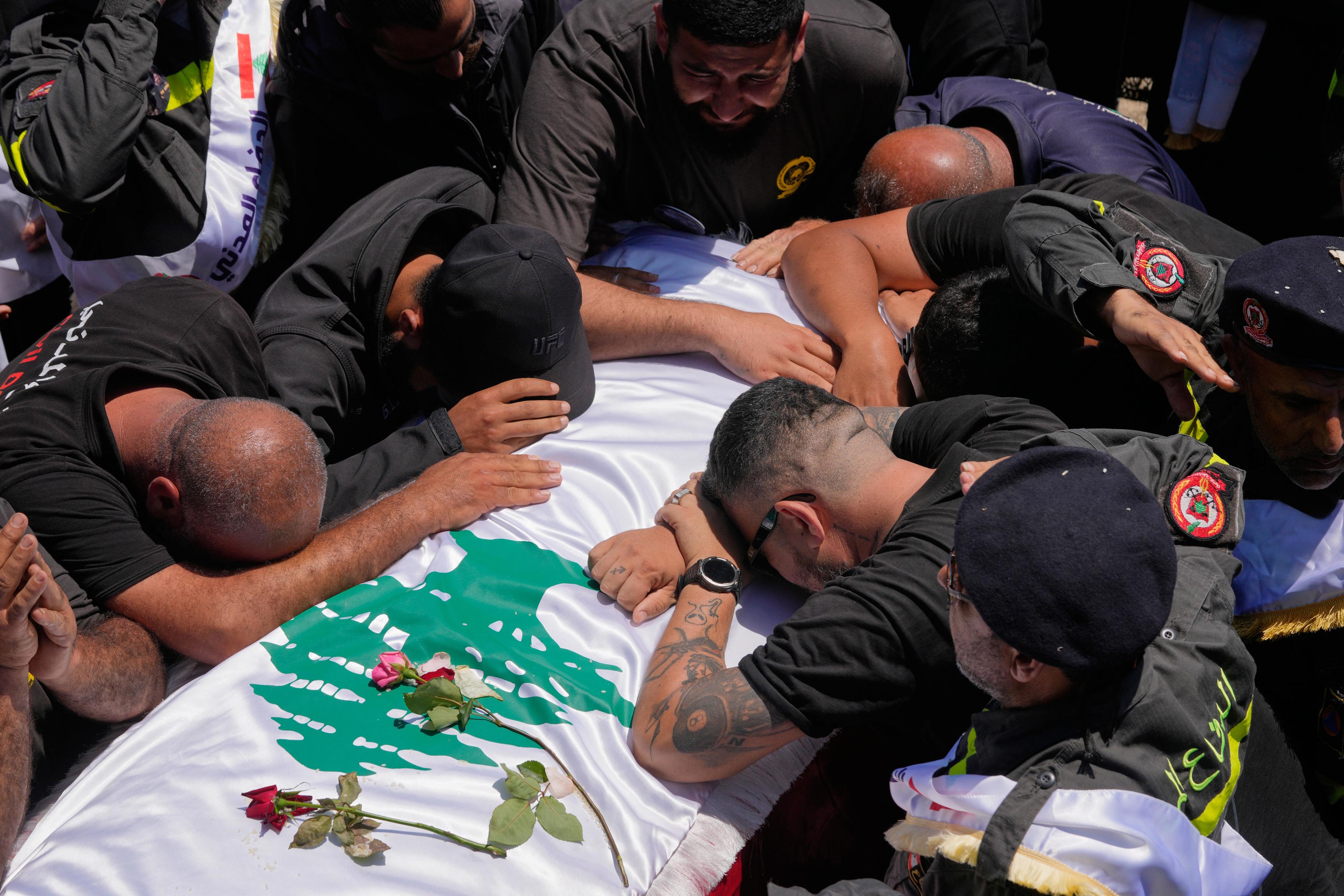
The Ministry of Health of Lebanon reported yesterday that the wave of Israeli airstrikes in the south of the country left nearly 100 dead and dozens injured between last Thursday and Sunday, in a sign of the fragility of the ceasefire in place since April 17, which in that region has been reduced to a mere hypothesis.
Local authorities added that two more people died on Monday morning in yet another attack by the Tel Aviv forces in the south of the city of Tyre. Meanwhile, Israeli military admitted on Sunday that they had attacked at least 120 targets in "various areas." "Seventy military-use buildings were destroyed, along with around 50 Hezbollah infrastructures," they stated.
The think tank Institute for the Study of War estimated that this is the "largest number of airstrikes" since the alleged ceasefire came into effect.
The escalation of conflict seems destined to worsen as Hezbollah continues to respond to Israeli assaults with rockets and, especially, with the new fiber optic FPV drones that they began using at the end of March.
The introduction of these AUVs into the local conflict scenario, previously used in the war in Ukraine, has revolutionized the military situation on the ground.
The death of two Israeli soldiers and an army employee in a few days, along with repeated attacks leaving dozens of soldiers injured, has caused significant media alarm in the country and a flood of criticism directed towards the political leadership.
As experts indicate, Israel, possessing the most powerful military in the region, has discovered that the strategy based on overwhelming dominance of combat aircraft, tanks, and artillery can be challenged by gadgets that cost only a few hundred euros.
"The most serious problem is a long-standing deficiency in the defense apparatus, as this issue has not received sufficient attention over the years," wrote the Ynet page.
"Israel has a serious problem in Lebanon. In recent weeks, Hezbollah has made an undeniable leap in its capabilities and tactics with drones. Israel should have anticipated the threat," echoed The Times of Israel.
Prime Minister Benjamin Netanyahu himself had to issue a recorded message this Thursday asking for "time" to address this situation.
"A few weeks ago, I ordered the creation of a special project to counter the drone threat. It will take time, but we are working on it. We will continue to ensure Israel's superiority in all areas," affirmed the head of the government.
With the possibility of Israel facing upcoming elections, rivals of the prime minister like Naftali Bennett have already rushed to turn the controversy into a political argument. Days ago, this far-right leader accused Netanyahu of allowing Israeli soldiers to go from being "hunters to prey due to political restrictions."
Israeli media reports that the army has hurried to equip its vehicles with nets or metal grilles used in Ukraine to mitigate these attacks.
The Ynet page indicated that a new system called "Iron Drones" has also been deployed, using several AUVs that launch nets to immobilize their aerial adversaries. However, the publication acknowledged that "it was tested about a year ago but was not effective."
"We are trying everything," stated an officer to the same newspaper.
As declared last Friday by the bloc of parliamentarians allied with Iran, the increasing use of these gadgets is intended to prevent Israel from consolidating the occupation of a buffer zone in the south of the country.
"Hezbollah is working to establish a new equation in Lebanon that does not allow the Zionist occupier to carry out aggressions and bombings without a painful retaliatory response," they stated in a release.
As Israeli analysts acknowledge, the appearance of these AUVs threatens to question the military effectiveness of the buffer zone occupied by their forces, which aimed to prevent rocket launches against the neighboring state's territory but did not consider the action of unmanned aircraft.
"Instead of being an isolation belt that prevents threats, it has become a space of permanent confrontation, where Israeli military presence has become a constant target for mobile operations," wrote a columnist for the Lebanese newspaper Al Akhbar on Monday.
Although the use of AUVs by the irregular group is still limited - compared to the massive presence in the war in Ukraine - experts believe this dynamic will increase over time, especially after the paramilitaries admitted to manufacturing the drones in the country.
A video released on Saturday - titled "Made in Lebanon with pride" - showed militants in a makeshift workshop assembling these AUVs.
"Hezbollah has had the ability to produce drones domestically since at least 2011," explained the Institute for the Study of War recently, although in this case, they referred to larger drones, not the fiber optic FPV ones.
However, the same analysis center indicated that the Israeli forces, operating in southern Lebanon, have "seized FPV drones with part of their structure assembled, spare components, and RPG warheads (explosives), suggesting" that the armed group "is manufacturing their drones domestically, at least partially, instead of receiving them from Iran."
In this regard, the head of the Israeli armed forces, General Eyal Zamir, ordered days ago to intensify the aerial bombings against "the supply and production chain of FPV drones" beyond the south of the country.
The Israeli Defense Forces are literally devastating the southern border region, following the conduct pattern applied in Gaza, something publicly acknowledged by Defense Minister Israel Katz. "All homes in the Lebanese villages near the border will be destroyed, following the model of Rafah and Beit Hanoun in Gaza," he stated.
An analysis of satellite images released on Sunday by The New York Times confirmed that the Israeli soldiers have demolished at least dozens of towns in that area.
Attacking or destroying civilian infrastructure constitutes a war crime, as countless legal experts and human rights activists have warned.
Nearly 2,700 Lebanese have died since the war began on March 2, alongside 21 Israelis.