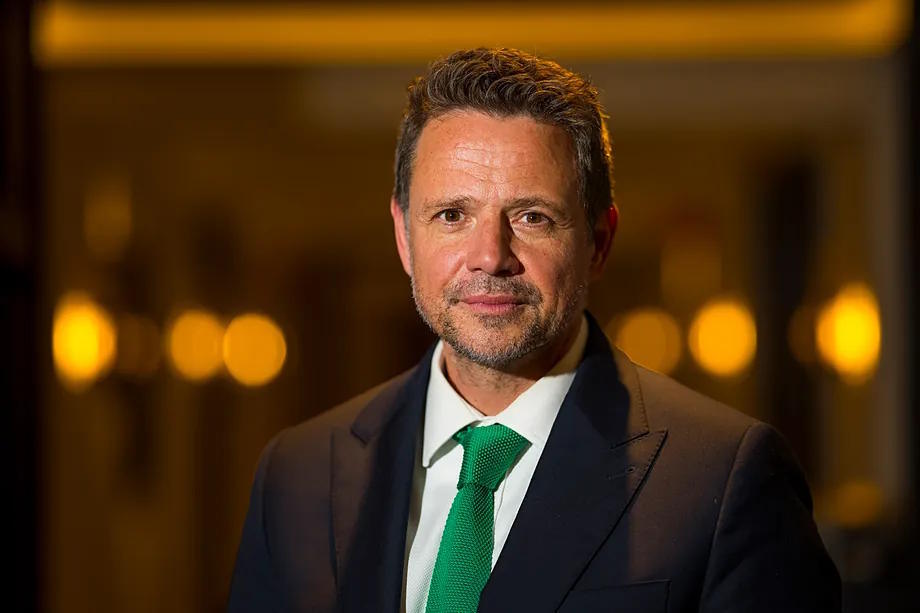
Rafal Trzaskowski is not just any mayor of a major Polish city. This liberal and pro-European politician has stood up to the conservative ultranationalism in his country in two presidential elections (2020 and 2025), as a candidate of the party of Prime Minister Donald Tusk. He came close to victory in the second occasion, falling just one point behind Karol Nawrocki. He is willing to discuss this and much more during a visit to Madrid.
QUESTION. Is your goal to transform a city, Warsaw, or a society, the Polish one?
ANSWER. My work is to transform Warsaw and make the city as livable as possible, but also to address people's issues, such as high housing prices or the mental health crisis among young people. At the same time, I try to tackle some of the national-level problems. Poles are highly polarized due to social media, where algorithms only fuel conflict and negative emotions. That's why we teach our children in schools to develop the instinct to verify the information they see, not to take it at face value, but to question the reality.
Q. Would you run for the Polish presidential elections again?
A. It's hard to imagine such a situation. Right now, I am focused on the city. But what's important for us, meaning my political party in power, is to learn from those elections, and the main lesson is that people under 35 do not respond to the usual messages. We need to be much more active on social media, and they are tired of polarization, so we also need to convey more positive messages and address the issues that matter to them. But it also sends a clear message to the Government that it must fulfill its promises because my candidacy was also judged based on the fact that I come from the same party as the Government, and although the Government has done a tremendous amount of work, given that we are in a coalition, we have not fulfilled all the promises. Unfortunately, populists are now on the rise in many countries. They find it easier to win because many of them have no track record. That's why it's much harder to turn public opinion against them.
Q. Did Poland miss the great opportunity to have a president and a prime minister of the same political sign to move forward, or is Donald Tusk still managing to push his agenda forward?
A. If we had a positive and rational president, we could have advanced and modernized the country faster, leveraging the potential of the people and the economy for the nation's benefit. But unfortunately, we have a president [Nawrocki] whose main task is to make the Government's life difficult and block any initiative, and he doesn't even hide it. I mean, the previous president [Andrzej Duda], who was also a populist, vetoed laws on rare occasions. This president vetoes many measures presented by the Government simply because he doesn't want the Government to fulfill its promises. And sometimes his actions are very hard to explain. For example, we wanted to regulate cryptocurrencies, and he vetoed it. And now we have one of the biggest scandals with cryptocurrencies, where 30,000 people who invested were left without security guarantees. So he is blocking laws that are good for the people, that have no political connotations, just to make the Government's life difficult.
Q.With the threat from the neighboring Russia so close, is the polarized Polish society united on the Defense issue?
A. Yes. Regarding strengthening our armed forces, strengthening our ties within the Atlantic Alliance, and aiding Ukraine, most Poles agree. The previous president, also from the Law and Justice party, was a populist. But on issues like supporting Ukraine, supporting our defense industry, our relations with NATO, and good relations with our European partners, he was in line with this Government. Unfortunately, the new president is even reluctant in that. For example, he vetoed the European SAFE program, which would have allowed us to use a large amount of EU loans to invest in our armed forces and defense industry, arguing that it would make us dependent on Germany. So, although there is broad consensus on security issues and helping Ukraine, some populists are now even questioning that, which goes against Poland's national interest.
Q.How is Spain perceived from Poland in the Defense issue? Is it considered that our country is ignoring threats by not even approving investing 5% of GDP?
A. The danger is the same for everyone. I understand that Spaniards may not perceive the imminent threat as we do in Eastern Europe. But crazy dictators destabilize the world. And if Putin goes unpunished, all these dictators will see that Europe and the Western alliance are weak and not credible. The times when we could rely on Americans for security and do nothing on our own are over. The world is becoming more destabilized as we speak. So, if we want to stand together on this and show solidarity, we all have to spend more money on Defense because no one will do it for us. Look at what's happening in Ukraine, look at what's happening in the Middle East or the Persian Gulf. Everything has a huge influence on what's happening in Poland, but also on what's happening in Spain. Look at energy prices. Even though the current Spanish Government is doing a lot to achieve self-sufficiency through investment in renewable energies, the impacts are still being felt. And if Americans are now considering relaxing their commitment to Europe, there is no other option but to be stronger ourselves in Europe. Of course, we have to invest in NATO because it is the cornerstone of our security. We have to explain to Americans that they need strong and loyal allies in Europe, but we also need to invest in our own European capabilities.
Q. The relationship with Donald Trump is really complicated. Do you understand the direct dispute between Pedro Sánchez and the President of the United States, or do you prefer to try to tone it down?
A. I regret that the new US Administration is becoming less predictable, but we should focus on what we need to do in terms of positive measures. I mean, Donald Trump is who he is. Now, the question is: should we judge him?, and stop complaining?, is that effective in politics or should we learn from it? If we want to learn from it, then we should focus on ourselves, on strengthening the European economy, on enhancing our competitiveness, on carrying out common projects together. For example, in terms of the Defense industry, that becomes a lever for economic development. But let's not duplicate what we do. We have to make decisions on sensible energy policy, where yes, we fight against climate change, but prioritize the competitiveness of our economy if we have to compete with others. We have to agree on research and development and on our own Artificial Intelligence model. We have to do all that when we see that Americans are less predictable than they used to be.
Q. Is the German government's announcement of cuts in the Welfare State to address growing expenses such as investment in Defense well-oriented?
A. I am very pleased that Chancellor Friedrich Merz has recognized some of the mistakes Germany made in recent years.
Q.Are you referring to when Angela Merkel was in power?
A. Yes. Immigration policy, energy policy, dealing with Russia and dependence on it, on its fossil fuels, treating Moscow as a reliable business partner, and becoming heavily dependent on China and its exports. I mean, it's good that Merz admits those mistakes because since 2004 we have been telling our European friends that we needed to be self-sufficient and independent in energy matters. We told our friends that Putin only understands power and should not be treated as a businessman. And then our friends in Europe told us that we were obsessed with Russia. Unfortunately, history has proven us right. Additionally, Germany was not spending enough on Defense, so it needed to reform its policies. I am very pleased that Chancellor Merz's geopolitical analysis is very similar to ours.
Q.But History carries a lot of weight in that area of Europe. Is the situation different now? Does Poland want to see a strong Germany?
A. It's not about a strong Germany, but a strong Europe. Germany is a very close partner for us, as is France. Additionally, the Tusk Government collaborates closely with Spain, Italy, and also with the UK, even though it is outside the European Union.
Q. When you mentioned past mistakes of Germany, you issued a warning about the proximity to China, something that Spain currently practices: closeness to Beijing.
We must draw conclusions from the past. We have already seen what happened with Russia. Of course, China is a completely different country. China can be our partner. But above all, we have to think first about Europe and not rely too much on China. What Russia taught us is that we can only be strong when we speak with one voice. What the current relations with the US should teach us is that Trump will take us seriously if we stay united. The same applies to China. If any European country wants to have a special relationship with China, it undermines to some extent its own position and that of the European Union. We should have a unified policy towards China. It doesn't have to be aggressive. It can be firm, based on collaboration, but it's better if we do it together, and the Chinese will respect us more. If we agree, Europeans have incredible potential. We are much stronger when we act together.