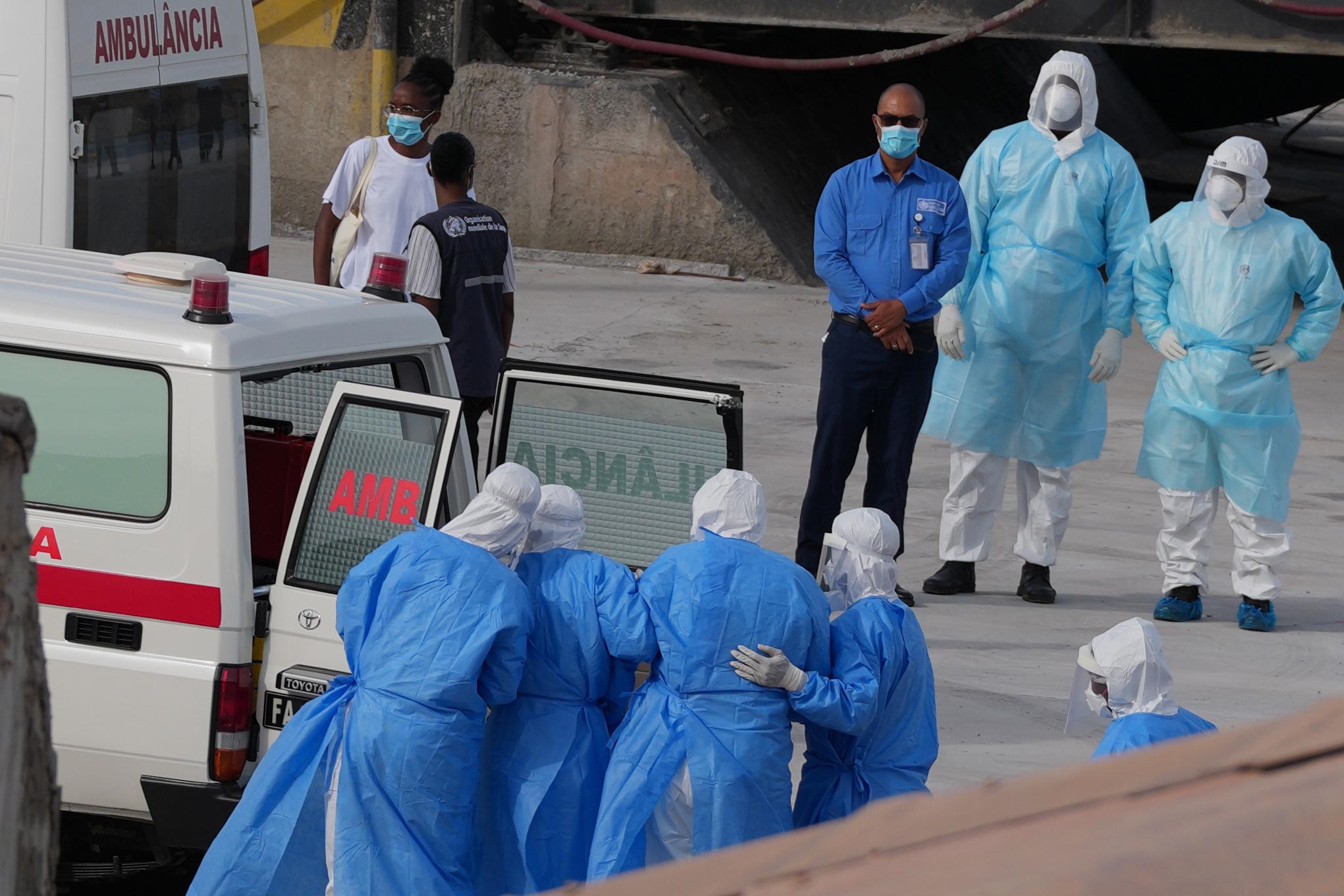
The cruise ship MV Hondius affected by the hantavirus outbreak will disembark in the Canary Islands this week, in three or four days. The Ministry of Health, after meeting with the World Health Organization (WHO), announced yesterday that they accepted the decision to welcome the vessel in compliance with International Law and humanitarian spirit.
The WHO has explained that Cape Verde cannot carry out this operation and the Canary Islands are the closest location with the necessary capabilities. "Spain has a moral and legal obligation to assist these individuals, including several Spanish citizens," the Government stated in a press release. They will do so in coordination with the European Union. The Government will disclose the details of this protocol as soon as they are defined by the WHO and the European Centre for Disease Prevention and Control (ECDC). Additionally, they will provide timely updates on its implementation.
The Government has also accepted the request from the Netherlands Government to welcome the doctor from the MV Hondius, who is in critical condition and was transported to the Canary Islands in a medicalized plane last night.
Throughout the day, speculation arose about the ship's arrival in Spanish territory, but at noon, the uncertainty was cleared: the decision would be made "based on epidemiological data." The vessel, as of the time of this edition, remains anchored in Cape Verde. Yesterday afternoon, it received a team of WHO epidemiologists to assess and determine the next steps.
How has the epidemiological examination been conducted on board?
The ECDC is conducting a thorough examination of the ship to determine which individuals need to be urgently evacuated in Cape Verde. The rest will continue towards Canary Islands, where they expect to arrive within three or four days. The specific port in the archipelago has not yet been defined, as reported by the Health Ministry. Once there, crew and passengers will be properly examined, cared for, and transferred to their respective countries.
The process will be carried out through a common protocol for managing cases and contacts developed by the WHO and the ECDC, and will have all necessary safety guarantees. Both medical care and transfers will be conducted in specially equipped spaces and transports ad hoc for this situation, avoiding all contact with the local population and ensuring the safety of healthcare personnel at all times.
Prior to this, suspected cases remaining on board will be evacuated in medicalized planes to high-isolation units for treatment. The two symptomatic cases will be evacuated to the Netherlands from Cape Verde. High-risk contacts will be quarantined in Germany, as reported by Mónica García's department.
The Canary Islands Health Department has confirmed that since Monday, the Health Alerts and Emergencies Coordination Center (CCAES) and the Health Department had been considering the possibility of the ship heading to the Canary Islands. Fernando Simón, director of the Health Alerts and Emergencies Coordination Center (CCAES) of the Ministry of Health, highlighted yesterday that "fortunately, in the Canary Islands, there is a high-level treatment unit for infectious patients."
How should passengers and crew disembark upon arrival in the Canary Islands?
So far, the number of affected individuals in the outbreak has risen to eight: three deceased, two cases transferred with symptoms to South Africa, two suspected infections, and one high-risk contact to be transferred. Mar Faraco, head of the External Health Service in Huelva, emphasizes that "protocols for controlling cases and possible contacts must be applied." This is crucial due to the uniqueness of the outbreak caused by this hantavirus strain, which generally "is very unlikely to be transmitted from person to person. There are very few documented cases," as explained by the secretary of the Association of External Health Physicians (AMSE).
"The ideal scenario would be to disembark with caution, in isolation, with specially prepared ambulances and protective equipment."
Faraco details how this process should be carried out: "The ideal scenario would be to disembark with caution, in isolation, with specially prepared ambulances and protective equipment, for the sick or suspected cases, even if they have just a slight cough or fever."
Afterward, the rest of the passengers and crew who could be considered contacts should be observed. "It is necessary to assess whether they have been in close proximity to the most severe cases and evaluate if any have had very close contact, such as sharing the same cabin or spending a lot of time together; a certain quarantine could also be considered."
For the others, if they have had more casual contact and do not have symptoms, "each one should go home using regular transportation and monitor symptoms. If a fever arises - temperature should be checked in the morning and at night - and if any symptoms appear, they should go to their hospital or reference center, mention their contact with this case, and be evaluated," comments the head of the Huelva External Health Service, while suggesting the "preventive use of masks."
Symptom monitoring should be carried out for at least 15 days after disembarkation, as the infection has a long incubation period; "up to six weeks have been described," Faraco emphasizes. The 14 Spaniards on board - 13 passengers and one crew member must follow these protocols once they disembark. Five Catalans, three Madrileños, one Valencian, and one Galician are among those confirmed by their respective Health Departments.
Secondary objective: finding the origin or patient zero of the hantavirus outbreak
As highlighted by the head of the External Health Service in Huelva, the most important aspect is to conduct a thorough study of each case. Benjamin Brennan, group leader and associate professor at the MRC-University of Glasgow Virology Research Center, suggests that knowing the travel history to South America of those who boarded is crucial. This expert points out that a key clue is that the initial cases traveled through South America, including Argentina, before boarding the cruise.
"This is crucial epidemiological information, as it suggests that the infection was contracted in an endemic hantavirus region and brought on board, rather than originating on the ship. In Argentina, the Andes virus circulates, so 'identifying which virus strain is responsible is essential to assess the current risks associated with the outbreak,'" the expert comments to the Science Media Centre in the UK.
"The appropriate priority should be given to rapid isolation, medical evacuation, and contact tracing."
Brennan emphasizes that "currently, the appropriate priority should be given to rapid isolation, medical evacuation, and contact tracing, so that affected patients receive the complete and thorough medical treatment they need."