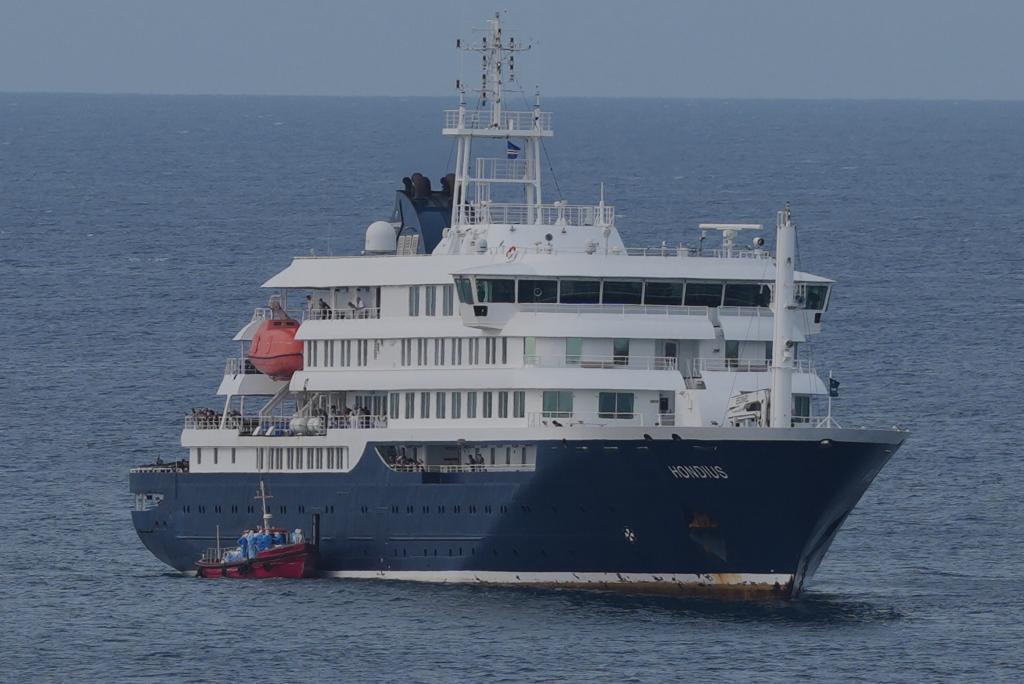
Mónica García, Minister of Health, has reported the latest details on the situation of the ship affected by hantavirus. "Today, after the inspection, there are three symptomatic cases, one of them being the ship's doctor, a British national in critical condition," she pointed out. "Everyone remaining on the ship is asymptomatic, including the Spaniards". The action plan includes repatriating foreigners and quarantining Spaniards, who will remain quarantined for at least 45 days at the Gómez Ulla Central Defense Hospital in Madrid.
García made it clear that "the rescue and repatriation process to be carried out in the Canary Islands will not pose any risk to the Canarian population or its economic activity". She emphasized that "Spain has all the capabilities to assist all individuals and to maintain the protection of public health as we deserve."
What are the action plans for the ship?
The minister has informed about the steps to receive the ship, which "will arrive at the Port of Granadilla de Abona, located 10 minutes from Tenerife South Airport, where a repatriation protocol for all foreigners will be implemented, unless there is a medical condition preventing it." García emphasized that "this entire process is led by the European Commission and will have all the necessary guarantees, spaces, and transportation, avoiding contact with the local population."
During the press conference held with the Minister of the Interior, Fernando Grande-Marlaska, she detailed the meetings held with the World Health Organization (WHO), the European Centre for Disease Prevention and Control (ECDC), the European Commission, the Netherlands, South Africa, Cape Verde, and the Government of the Canary Islands. In response to accusations of lack of coordination and misinformation, the Minister of Health reiterated that the technical teams have been in constant contact with each other, and External Health has maintained continuous coordination at all levels to share information, assess risks, and coordinate the response.
Regarding the location of the MV Hondius vessel, it is public —"it can be tracked live"— and she explained that "it is currently anchored near Praia, the capital of Cape Verde." There, the team of epidemiologists from the European Commission's Health Security Committee, in which the ECDC participates, has conducted a thorough assessment of the situation and identified three cases on board, she detailed. "These individuals are being evacuated from Cape Verde to the Netherlands." She mentioned that the ship's doctor, a British citizen who was in a more critical condition yesterday, "has been stabilized, so he will not be transferred to Spain as requested by the Dutch government, but the option of transferring him to the Netherlands has been considered and is being carried out there."
García emphasized that "as of today, all passengers and crew remaining on the ship are asymptomatic". Once the evacuation of all symptomatic individuals in Cape Verde is completed, the ship will continue its course to the Canary Islands, "where it is expected to arrive at the secondary port of Granadilla de Abona within three days." The minister explained the choice of this port as "it is a port with very little activity, secondary, located 10 minutes from Tenerife South Airport."
From the airport, the plan is to implement a joint mechanism for health assessment and evacuation "to repatriate all foreign passengers, who will be repatriated through a European civil protection mechanism, which will then be informed by the Minister of the Interior," García explained. This entire process is led by the European Commission, with the support of the WHO and the ECDC, García confirmed. This European civil protection mechanism will have all the necessary security guarantees: "both medical care and transfers will be carried out in special facilities and transportation, avoiding all contact with the local population and ensuring the safety of the assistance personnel at all times."
What will happen to the Spaniards on board?
The Spaniards, 13 passengers and one crew member, will be evaluated and examined upon arrival in the Canary Islands. The minister explained that they will be transported by military aircraft to the Torrejón Air Base and from there to the Gómez Ulla Central Defense Hospital, where they will be cared for, examined, and quarantined for as long as necessary according to clinical protocols. Regarding the observation period, the minister specified that it will be "at least 45 days and as long as necessary" to ensure both their health and that of others.
The choice of this destination for the Spaniards is based on the capabilities and security mechanisms of this center. "It has units called UATAN (units for high-level isolation and treatment) that allow for the isolation of these individuals due to their characteristics." García mentioned that if needed, "there are another 16 similar facilities in Spain." She confirmed that the University Hospital Nuestra Señora de Candelaria in Tenerife also has one. "They told us it was not ready yet, but they are already working on getting it ready in case it is needed."
In this military hospital, they have the capacity and security to "have all the necessary tests, including PCR and serologies, and other microbiology needs to, if necessary, when the protocols indicate, be able to subject suspected and symptomatic cases" to all these tests, the minister explained.
Additionally, García confirmed that the hantavirus strain detected on board is the Andes virus. This infectious form has the highest transmissibility of the virus among humans. García emphasized that the risk to the general population is very low and reminded that interpersonal transmission of the Andes hantavirus is extremely rare.