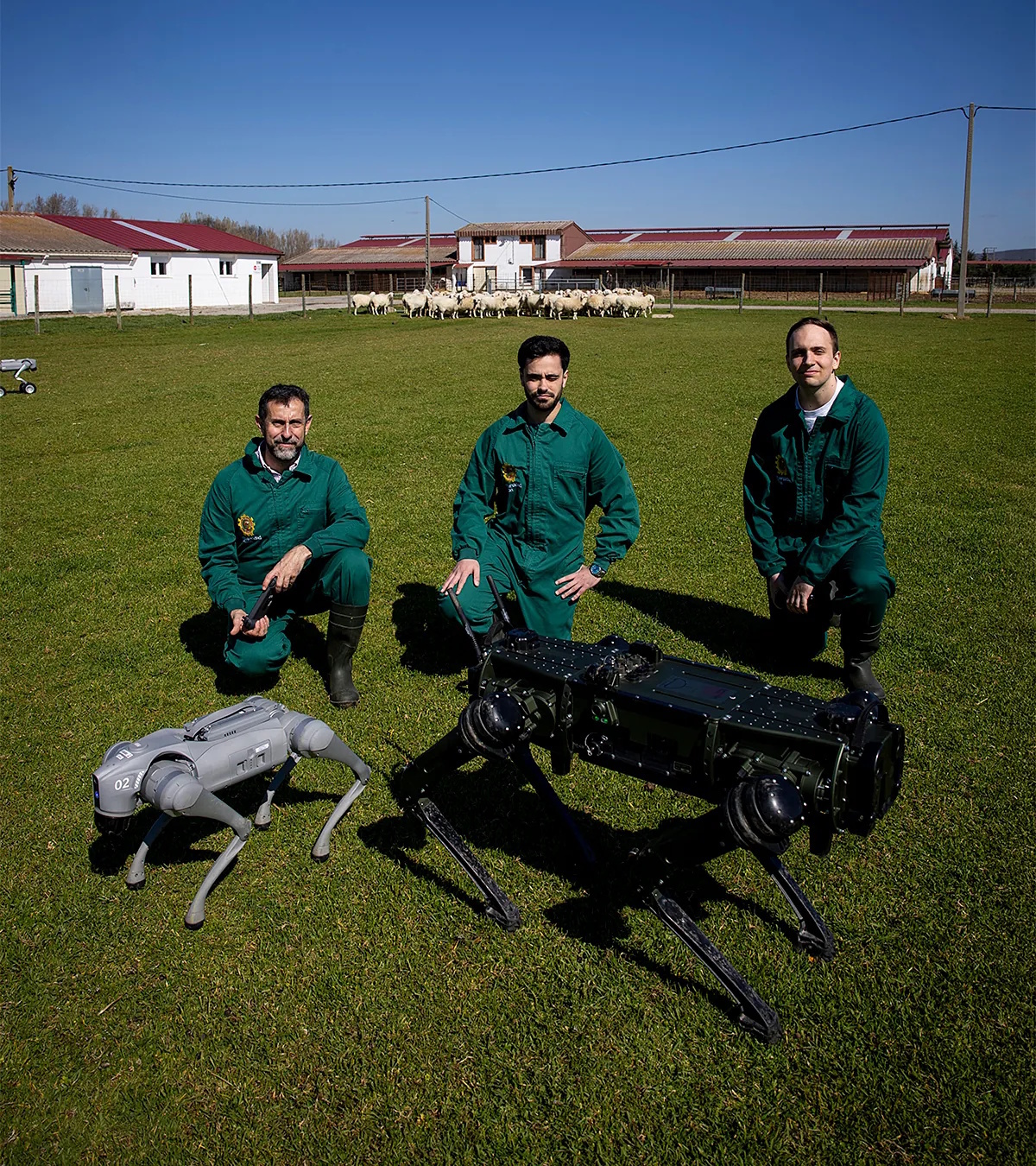
The future is reached by the road that curves between Navatejera and Villaquilambre. Behind the fence of a farm indistinguishable from any other at first glance, in a trapezoid-shaped meadow, something resembling a revolution can be glimpsed. Three specialists advance towards a flock of sheep in green uniforms and a video game-like controller. Just as many quadruped automatons - one of them with wheels - march following their instructions to meet the ruminants. The sun shines for the first time in almost three months. Barely a slight rattling breaks the peace of the countryside. In such circumstances, an unusual encounter takes place on the outskirts of León: that of robotics and shepherding, the avant-garde and the ancestral. Unusual also because rarely in a technological testbed do you have to navigate around cow dung.
"Here we have 250 Assaf sheep and 60 Churras. Both give good milk. Almost no one comes for the wool anymore," explains Jesús García, 60 years old, in charge of the farm. A cattle rancher but with cattle in the mountains. "The robot dogs? The first time they brought them, the sheep were curious... and also scared," he recalls while witnessing a new animal-machine interaction. "The problem is that they are very gregarious and very fearful. As soon as four or five of them leave, the rest follow," echoes in work clothes the professor Vicente Matellán, the main person in charge of a pioneering project throughout Europe. He and the two researchers accompanying him try to herd the flock with the metallic canines Sultan, Tuercas, and Ruedines. Something as challenging as trying to pick up a drop of mercury with your fingers. Perhaps even more striking than watching humanoids doing kung fu on prime-time Chinese television.
Warren Bennis' words about the factory of the future are well known. The advisor to up to four US presidents, a pioneer in leadership studies, predicted that such a factory would have only two employees: a man and a dog. "The man's job will be to feed the dog, and the dog's job is to make sure the man doesn't touch the equipment," wrote Bennis, popularizing a joke that had actually been circulating among the British Postal Engineers Union since the late 1970s. Even earlier, the master of science fiction literature Isaac Asimov had imagined the complete automation of agricultural tasks in The Caves of Steel (1954), envisioning a world where lettuce and tomatoes would reach the salad bowl without a single person having touched them during planting, harvesting, or dressing.
Well, the Robotics Group of the University of León (ULE) is working on an intermediate scenario where humans, programmable assistants, animals, and crops coexist. Matellán is the founder of the team of researchers dedicated to the Self-Air and Auroras projects, which include a dozen professors and former students from the master's program at the Castilian-Leonese center and the Rey Juan Carlos University (Madrid). The first of the projects was funded by the Ministry of Ecological Transition with European funds and aimed to create a robot dog capable of assisting in livestock tasks. Specifically, in sheep herding and -attention- in protection against potential predators like the wolf.
The second project, co-financed by the EU and channeled through the Ministry of Science, aims to provide said device with intelligent behavior to address other needs in the primary sector. "We are applying the same algorithmic philosophy to soil sensing to detect weeds or measure moisture levels," explains Professor Lidia Sánchez, the principal investigator of Self-Air along with Francisco Javier Rodríguez, and now focused on Auroras.
Both projects refute the perception of the automaton as an inhabitant, or fetish, exclusively urban. A century-old stereotype - the first mention of the word robot as a synonym for an artificial being dates back to 1920 - fattened with tons of movies, series, comics, or stories. And by presentations by Elon Musk in auditoriums always with lots of LEDs and no mud. In short, a cliché spreading the idea of rural areas as infertile ground for R&D. At least, for the audience not familiar with irrigation and milking.
Representatives from ULE mention that, compared to the high level of technological advancement in agriculture in Spain, livestock farming has fallen behind. Especially extensive farming. "In Australia and in some areas of the United States, drones are used to monitor herds on large estates. Here, however, it is anecdotal. And the use of quadruped robots is rare," Matellán explains in an office filled with mini toy androids.
"When we started in 2022, there was some news about the interaction of a Boston Dynamics robot with animals, but this one was teleoperated [controlled by a human]. Our goal was to develop a software that would allow, for example, to detect the greenest pastures by combining different sources: multispectral camera, satellite images...," adds Sánchez.
"The big gap, what will require a significant investment, is here, in the software, because the hardware is reasonably well resolved by the Americans and the Chinese. What we lack is that intermediate part that takes the collected information, processes it, and decides on the actions," emphasizes the professor regarding the models of cognitive architecture that function as brains of the synthetic pack.
Ruedines and Tuercas came off the assembly line of Unitree (China). Sultan is the Vision 60 device from Ghost Robotics (USA) rebranded with a dog's name, although it looks like a hormonated insect. It is the largest one operated by the ULE laboratory. It weighs around 50 kilos. It is resistant to rain, dust, and tumbles that end in a rollover. It has a maximum autonomy of three hours. It cost 180,000 euros with the basic package.
Today, it has several super senses thanks to the combination of mechatronics and AI, making it an advanced version of the V60s already used in the US for perimeter surveillance of strategic facilities or for detecting toxic gases in landfills. It can maneuver at various speeds on uneven terrain. It integrates navigation systems based on GPS, artificial vision models, different sensors (proximity, thermal, etc.), and a dataset with over 80,000 images. Some provided by shepherds from the province of León; others incorporated by the researchers after a dozen field tests on the farm, also frequented by their Veterinary colleagues. This is only in relation to the sheep. Despite contemporary infantilization portraying them as cottony cloned creatures, they are not all the same.
"We went to Extremadura to conduct another test, and instead of being white, they were almost black. Of course, the algorithms we had trained didn't recognize them. Then we mixed Tuercas with Merino sheep, which are more brown, and he identified them as dogs, wolves, foxes, horses, bears... any animal that wasn't a sheep. We had to do a lot of retraining," confesses Professor Camino Fernández, the team's haptics specialist, regarding the initial test results. On another occasion, Sultan moved to a new neighborhood and was butted by a cow, who perceived him as an unwelcome presence.
Perhaps the most decisive outing, however, was the one the group took to a meeting of shepherds in Zamora. The presentation of Sultan as an alternative to biological dogs left the attendees indifferent. They argued that their livestock herding was already covered by their Carea, the native dog breed of León: intelligent, inexpensive, and easy to train. And they added that the protection of the flock was entrusted to the intimidating mastiffs.
At that moment, the shepherds were unaware of the implications of having a device that could identify, from dozens of kilometers away, whether a sheep was injured or lost. And that didn't need to eat, rest in the shade, or sleep at night. Precisely when the mastiffs were off duty. Precisely when wolves usually attacked. That's when things changed: the dismissive "meh" transformed into a curious "uhm."
'Self-Air' and 'Auroras' are the projects that employ robots in the agricultural and livestock sector.
The specialists from León then decided to learn more about Canis lupus signatus, the subspecies endemic to the Iberian Peninsula. They traveled to the Félix Rodríguez de la Fuente Center (Puebla de Sanabria) to study its behavior. "They are imprinted wolves. They aren't domesticated, but they are accustomed to the presence of people," Matellán explains. They remotely operated Sultan while a caretaker was delivering food to the reserve's residents.
The reaction can be seen in several YouTube videos hosted on the Group's account. First, as soon as the robot starts moving, there's distrust. Then, when it tries to approach them, there's fear before they flee. "I'm sure a wild wolf would also run away," the professor maintains. His researchers learned a lot from these encounters in the third jaw. They confirmed that the wolf's primary sense is smell, not sight. They discovered that there are sounds, like the drone's hum, that are unbearable to them. Consequently, they considered possible non-harmful deterrent strategies, such as installing emergency lights or scent dispensers on the robot.
Some might say: well, what outlandish and impractical solutions. But anyone who thinks this is worthwhile should also consider any proposal that could reduce the damage caused by the expansion of wolf packs (333, according to the latest census by the Ministry for Ecological Transition).
"Wolf attacks on livestock are a problem for farmers, but also for the wolves themselves, because they are the main reason for their persecution by humans. It seems positive to me that robotics researchers recognize this as a problem worthy of being addressed," emphasizes biologist Juan Carlos Blanco, the expert the European Commission contacts when it has questions about Canis lupus. He also points out that it's now almost impossible to find a story about a bad wolf.
In Spain, there is no unified registry of wolf bites and claw attacks on livestock. It is estimated that in 2025, nearly 18,000 attacks occurred in the five regions with the highest wolf population (Castilla y León, Galicia, Cantabria, Asturias, and La Rioja). In the Castile and León region, these attacks increased by 47% between 2021 and 2024. Four and a half years ago, the government included wolves in the List of Species Under Special Protection (LESPRE), which led to a ban on hunting them. Since then, the debate between livestock and conservation organizations has resembled a Sunday afternoon paintball match. The former argue that the protection has intensified the pressure on their herds, while the latter claim that the figures may be inflated with the dual aim of criminalizing the aggressor and demanding higher compensation.
How viable would Sultan's integration into the pastoral ecosystem be? Could we see him in a few years, with his prosthetic gait, in Montaña de Riaño? Is this a business opportunity for a startup in León? How much would it cost to scale up the basic prototype? Will mechanized deterrent hunts replace traditional ones with shotguns? "Here, we do basic research, with the advantage of having a farm and veterinarians and ethologists right next door. What interests us is demonstrating whether we can solve these kinds of problems with technology. And the answer is yes: it's feasible for a robot to manage a flock and detect predators," Sánchez summarizes. "What falls outside our scope of study is economic viability. Today, it wouldn't be viable due to the cost of the robots," the researcher clarifies, aware that the key lies not in manufacturing a few units, but millions of them.
"Answering these questions could take a long time... or it may never be possible," Matellán interjects. "Look, NASA started sending rockets into space in the 1960s, and it wasn't until the beginning of this century that we saw the commercial exploitation of that technology by companies like SpaceX. Satellite constellations have taken five decades to mature. We think this robot dog can be used to watch over flocks, but perhaps it's more useful for transporting cargo, monitoring pesticide use, or tracking forests. Instead of using camera traps with fixed cameras, we could use the dog to have a wider field of vision."
A G1 humanoid robot from Unitree—the same model that performed acrobatics on Chinese television—has gone viral these past few days after chasing three wild boars through the streets of Warsaw. Its manufacturers probably didn't foresee that it could be used to remove wild animals from residential areas.
Luis Prieto and Sergio Sánchez are the two former students of the Robotics Master's program at the University of León (ULE) who are accompanying the professor on the visit to the farm. They now work for the department. They operate Sultan and Nuts, respectively, with gamer-like skill. "The hardest thing to achieve will be autonomous behavior," predicts the former. "I'm optimistic. I like to think that in a few years, with the advances being made in hardware and software, these robots will be implemented in every imaginable field," adds the latter. The depopulation of inland Spain and the lack of generational succession in extensive livestock farming could be incentive enough for the presence of robot dogs in agriculture to become more than just a token gesture.
"The complaint we hear most often is that robots are going to take our jobs. I say it's quite the opposite: people don't realize the amount of work they provide. Programming, modifying, or maintaining them are tasks that generate employment for many people. What changes is the level of specialization. To do these jobs, you need to be more highly trained. And that's what universities are for," Fernández points out. "The technology we develop here aims to make people's lives easier." "I want to believe that technology is at the service of society for good. These robots aren't going to replace a shepherd or any other dog, but rather help them," his partner counters.
The pair of former students readily hand over the controls for a while to the author of these lines. Activating Tuercas on the farm or guiding him through the corridors of the MIC (Cybernetic Research Module) is somewhat more difficult than piloting a 4x4 by remote control. At times, his trot is reminiscent of Aibo, the robotic puppy for children that Sony marketed between 1999 and 2005. In fact, at educational events like Expociencia, children often pet the synthetic Leonese with genuine tenderness. The UX [user experience] with Sultán, on the other hand, translates into unease. The eldest of the family is subconsciously perceived more as a weapon than a pet.
Professors at the University of León (ULE) explain that the average person began to get used to living with robots exactly a decade ago, with the popularization of disc-shaped domestic vacuum cleaners and pool cleaners. "The image people had of robots up until then was that of the industrial environment: an enormous arm handling metal parts," Matellán contextualizes. "Now, although robots still attract attention, they no longer surprise us."
The use of IP67-certified quadrupeds in the war in Ukraine partially refutes that perception. Commander Oleksandr Syrskyi's V60s aspire to be as lethal on the front lines as a Doberman with a flamethrower. The robot dog is the latest pop culture myth to be debunked: see the "Metalhead" episode of the Black Mirror series. When the Group presented Sultan and his new brain on Facebook, the reactions thundered like a hailstorm. "It's missing a machine gun...", "This thing has little to do with a dog, it's a cross between an ant and a grasshopper," "Please, I'm a sheep and I'd have a heart attack!", were some of the comments.
"We haven't done, nor do we intend to do, anything related to military applications," the professor clarifies. "We have collaborated with the Military Emergency Unit (UME)," Sánchez specifies. "Perhaps disaster management could be an interesting area in the future." For example, if we send the robot to a building in danger of collapsing, we can see if there are victims or if there has been a gas leak."
The ULE researchers' headquarters features a pilot apartment reminiscent of the houses in the film Dogville. It has a kitchen, bathroom, living room... and not a single wall. This is the space where the robots tinker with household items, dodge furniture, and try not to bump into things. The ceiling is reserved for the OptiTrack motion-capture system, although the Group has already moved to a higher level: massive neural networks, subsymbolic processing, and mission design.
A small plot of land right next to the Robotics building allows the quadrupeds to have their first contact with the ground before being moved to the farm. The ground is furrowed as if it were a newly sown vegetable garden. However, the only animals that wander around are sparrows.
What might happen in the open field with a Sultan equipped with AI is a tantalizing unknown. In one of his most memorable speeches, Félix Rodríguez de la Fuente declared: "The howl of the wolf is one of the most impressive sounds produced by any living creature. May the wolf live wherever it can and wherever it should live so that the beautiful howls of the wolf may never cease to be heard on Spanish nights." The encounter between this state-of-the-art robot and one of the most fascinating animals—feared, admired, persecuted—of the Iberian ecosystem would represent more than just a milestone.
"It would confront the mystery of the primal with an automated future of algorithms and sensors, of flocks without mastiffs or shepherds. The image projects the promise of greater efficiency in livestock management, but it also implies the loss of a millennia-old bond between shepherds and dogs that has produced a rich cultural heritage, which would likewise disappear," envisions Francisco Almarcha, a graduate in Social Anthropology from the University of Alicante and author of *The Wolf: Totem and Taboo* (Tundra Publishing).
"It would be fantastic news if these robot dogs were perfected into highly effective deterrents. This would greatly reduce animosity towards wolves and facilitate coexistence. It would increase both effectiveness and productivity," he says. "However, if this is done on a massive scale and without regard for the ecological, cultural, and sentimental value of the landscape, it would turn the countryside into a more inhospitable, threatening, and surveilled place. The key is to implement all these technological changes prudently. The beauty, magic, serenity, and freedom that nature provides are part of our identity and a source of well-being. Judging by the criteria applied to the installation of wind farms and solar plants, I'm not very optimistic."
Sultan doesn't wag his tail when he's happy. He doesn't lie down at our feet with furry empathy. He doesn't bark either. It will be others who say "woof" as he passes by.