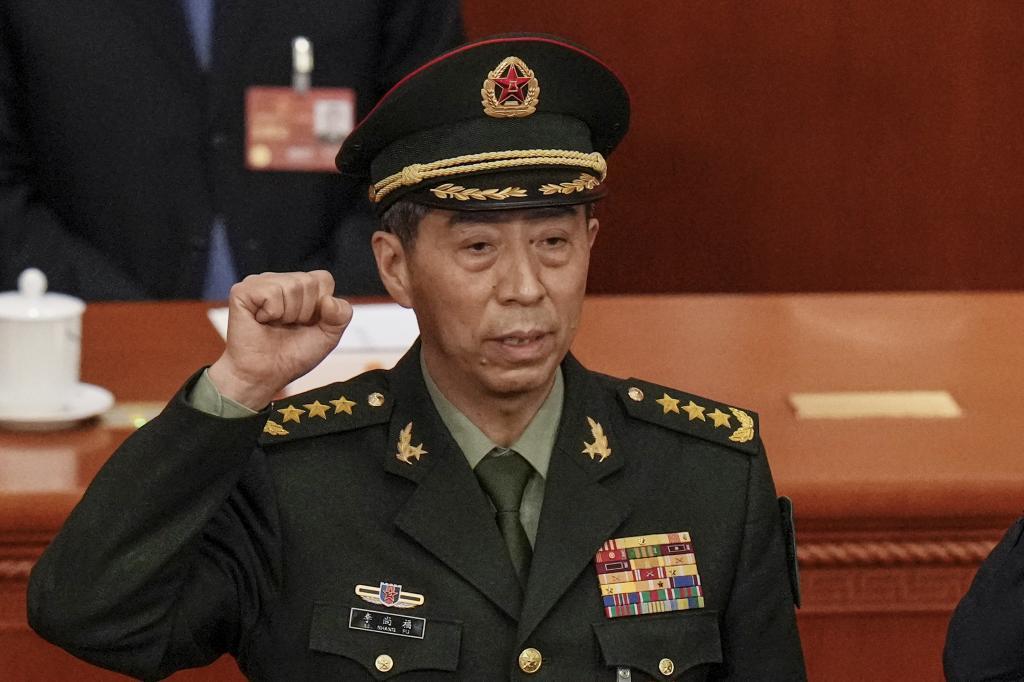
China announced on Thursday the suspended death penalty for two years for former Defense Ministers Wei Fenghe and Li Shangfu, accused of corruption, bribery, and abuse of power. The sentence, issued by a military court and reported by the official agency Xinhua, represents one of the hardest blows against the top leadership of the People's Liberation Army (PLA) since Xi came to power in 2012 promising to clean up the party and the armed forces.
In practice, the "death penalty with a two-year suspension" rarely ends in execution in China. It is a judicial formula commonly used in major corruption cases or political purges. If the convicted person does not reoffend during that period, the sentence is usually automatically commuted to life imprisonment.
In the case of Wei and Li, authorities have already announced that after this commutation, both will remain imprisoned for life without the possibility of parole or further sentence reductions. In other words, an irreversible life sentence wrapped in the political drama of a capital punishment.
The portfolio held by both Li and Wei, unlike their Western or other Asian counterparts, carries more diplomatic and ceremonial weight than political decision-making. In China, it is the powerful Central Military Commission (CMC) that truly directs military affairs. This body is composed of seven individuals, including Li, but always subordinate in the chain of command to two vice-chairmen and President Xi Jinping.
The omnipresent supreme leader also heads this commission as the country's top military authority. Despite the limited internal weight of the Defense Minister, they play a key role in facing military officials from other countries.
The armed forces have been one of the main targets of an extensive anti-corruption campaign ordered by Xi, which has taken down, especially since 2023, dozens of high-ranking officers and defense industry executives.
Wei Fenghe, minister from 2018 to 2023, was accused of accepting "huge amounts of money and valuables" and manipulating military promotions and appointments. Li Shangfu, his successor, fell just seven months after being appointed minister. Investigations concluded that he had received million-dollar bribes and used his position to benefit third parties and enrich himself personally. Official media accused him of "betraying his original mission" and "seriously contaminating the political environment" of the army.
Li's fall was particularly striking because he was considered a close ally of Xi. Trained as an aerospace engineer, he led the Xichang Satellite Launch Center and oversaw milestones in the Chinese space program, including the country's first lunar mission. Later, he was promoted to head of military acquisitions, where he promoted the purchase of Russian Su-35 fighters and S-400 anti-aircraft systems, operations for which he was even sanctioned by the United States.
That period leading arms purchases eventually became the epicenter of the investigation. Beijing uncovered irregularities in military tenders, leaks of secrets, and a corruption network linked to multi-billion-dollar army modernization contracts.
In the anti-corruption campaign within the PLA, the most recent impactful downfall earlier this year was that of General Zhang Youxia, CMC vice-chairman, Politburo member, and heir to a revolutionary family historically linked to Xi's clan. His investigation for "serious violations of discipline and state laws," the usual euphemism for corruption and political disloyalty, shook the regime's foundations.
Liu Zhenli, former Chief of the Joint Staff, and one of the few senior Chinese commanders with real combat experience, was also removed. Before that, other key generals had already fallen, such as Miao Hua and He Weidong, another CMC vice-chairman.
Xi Jinping insists that absolute loyalty to the Communist Party is as important as technological modernization. In his recent speeches to the military leadership, he has reiterated the need to strengthen "ideological control" and ensure that the army remains "the Party's army."
However, the scale of the purges began to raise doubts even outside China about the true state of readiness of the PLA. A report from the International Institute for Strategic Studies warned that the anti-corruption campaign is leaving "serious deficiencies" in the military command structure and may have weakened the operational capacity of armed forces immersed in rapid transformation.