Two Argentine officials investigating the origins of the hantavirus outbreak on the luxury cruise ship MV Hondius have indicated that the government's main hypothesis is that a Dutch couple contracted the virus while birdwatching in the city of Ushuaia (Argentina) before boarding.
These officials have stated that the couple visited a landfill during the tour and could have been exposed to rodents. The officials spoke on condition of anonymity because they are not authorized to inform the media while the investigation continues, as reported by AP.
WHO seems to support this hypothesis, stating that the first infected person could not have contracted the virus on board the cruise ship MV Hondius or during one of the stops made by the vessel, as, due to the known incubation periods of the virus, everything indicates that the infection must have occurred before its departure from Ushuaia in early April.
The cruise ship departed from southern Argentina on April 1 for an expedition to the Cape Verde archipelago. A 70-year-old Dutch passenger was the first to show symptoms (fever, headache, diarrhea) on April 6 and died on the 11th. "The incubation period —the time between infection and symptom onset— ranges from one to six weeks, but it is generally more likely to be two to three weeks," stated Anaïs Legand, a technical expert in viral hemorrhagic fevers at WHO.
Therefore, the first infected person "could not have been infected on the ship or on one of the islands," but "clearly had some contact before boarding, most likely through a rodent," emphasized the spokesperson.
According to sources from the Communicable Diseases Area of the National Center for Epidemiology (CNE), of the Carlos III Health Institute, "with the information available so far, including the type of virus that caused the outbreak - the Andes variant - it is plausible that there are cases that contracted the disease through contact with rodents during their time on land, before starting the cruise, and others through person-to-person transmission during the cruise."
This viewpoint is also shared by Pello Latasa, vice president of the Spanish Society of Epidemiology. "The main hypothesis being considered by WHO, given the sequential appearance of cases, is that a chain of transmission has occurred," he points out.
"The most likely scenario, as the disease's incubation period is usually long, is that the initial cases were exposed to the virus off the ship, and subsequently, there was secondary human-to-human transmission on board," explains the SEE spokesperson.
Daniel Antenucci, a Physiology professor at the University of Mar del Plata and associated researcher at Conicet (National Scientific and Technical Research Council of Argentina), states that, while not ruling it out 100% "because it would not be impossible for there to be a rodent on board," the probability of acquiring the infection on board from a rodent "is minimal," leaning towards the option that the first affected couple "got infected outside and boarded already infected."
This Argentine expert explains that "transmission on board could have occurred due to the close quarters and enclosed spaces."
"That is the main hypothesis, but until the epidemiological and microbiological investigations are completed, we will not know for certain," Latasa adds.
Benjamin Brennan, group leader and professor at the MRC-University of Glasgow Centre for Virus Research, at the University of Glasgow, points out that "cases 1 and 2 traveled through South America, including Argentina, before boarding the cruise. This is crucial epidemiological information, as it suggests that the infection was contracted in an endemic hantavirus region and brought on board, rather than originating from conditions on board the ship," he stated in comments to the Science Media Center UK.
Brennan adds that "previously, only limited person-to-person spread with the Andes virus had been documented. The incubation period and disease progression rates in this outbreak justify close monitoring."
Timeline of the search for the origin
From Argentina, efforts are being made to determine which parts of the country the infected passengers traveled to before boarding the Dutch-flagged cruise ship in Ushuaia, a city in southern Argentina known as the end of the world. Once their itineraries are known, they assure that they will trace contacts, isolate those with whom they had closer contact, and carry out active monitoring to prevent further spread.
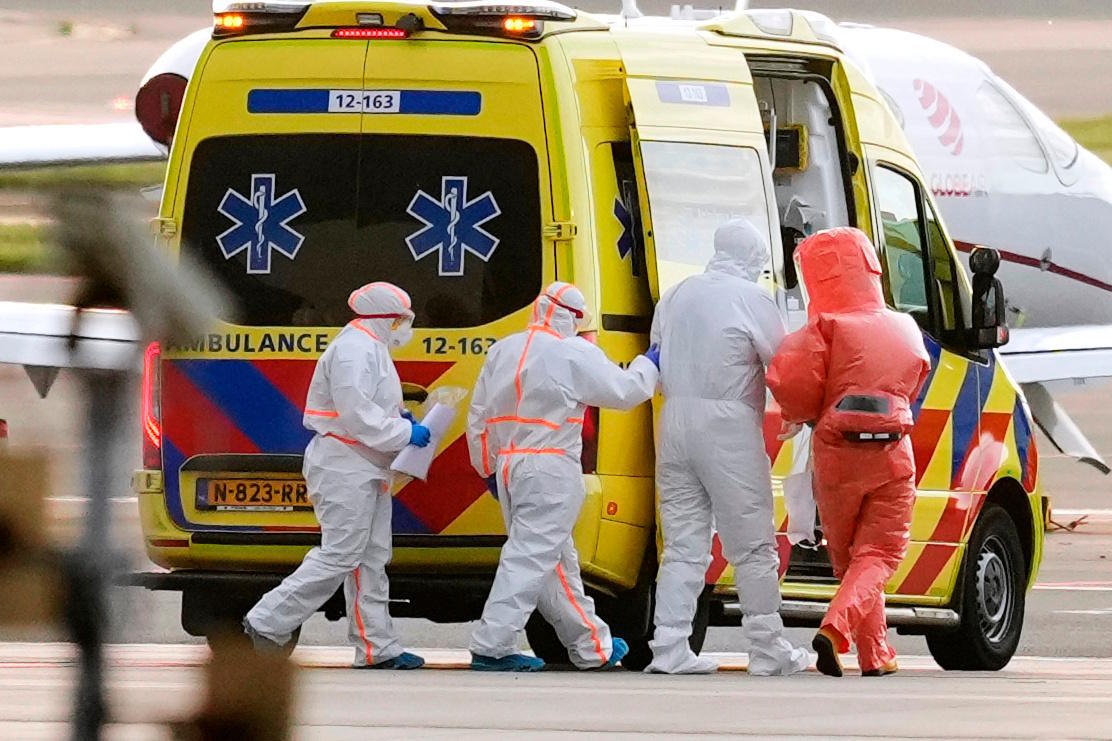
WHO, the UN health agency, indicated that the first death on board, a 70-year-old Dutch man, occurred on April 11. His wife, also Dutch and 69 years old, died on the 26th of the same month. The third passenger, a German woman, died on May 2.
The virus can have an incubation period of between one and eight weeks. This makes it difficult to determine if the passengers contracted it before leaving Argentina for Antarctica on April 1; during a scheduled stop on a remote island in the South Atlantic; or on board the ship.
Before boarding, the Dutch couple toured Ushuaia and traveled to other places in Argentina and Chile, as reported by WHO.
Therefore, the main hypothesis of the Argentine government is that the couple contracted the virus during an outing to birdwatch in Ushuaia. Authorities are also tracing the steps of the Dutch tourists through the forested slopes of Patagonia, in southern Argentina, where some infections are concentrated.