A new and significant defeat for Donald Trump. The US Commercial Court ruled this Thursday that the President of the United States does not have the authority to impose new global tariffs appealing to trade imbalances, invalidating the 10% surcharge that the White House activated a few weeks ago, just after the Supreme Court overwhelmingly struck down almost all of the protectionist wall erected by the administration in early 2025.
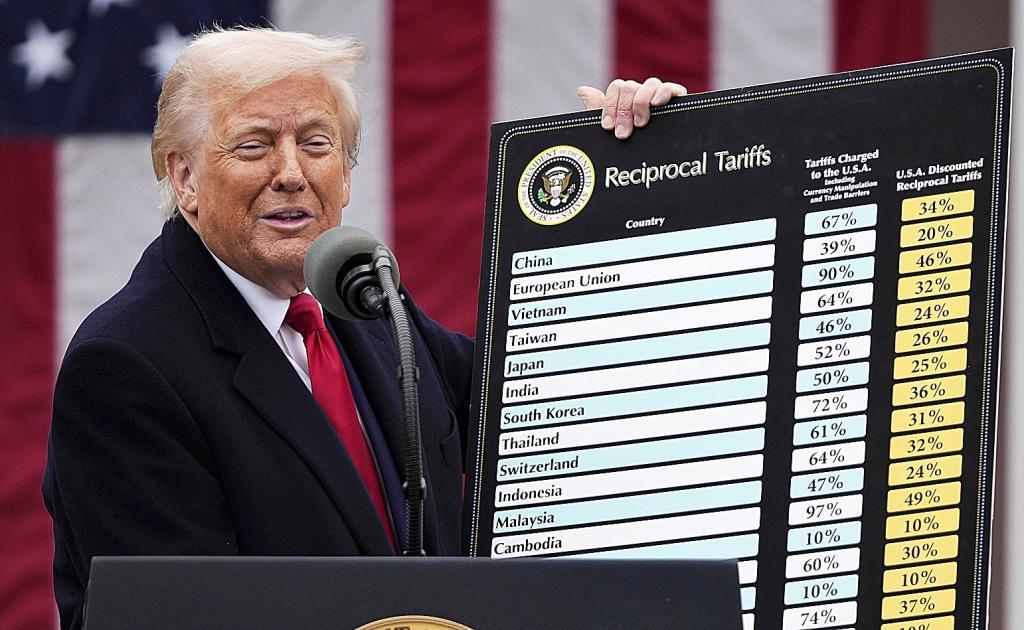
The Supreme Court did not say that tariffs cannot exist, but that Trump chose the fast and wrong path, relying on the Emergency Economic Powers Act to punish Mexico and Canada for drug entry into the country as well as for the so-called "reciprocal tariffs" that Trump announced in early April last year, on the so-called "Liberation Day". And that if he wanted to change trade policy, he should turn to Congress or other instruments.
Trump, furious with the judges, tried to convince himself and others that it was not a big problem, even though he had to start returning over $165 billion irregularly collected from companies. His first reaction was to invoke Section 122 of the Trade Law, which gives temporary powers to the Executive. But now the panel of judges, by a 2-1 vote, has established that this is not the way either.
The news comes on the same day that Trump spoke with the President of the European Commission, Ursula von der Leyen, about the relations between both blocs. A few days ago, in his usual style, Trump unilaterally announced once again that he was raising tariffs on European vehicle exports, both as a way to penalize the German government for Chancellor Friedrich Merz's criticisms of the military operation in Iran and to put pressure on Brussels, as the EU has not yet approved the new trade agreement that Trump has forced to establish, with tariffs of up to 15%. The European Parliament continues to demand protection clauses and annulment precisely for situations like the current one, in which Trump decides to threaten countries, their sovereignty, or impose new tariffs on a whim.
The commercial court, a highly specialized body, considers that this mechanism chosen by the White House also does not meet the specified criteria in the trade law for the application of import surcharges, a very severe defeat. Tariffs are not just a mechanism of economic protectionism, but the main instrument of Trump's economic and foreign policy, the weapon he has used time and time again against friends and foes in his first year and a half in power.
The ruling is more important for the message it sends, further limiting the government's room for maneuver, than for its practical effects, because in reality, that 10% surcharge announced just after the Supreme Court ruling has a maximum deadline of 150 days without Congressional approval, and it expired in July. It is then when, in theory, the administration will present another different tariff battery, this time appealing to Section 301 of the Trade Law, which authorizes them to address "unfair trade practices" of other nations. Likewise, the three judges have chosen not to impose what is known as a "universal injunction" against the government, that is, they do not order it to stop and immediately compensate the importers affected by the decision.
When Trump imposed that 10% (actually, the next day he said it would be 15%, but never tried to apply it), almost half of the country's states, along with several companies, went to court. The panel of judges that ruled today held a public hearing last month to try to precisely define what the legislators had in mind when, drafting the trade law in 1974, they mentioned "fundamental problems of international payments" and "balance of payments deficits". These were times when the dollar was tied to gold, which posed risks that no longer exist now and that, it was thought, the president might have to address with selective tariffs.
Trump and his team have based their entire tariff strategy on trade imbalances. The formula used to calculate the exact rates for each country, for example, was a nonsense that simply reflected in percentage form the purchases and sales of each country, yielding completely absurd results that penalized up to 90% or 100% tiny countries that inevitably sell more than they buy from the US.
The two judges, appointed by Barack Obama, who have decided the sentence consider that this type of reasoning is also not valid for the application of Section 122 and emphasize that Congress, in passing the trade law, took measures "to carefully limit presidential discretion". The dissenting judge, appointed by George W. Bush, said in his separate opinion that he did not think the panel "was empowered to review the factual conclusions that led it to determine that the action was necessary or appropriate".