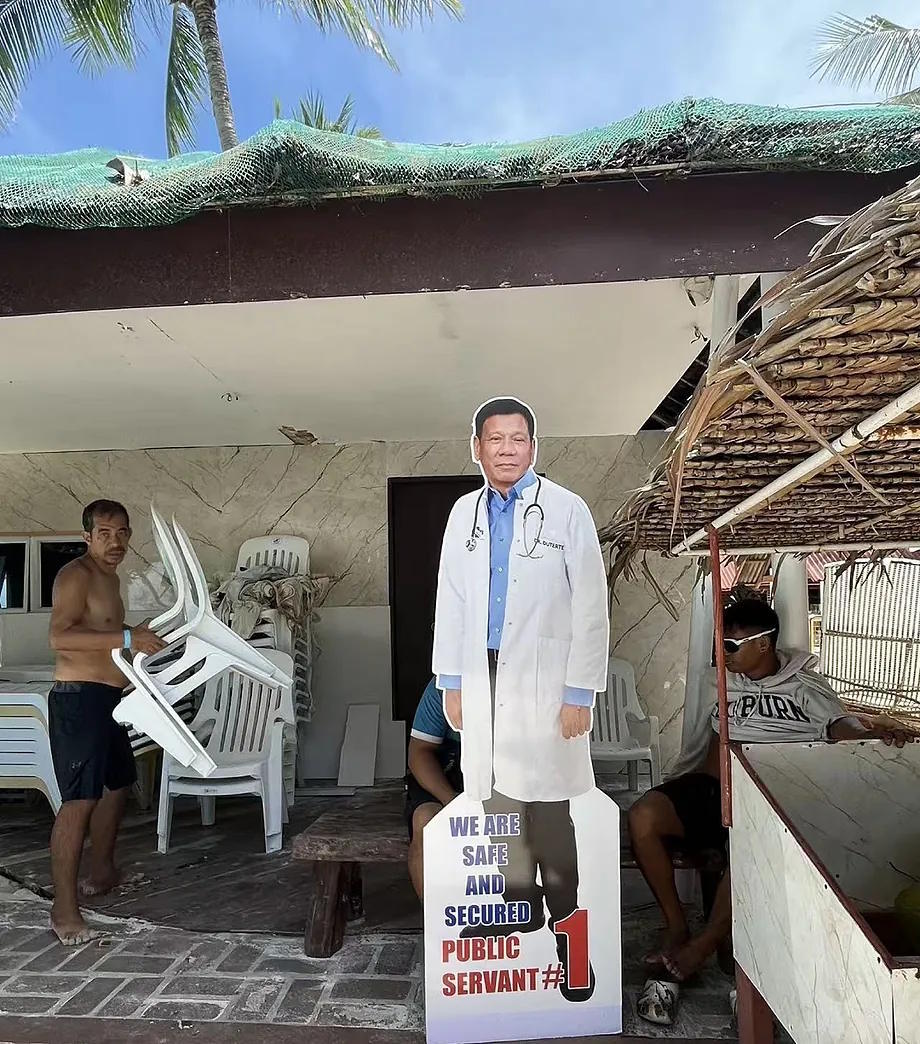
Early in the morning, the heat falls like a damp sheet over the empty beach hammocks. A dog sleeps under the dark wooden table of a kiosk with nipa roofs dried by the sun. Next to some stacked plastic chairs stands a nearly two-meter cardboard figure, dressed in a white doctor's coat. It is the former Filipino president Rodrigo Duterte, full-body, with a stethoscope around his neck, watching over the beach like a patron saint of public order. His face retains that half-smile with which he threatened drug traffickers for years, joked about murders committed in his name, and promised security to a country exhausted by poverty. At the base of the sign, with blue and red letters that still resist the sea moisture, it reads in English: "We are safe and protected".
In Bohol, a Philippine island with white sand and coconut trees bent by the wind, Duterte continues to appear on beaches, dining rooms, barbershops, mobile phone stores, and rickety buses as if he had never left power. Or as if he is not now sitting in the dock in The Hague, accused of crimes against humanity. His face continues to be part of Filipino daily life with the persistence of religious icons. He shares space with virgins, fighting cocks, and beer ads.
"Duterte was a strong leader. Everything he did, starting with his famous war on drugs, was for the country's security and to protect honest people from criminals. It was the only way to restore order in the neighborhoods. Other governments were weak; he did what needed to be done." The staunch defense of the former president is pronounced by a former police officer who claims to have been part of the so-called death squads during Duterte's government. The man introduces himself as Juanito.
In Bohol, which is a two-hour ferry ride from Cebu, Juanito now works as the head of security at a beachfront resort. He is around 50 years old, speaks fluent English, and does not shy away from the question of whether he participated in the extrajudicial executions that multiplied throughout the country during the war on drugs, even investigated by the Filipino justice system. "In self-defense, I myself shot drug traffickers. We went in groups of eight or nine, dressed in civilian clothes, patrolling the most problematic neighborhoods of the province of Cebu at night. The criminals were armed too. It was either them or us," he recounts.
Let's go back to 2016. "Forget about human rights. You, drug traffickers, robbers, and lazy people, you better leave because I will kill you," Duterte declared in an interview shortly before general elections that he won overwhelmingly under the promise to extend the bloody anti-drug campaign he had implemented for over two decades as mayor of Davao, the third-largest city in the Philippines, to the entire country.
He kept his word. Some bodies began to appear floating in rivers. Others were found lying in alleys, with their hands tied, their faces covered with duct tape, and a cardboard sign hanging around their necks: "I am a drug addict".
Under that presidential order, hitmen and criminal organizations thrived, taking advantage of the hunt to settle personal scores. Over the years, official investigations and testimonies from former agents have uncovered dozens of police setups: weapons placed next to bodies, drug packages planted at the crime scene, and identical versions claiming that the suspect had fired first. Officially, the war on drugs resulted in over 6,000 deaths. Human rights organizations raise the figure to 30,000.
Duterte, now 81, was arrested last year at Manila airport and transferred to The Hague, where he will be tried by the International Criminal Court (ICC). "Duterte created, financed, and armed death squads to murder alleged drug traffickers and users between 2016 and 2022," the court prosecutors argue. Last week, the ICC confirmed that the former president will face trial on three charges of crimes against humanity.
"In many marginalized neighborhoods of Manila or Cebu, people slept in terror. Every week we collected bodies of children hooked on shabu," says Juanito, citing the local name for crystal methamphetamine. "We never killed any innocent people," he insists, although he avoids explaining exactly how his squad's raids worked.
Other anti-drug unit police officers, cited in Amnesty International reports, confessed to receiving payments for killing alleged drug traffickers, rewards ranging around 15,000 Philippine pesos (around 210 euros). Some even claimed that local funeral homes paid them for each delivered corpse.
"The police version always said that the suspect had opened fire and that the agents acted in self-defense. But families spoke of executions. In our investigations, we discovered that, in the vast majority of cases, they were cold-blooded murders and that the police would place weapons and drugs next to the bodies afterward," explains Peter Bouckaert, emergencies director at Human Rights Watch.
That is precisely what, according to all judicial evidence, happened in the case of the Spanish Diego Bello Lafuente, shot dead on January 8, 2020, on the island of Siargao. "We hope that the trial for the murder of our son ends soon, by the end of this year, with a strong conviction against the three police officers who killed him," says Pilar Lafuente, Diego's mother, over the phone. She speaks to this newspaper in the same week when forensic experts from the Forensic Anatomy Institute of Madrid, who performed the autopsy when the body was repatriated to Spain, testified before the Manila court about the gunshot wounds to the ear, chest, and abdomen indicating an execution.
Pilar and her husband, Alberto Bello, have traveled to the Philippines several times to follow the process. In one of the hearings, they came face to face with the three police officers accused of the murder: Captain Wise Vicente Panuelos and Sergeants Ronel Pazo and Nido Boy Cortés, provisionally detained while being tried for murder, perjury, and evidence tampering.
According to the agents' version, Diego - who had been living in Siargao since 2017 and ran a nightclub with other partners - was suspected of drug trafficking. They claimed that, during an undercover operation, the Spaniard pulled out a gun, fired first, and tried to escape, forcing them to respond with gunfire. But the National Bureau of Investigation (NBI), the Filipino equivalent of the Judicial Police, dismantled that account.
Diego was not carrying any weapon. There was also no evidence linking him to drug trafficking. After reviewing the crime scene and hearing dozens of testimonies, the prosecutors concluded that it was all a police setup. Even the ballistics report revealed manipulations in the collected casings and determined that Diego was shot "from top to bottom," consistent with an execution rather than a shootout.
The three police officers, after being on the run for a year, surrendered in 2023. Pilar maintains that progress in the case was achieved thanks to diplomatic pressure from Spain and the European Union, in addition to the work of NBI investigators who dismantled the evidence fabricated by the officers, including the inclusion of Diego's name on a supposed list of drug traffickers.
"In all provinces, we had lists of drug sellers causing many problems. We would go to arrest them, and if they resisted with their weapons, as it almost always happened, we would take them down. I have no regrets," Juanito insists, without clarifying how he ended up working in private security at a hotel on a paradise island. Two years ago, Duterte himself admitted to the Senate that he had ordered his agents to "provoke" suspects to resist to justify the killings.