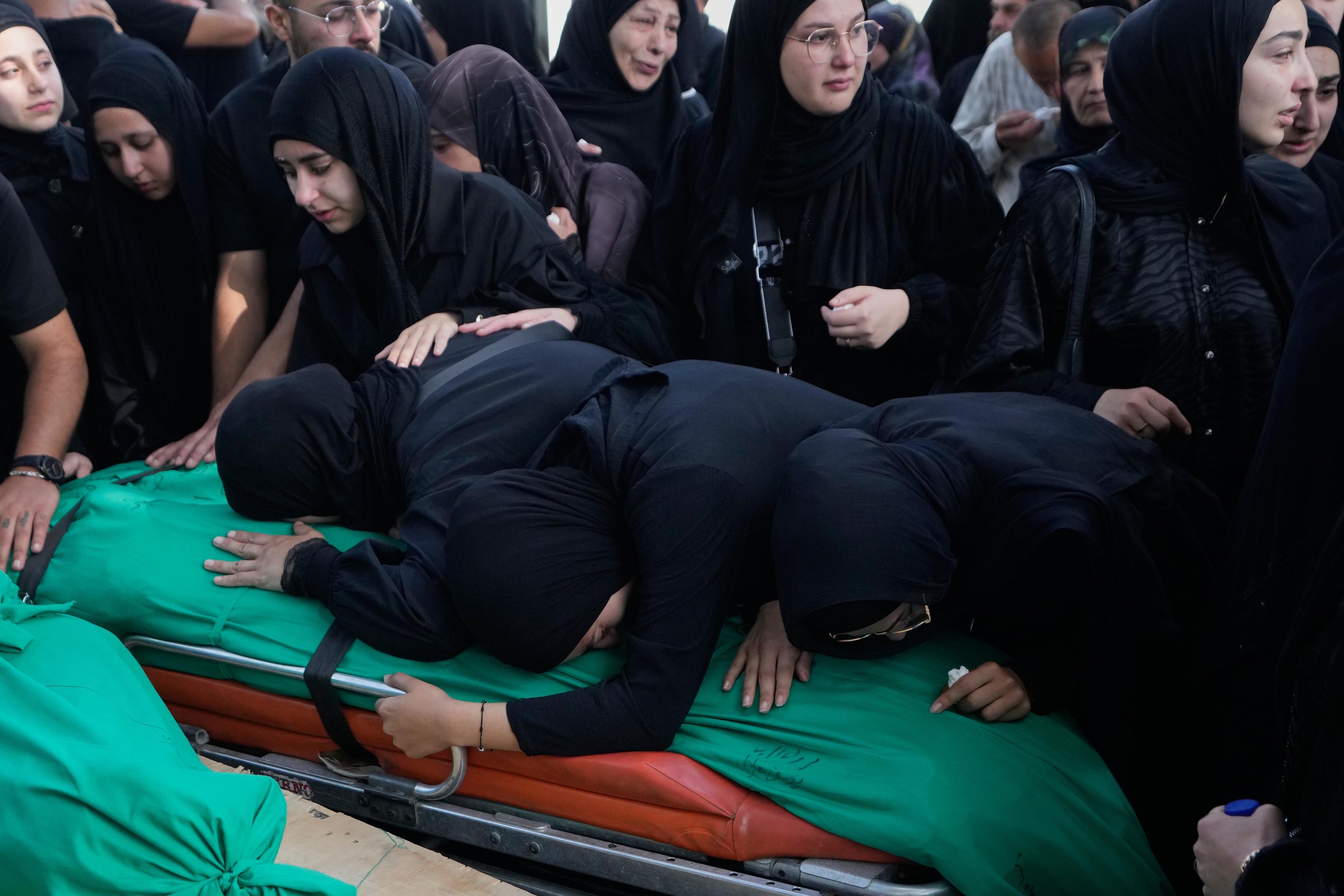
On the 1st of last month, Hussein Ahmad Sultan was supposed to celebrate his birthday. That day was when he was buried. The common grave, located next to the army barracks in Tyre, reflects the uncertainties of the uncertain ceasefire that came into effect in Lebanon on April 17.
During the first few days, the relatives of those who had died before that date hurried to unearth the bodies to bury them in the southern villages, previously inaccessible due to the fighting.
The precarious calm is history, and the makeshift cemetery - a simple trench dug by excavators - has resumed the practice of receiving the human remains of those who cannot be buried in their villages.
They place the coffins in the pit, cover them with soil, and assign them a number. Soldier Hussein Ahmad and his brother are the latest. Hussein will be number 35 buried in this place.
The coffin was carried on the shoulders by a group of uniformed men. It is the only one of the day covered with the national flag.
According to his cousin, Jamil Sultan, the soldier was in uniform when he rode the motorcycle. "He had arrived half an hour before the barracks to take his brother and help him gather his sheep," he recounts.
His widow, pregnant and mother of another two-year-old, collapses on the sandy ground, unable to bear the pain.
"Why do they murder soldiers? They are killing us all. It doesn't matter if you are a civilian, a soldier, or part of the 'resistance' (referring to the militants of Hezbollah)," adds Sultan, who is also part of the local armed forces.
Hussein Ahmad Sultan joins the long list of Lebanese military personnel killed by the Israeli army, reflecting the complex situation in which this institution is trapped.
The Armed Forces of this country do not participate in the confrontation between Hezbollah and Tel Aviv, which does not exempt them from being targeted by the latter at times.
At the same time, and for several months now, local authorities and Western countries like the US have intensified their demands for this institution to disarm the paramilitaries led by Naim Qassem.
Last April, several political figures from the US Republican Party expressed support for ceasing their country's aid to the Lebanese armed forces unless they undertake the task of disarming the Shiite militants.
"Congress should not support the Lebanese Armed Forces unless they act immediately," wrote the chairman of the Senate committee overseeing the military establishment of his country.
"The era of complacency and unconditional rescues must come to an end," echoed his colleague Jim Risch, who chairs the Foreign Affairs committee of the same chamber.
Another well-known politician close to President Donald Trump and the interests of Israel, Lindsey Graham, publicly called for the dismissal of the military chief, General Rodolphe Haykal.
Washington has been a significant donor to the Lebanese army for decades, having provided nearly $3 billion since 2006. In October 2025, the current Administration approved the allocation of an additional $230 million in funds for the armed forces and security.
Supported by the sentiment of a large majority of Lebanese people, who believe that the army should be the only armed formation in the country - four out of five, according to a Gallup survey from December 2025 - in March, the government of Nawaf Salam declared Hezbollah's armed wing "illegal" and shortly after, in April, ordered the confiscation of all weapons outside the central authority in the main city of the state, Beirut.
Earlier this week, the soldiers arrested eight individuals in the southern neighborhoods of Beirut and Baalbek - two enclaves where Hezbollah enjoys majority support - after these individuals showed up at one of the funerals of the militants killed in the conflict with Israel, armed and firing into the air.
The action - one of the first in which the uniformed personnel attempt to curb the activities of paramilitaries - has been interpreted as a "strengthening of the military's position" against the "illegal military activities of the Shiite militia," in the words of the local newspaper L'Orient Le Jour.
Following this initiative, President Joseph Aoun himself said on Tuesday that it was "time for the army to fulfill its responsibilities and be solely responsible for security in southern Lebanon."
However, the recent demands from Washington and, especially, Tel Aviv, raise questions about the military capability of the military establishment against a hypothesis, direct confrontation with Hezbollah.
According to L'Orient Le Jour, citing military sources, the Lebanese army currently has around 83,000 members compared to the approximately 30,000 militants affiliated with the Shiite group.
"Hezbollah has no artillery, no aviation, and no allies like the army does. The US would not stand idly by in the event of a confrontation," argues former General Khalil Helou, who spent 28 years within the institution.
But Helou's opinion - shared by other former military personnel consulted - clashes with an undeniable fact: not even Israel has managed to disarm Hezbollah.
Additionally, former members of the Armed Forces themselves admit that the assistance they have received from the US and other Western countries has maintained "red lines," in the words of the aforementioned Helou.
"They do not allow us to have weapons"
"The West is pressuring the army to disarm Hezbollah but they do not allow us to have the necessary weapons and capabilities. They only supply us with weapons that do not pose a threat to Israel," explains former General Chamel Roukoz.
For years, diplomatic representatives acknowledge that the West maintains a kind of "embargo" when it comes to supplying advanced military logistics to Lebanon.
The deliveries received by the country are limited to SUVs, Bradley vehicles, M60 tanks - the Pattons that fought in World War II - 155-millimeter artillery, some Super Tucano planes, light helicopters, and a few Cessna airplanes equipped with missiles.
Another source, referring in this case to European nations, is even more ironic: "They have given us underwear and socks."
Western nations' reluctance reached such a point that in 2008, Lebanon was forced to reject a Russian gift of 10 MiG-29 fighters.
Chamel Roukoz joined the Lebanese Armed Forces during the civil war in 1980, as a rejection of the plethora of militias like Hezbollah dominating the scene in those days, immersed in a terrible fratricidal conflict.
"One of them, the Lebanese Forces, even poisoned me through a soldier they had infiltrated into my unit. It took me four months to recover in France," he recalls in his office.
After serving for 34 years in the military, leading one of the elite units of the soldiers - the Rangers -, reaching the rank of Brigadier General, and receiving a long list of medals including the Royal Order of Isabel the Catholic of Spain, Roukoz retired in 2015.
After serving as a parliamentarian, he now heads the Association of Retired Personnel of the Lebanese Armed Forces, a position from which he has not stopped pointing out the shortcomings faced by his former comrades in arms.
"During the economic crisis (in 2019), soldiers went from earning around 1,000 euros to just under 65, at the most critical moments," he recalls.
There were moments when the soldiers also worked as valets, mechanics, or waiters to support their families. Meat was removed from the barracks' menu, and the air force even rented out their helicopters to fly over the country in search of any source of income.
Although the situation has improved, now soldiers earn no more than 250 dollars, and a general does not exceed 1,000, according to the estimation of the newspaper L'Orient Le Jour.
During the last century, the Lebanese army, like the state itself, began to cede prerogatives to armed groups as the country moved towards the catastrophe of the civil war (1975-1990).
In 1969, Arab countries forced Beirut to grant absolute control of the Palestinian camps to the paramilitaries of that community. Since then, the refugee enclaves have been like independent islands outside the central authority.
Soldiers only started confiscating a minimal part of the huge arsenal stored in those enclaves last year.
Despite its weakness - the publication Global Firepower estimates that the Lebanese army ranks 116 out of the 145 countries it has studied, compared to Israel's 15th position - the military quelled an Islamist uprising in the Palestinian camp of Nahar al Bared in 2007 and defeated Islamic State acolytes in separate offensives in 2014 and 2017 on the border with Syria.
"We have a good army, but the government cannot tell them, 'come, go disarm Hezbollah while Israel is occupying our territory,'" adds Roukoz.
In fact, Hezbollah sympathizers have openly criticized the Lebanese military for withdrawing from the south of the country instead of confronting the Israeli invasion. "Which commander will send his soldiers to suicide?" Helou points out.
Suleiman Fakif was another attendee at the funeral of the Sultan brothers in Tyre. He retired from the army in 2006. He spent almost three decades in the Armed Forces and ended up as a sergeant. During the war, he had to fight against the Christian Lebanese Forces militiamen near Sidon.
But when his superiors ordered him to act in southern Beirut to curb the Amal paramilitaries - another Shia movement - in 1983, "he went home." "I couldn't fight against my own people," he admits.
Fakif refers to another historical episode that bears some resemblance to the process the Arab country is currently witnessing. After the Israeli invasion of 1982, Lebanon elected the Christian Amin Gemayel as president with the support of Washington, the multinational forces deployed in the capital, and the tacit endorsement of Israel. The head of state had signed a peace treaty with Tel Aviv on May 17, 1983, which was perceived as a "betrayal" by Muslim armed groups.
Groups like Amal - at that time, Hezbollah was only incipient - began to clash with the armed forces until reaching the climax of what was called the "Intifada (uprising) of February 6," 1984.
That day, the militiamen defeated the army in west Beirut, taking advantage of the desertion of several Shiite and Druze majority units, and sealed the fate of the pact with Israel, which was later annulled.
The decision of the current Lebanese president, Joseph Aoun, to resume negotiations with Israel has brought back memories of that dark period and raised concerns about the future of the Armed Forces.
When the army disintegrated
During the bloody fratricidal confrontation of the last century, the Lebanese army disintegrated at least twice. Completely at the beginning of the war and to a lesser extent in 1984.
Nabil (does not want to give his last name) was also a soldier, but his uniform was not the country's standard one, but the one provided by Israel to the so-called South Lebanon Army (SLA). That formation was created in 1976 by a southern Christian officer, Saad Haddad, who defected along with a significant number of uniformed personnel of his own confession to establish a territory outside Beirut's control on the border with Israel, assisted by the Israeli military.
Nabil is not a Christian but a Shia. "The commanders were Christians, but the majority of the soldiers were Shia. In southern Lebanon, the majority are Shia, and it was mandatory for each family to provide a male member to enlist in the SLA," he comments at his residence north of Beirut.
The existence of the SLA is a reminder of the chaos that Lebanon had to face for 15 years, divided into cantons, with dozens of militias and a fragmented army in multiple independent units.
The former Lebanese militiaman, who does not hide his animosity towards Hezbollah, joins - on the contrary - those who believe that the army cannot disarm that faction.
"It's impossible. Hezbollah has many people within the army. If they try, it will divide again," he proclaims.
Nabil's opinion is dismissed by all the former military personnel consulted. According to former General Khalil Helou, "after the civil war," Lebanon made "many efforts to ensure that army units were not predominantly from one sect or another. That culture is in the past. There may be soldiers with sympathies towards one political force or another, but there is a big difference between sympathy and desertion," he concludes.
"That is Israel's goal, to divide the army. It won't happen," Chamel Roukoz adds.