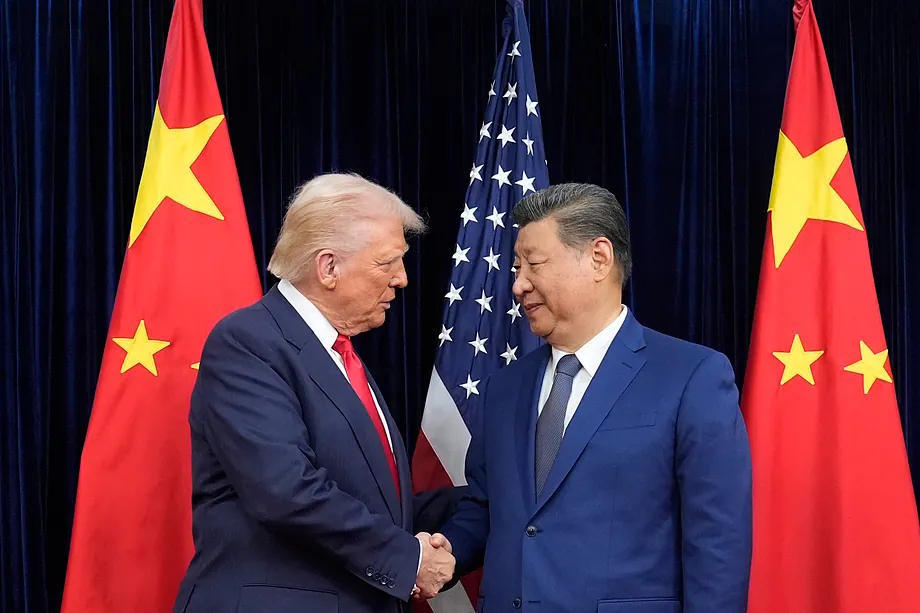
The first signs that this time, Donald Trump would not postpone his trip to Beijing as he did in March did not come from official diplomatic channels, but from dozens of videos that began circulating on Chinese social media a few days ago. In them, a line of huge black SUVs advancing on a Beijing highway, escorted by motorcycles and local security vehicles, could be seen. These were the armored Chevrolet Suburbans of the U.S. Secret Service, recognizable to any Chinese geopolitics enthusiast. Also in that convoy was "the Beast," the presidential limousine built on a Cadillac chassis that the United States dispatches around the world as if it were an armored embassy on wheels.
Beijing residents interpreted the mechanical parade as the definitive confirmation that there would be a summit between Xi Jinping and Trump. In addition, several C-17 Globemaster III military aircraft have landed transporting the armored vehicles. The arrival of the U.S. logistical apparatus heightened anticipation around the most important diplomatic meeting of the year.
The U.S. and China, although they have taken their time, have already confirmed that Trump will land on Wednesday night in a Beijing very different from the one he visited in 2017. Back then, during his first term, Chinese authorities staged an imperial choreography: a private visit to the Forbidden City, a lavish ceremony in the Great Hall of the People, and a traditional opera performance. Xi wanted to showcase the Republican leader as a leader seduced by Chinese historical greatness. All of that happened before the pandemic, before the technological war, before the collapse of the bilateral relationship, and before both superpowers became entangled in a spiral of sanctions, tariffs, and continuous suspicions of espionage.
This will be the first trip by a U.S. president to China in almost nine years. Most analyses agree that Trump returns very weakened. "Trump needs a deal with China that he can present as an internal victory, especially before the November 2026 midterm elections, but he will arrive in Beijing in an extraordinarily weak negotiating position for a president who has made strength his distinctive hallmark," points out Alicia García-Herrero, chief economist for Asia-Pacific at the investment bank Natixis.
"Trump is embroiled in the conflict with Iran, in which U.S. allies in Europe do not support him, while the U.S. economy suffers the consequences of the tariffs he imposed himself and that the Supreme Court has blocked. Meanwhile, President Xi does not have elections or a free press complicating things." The analyst adds that the current international context also favors Beijing. "In response to Trump's foreign policy adventures, China has opted for a calculated containment strategy, based on tough rhetoric and public rejection of U.S. hegemony," she concludes.
"Domestic weakness places any U.S. president in a precarious position against Xi Jinping," shares Brett Bruen, former director of global relations at the White House, in another analysis. "Xi not only detects that fragility but also seeks to exploit it." In Beijing, many make the same diagnosis. Officials and close advisors to power consider that Trump arrives under pressure from falling popularity, from the wear and tear of the war with Iran, and from the judicial chaos threatening his tariff policy.
The U.S. Supreme Court has already declared part of the tariff scheme that Trump had turned into a political emblem unconstitutional. The decision now forces the White House to follow much slower administrative procedures and limits the presidential capacity to improvise economic measures through decrees or social media messages. The blow is huge: the trade war - Washington had imposed tariffs of 145% on Chinese products - had been presented by Trump as a show of strength against the Asian giant.
The last time Xi and Trump met face to face was last October in Busan, South Korea, on the sidelines of a regional summit. In that meeting, they extended a trade truce that eased tensions but did not resolve the structural conflict. The U.S. maintains technological controls aimed at curbing Chinese development in semiconductors and artificial intelligence. Meanwhile, China continues to use its dominance over critical minerals as a tool of strategic pressure.
"Washington heads to the summit facing an uncomfortable reality: its rapid spending on advanced weapons systems in the Middle East and Ukraine exacerbates deep vulnerabilities in supply chains linked to rare earth elements and magnets, inputs dominated by China," highlights Heidi E. Crebo-Rediker, researcher at the Council on Foreign Relations think tank.
In the weeks leading up to the Beijing summit, officials from both countries have been discreetly negotiating possible Chinese agricultural purchases, Boeing aircraft orders, and joint statements on artificial intelligence. Both countries announced that Chinese Vice Premier He Lifeng will travel to South Korea on Tuesday and Wednesday to hold trade talks with U.S. Treasury Secretary Scott Bessent in a final round of negotiations.
One of the main issues that will overshadow the entire summit will be the war in Iran. Chinese officials believe that Trump is trapped in a military conflict that consumes political capital and further strains the relationship with European and Asian allies. China wants to take advantage of this, although several U.S. media outlets have reported that Trump intends to pressure Xi to "halt China's support for Iran." In recent days, the U.S. has sanctioned Chinese companies and refineries linked to the purchase of Iranian oil.
On this front, the Chinese regime seeks to maintain calculated ambiguity. On the one hand, it needs cheap Iranian oil and publicly rejects U.S. sanctions. On the other hand, it also does not want a prolonged war that destabilizes the Middle East and harms the global economy. Chinese analysts assert that this middle position allows Xi to present himself as a rational actor against a Trump Administration increasingly perceived as erratic.
In parallel to the war in Iran, the Taiwan issue will remain the most explosive during the meeting. Chinese Foreign Minister Wang Yi stated this week that the island represents "the greatest risk" to bilateral relations.
Beijing hopes to receive some signal of moderation from Washington. Trump has already shown a less enthusiastic language regarding support for Taipei than his predecessors, describing the autonomous territory more as an economic competitor than as a democratic ally.