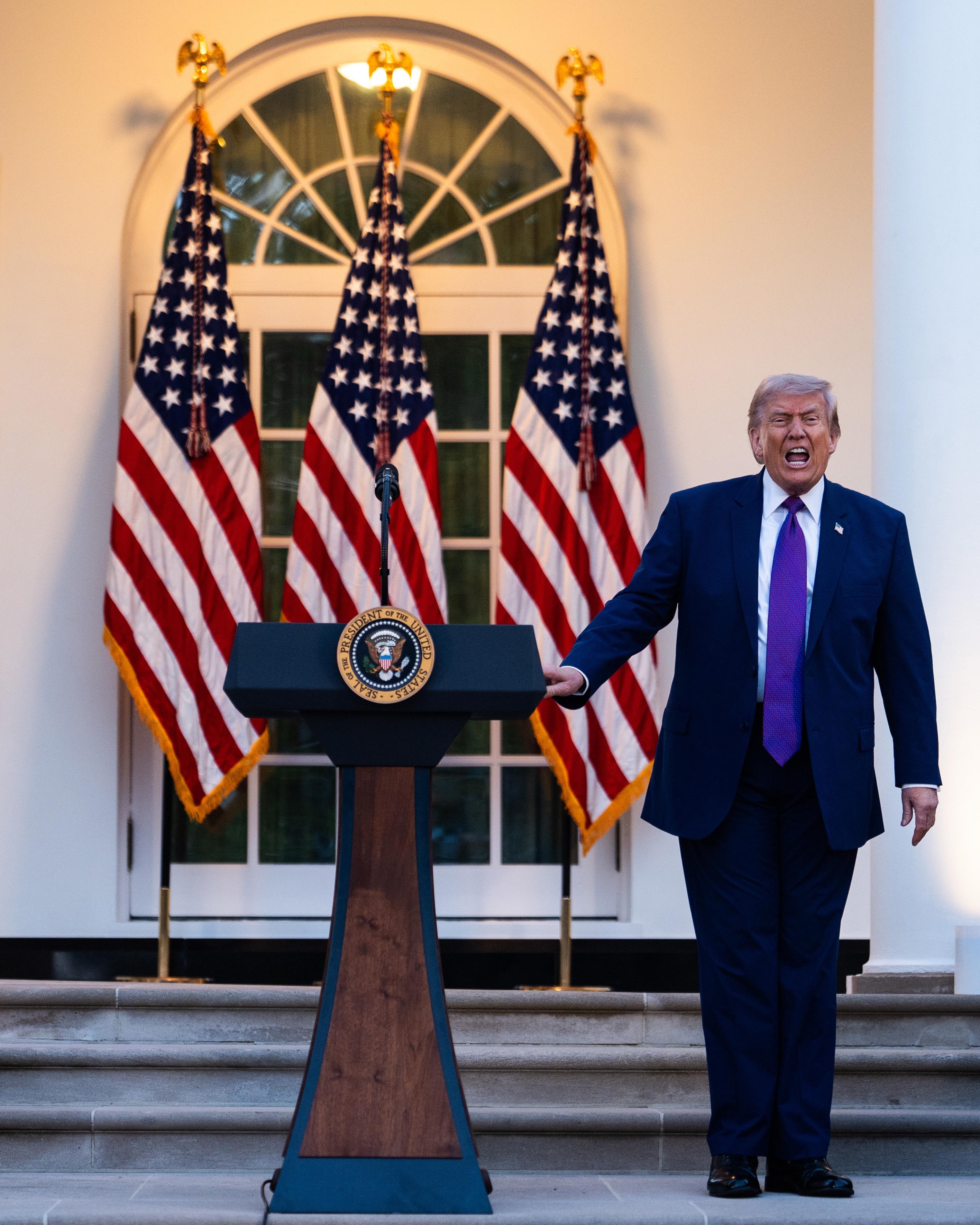
The President of the United States, Donald Trump, begins his official visit to China this Wednesday, a highly anticipated three-day trip amid a tumultuous trade relationship, trade war, and Middle East conflict. He will be accompanied by 16 of the world's top executives, such as Elon Musk, Tim Cook, or Larry Fink.
The main points on the agenda inevitably revolve around the mentioned issues, but also focus on the future of Taiwan, technology, and strategic stability between Washington and Beijing, with Russia and Iran in the background. Trump, obsessed for decades with the trade deficit with China, wants Beijing to accept his protectionist wall, but without reciprocating. Instead, he aims to boost purchases of American products, especially agricultural products like soybeans. Meanwhile, the U.S. is expanding its acquisitions of minerals and rare earth materials. To achieve this, he has proposed a kind of investment and trade board.
China seeks stability in all areas. In bilateral relations and beyond. They want tariffs lifted, restrictions on chip and advanced technology purchases removed, tensions with Tehran eased, the Strait of Hormuz reopened (a significant source of the crude oil consumed in the Asian powerhouse), and for Washington to stop selling arms to Taiwan.
This Monday, the White House released a provisional list of the prominent business leaders accompanying the President to Beijing. The most prominent name, for obvious reasons, is Elon Musk, the founder of Tesla, SpaceX, and owner of the X social network. The world's richest man, who fell out of favor with Trump after informally entering his government to dismantle the state from within and ended up being ousted. After exchanging attacks, insults, and threats, it seems they have rebuilt bridges, at least enough for Musk, with significant interests in batteries and electric cars, to join the delegation.
Also present will be the outgoing leader of Apple, Tim Cook, just weeks after announcing his upcoming departure. Alongside them, the influential Larry Fink of BlackRock, the world's largest asset manager. Stephen Schwarzman of Blackstone, also the largest alternative asset manager. With them, Kelly Ortberg from Boeing; Brian Sikes from Cargill. Jane Fraser from Citi. Jim Anderson from semiconductor manufacturer Coherent. Larry Culp from GE Aerospace. David Solomon from Goldman Sachs. Jacob Thaysen from biotechnology company Illumina. Michael Miebach from Mastercard and Ryan McInerney from Visa. Dina Powell McCormick from Meta. Sanjay Mehrotra from semiconductor and data center giant Micron. Or Cristiano Amon from Qualcomm.
The notable absentee is undoubtedly Jensen Huang, CEO of Nvidia Corp., the world's most valuable company and manufacturer of advanced chips driving the global AI boom. Since Biden's era, the U.S. has restricted the types of chips that can be traded with China. Nvidia, according to Huang, has a potential market of $50 billion in sales there, but relations are tense.
Trump believes, rightly so, that major U.S. companies have more influence over Beijing than many governments or diplomats, including his own. He boasts repeatedly about his excellent relationship with Xi Jinping, even though the same enthusiasm is not reciprocated. Xi, the most influential leader in half a century and a figure of growing assertive power, does not like Trump's style but is not intimidated either. He is almost the only world leader who has not played by Trump's rules or accepted his style. And now he plays on his home turf.
The White House, as always, seeks powerful announcements of quick agreements and investments, and bringing the elite of Wall Street and Silicon Valley can help. With these names, it may be easier to find common ground on chips, artificial intelligence, batteries, electric vehicles, or satellites.
Boeing, for instance, is reportedly on the verge of closing one of its largest sales in history, according to Bloomberg. An order for 500 737 Max aircraft that will be announced during Trump's visit to Beijing. Ortberg himself stated last month that this order could reach a substantial figure.