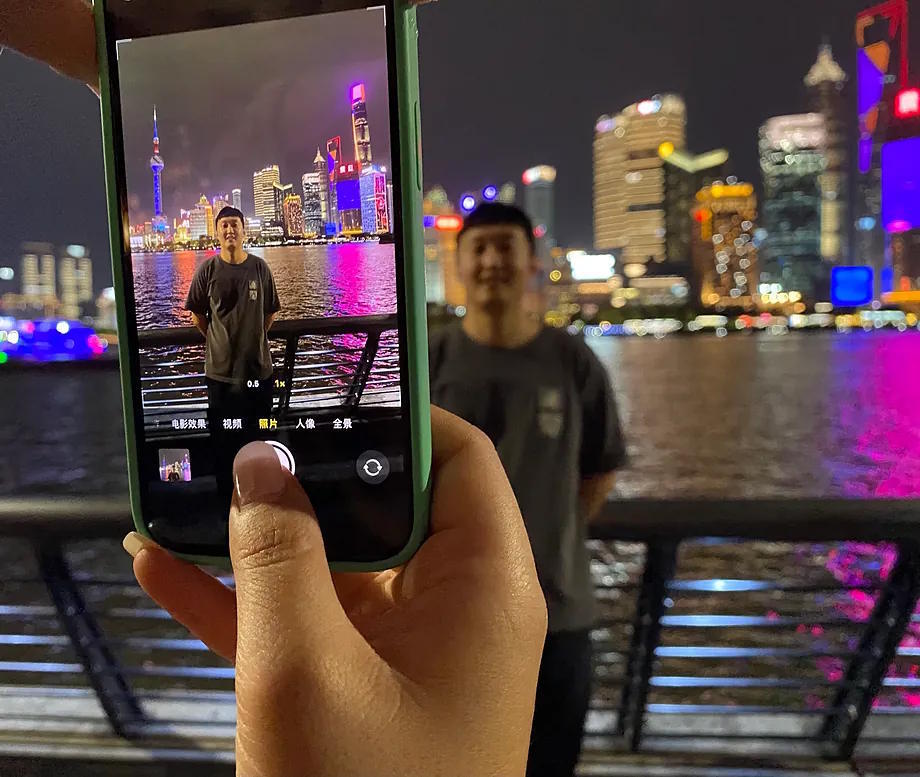
In the former American concession in Shanghai, red brick buildings survive, Baptist churches hidden among office blocks, and open avenues that follow an urban logic imported from across the Pacific. In these streets of the Hongkou district, the United States established one of its first influence laboratories in Asia in the 19th century. Attracted by the port and the promise of a gigantic market when China began to open up to foreign trade after the Opium Wars, Americans built schools, hospitals, and chambers of commerce.
Shanghai, the current showcase of Chinese capitalism, was long divided by colonial powers in the so-called "concessions," neighborhoods where Chinese laws ceased to apply and where traders, bankers, spies, mobsters, and missionaries coexisted under the protection of Western gunboats. This city was where local elites learned to admire what came from the US: Coca-Cola, jazz, and Hollywood.
"We still really like American movies and use their brands, but we no longer believe in the narrative that the US automatically represents something better," comments a thirty-something businesswoman named Lin Xiao, summarizing an increasingly common feeling among young Chinese people: the US is a country in decline.
In a café in the former American influence zone in Shanghai, Zhang Wei, a 28-year-old graphic designer, looks at some social media comments on his phone about President Donald Trump's visit, who lands in Beijing this Wednesday. "When I was a teenager, I thought the US was the future. We all wanted to study or work there. Now we see it more as an unfriendly and bullying country, always provoking wars," he says. His words are a symptom of a generation that has lost much of the attraction of the past for everything that came from the world's leading power.
"My parents believe in the American Dream more than I do," Mia Yan, a 40-year-old executive who works for an international multinational and studied in Chicago, says with a laugh. "For older generations, the US was synonymous with prosperity and freedom. But now it is a polarized country, with violence, drugs, cultural wars, and too much obsession with containing China."
Yan says she still admires American technological innovation, but the rise of China in all fields has burst the bubble of that American dream that her parents worked so hard for her to live. "Now, both to live and work, there is greater attraction to European countries," she maintains.
For many Chinese people, their country's rise represents a historical revenge against the time when Western powers divided China into spheres of influence, known as the "century of humiliation." And perhaps that is why, walking through Hongkou, among modern skyscrapers and old buildings built by foreign traders, there is now a new national confidence circulating, much more self-assured than a few decades ago.
"The West does not understand China. They still think as if they were the great powers of a hundred years ago, but the world has changed," says Wang, a retired professor, pointing to the imposing skyline in the background of the neighborhood. "All this you see here did not exist 30 years ago. My parents, and I too, grew up in a very poor China where America seemed like another planet. We have seen our country go from carts pulled by people to high-speed trains, from cheap factories to being leaders in technology. For the first time, many Chinese, even the older ones, feel that we do not need to look to the West, to the US, to imagine the future."
From the financial capital, we jump to the political capital. For a long time, the US embassy in Beijing was a kind of symbolic border to that other planet referred to by Mr. Wang. At dawn, the lines snaked for several blocks in the Chaoyang district: students with transparent folders, nervous parents reviewing bank statements, and engineers dreaming of Stanford, Columbia, or MIT.
Getting a visa to the US back then meant coming into contact with the most powerful promise of globalization: elite universities, salaries unattainable in China, and a life associated with prestige and social advancement. In the 2000s, the American dream became for millions of Chinese middle-class families the natural culmination of the country's economic success.
Today the scene is different. The lines are much shorter, the enthusiasm colder, and the conversation has changed in tone. Tensions between Washington and Beijing have eroded the US image: technological restrictions, trade wars, tightening of immigration controls, and espionage fights. This is compounded by an increasingly strong nationalism fueled by the ruling Communist Party, which champions the thesis of the fall of the Washington-led world order.
Trump will be the first US president to set foot in Beijing since 2017, when the Republican leader himself visited the Chinese capital accompanied by First Lady Melania Trump. At that time, bilateral relations were much better: Chinese President Xi Jinping offered his guests a guided tour of the Forbidden City. No foreign head of state had dined with a Chinese leader in the ancient imperial palace in over half a century.
"When Trump first appeared, many of us thought he was a strong, different man, even very funny. We didn't take him very seriously," says a young woman surnamed He who studied for a semester in California. "But then, with the pandemic, he started talking about the 'Chinese virus' and continuously disrespected a country that has a much longer and richer history than the US."
A few kilometers from the US embassy, in the parks surrounding the Temple of Heaven (the imperial complex that Trump will visit on Thursday, according to the official agenda), several retirees play cards under the trees. They all grew up in a China where the US symbolized wealth, modernity, and absolute power. "I don't like Trump, he looks like a bad person," simplifies Zhao, a former railway worker. Sitting next to him, a neighbor surnamed Chen reflects: "Before, the US came to China as the rich teacher who taught the poor student. Now both look each other in the eye on equal terms."