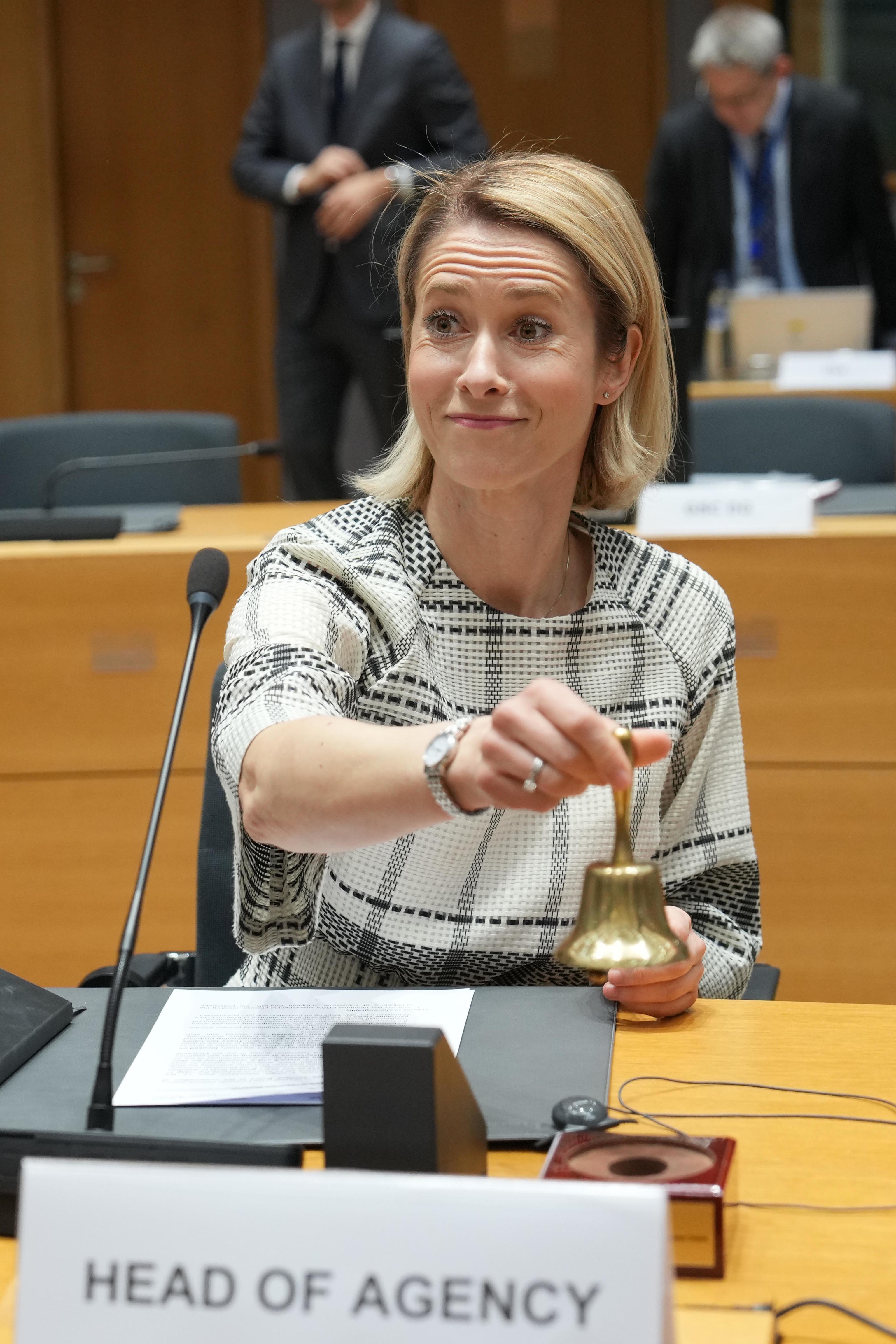
The European diplomatic chief acknowledges her "frustration" because, despite the many millions being allocated, the European defense sector is unable to accelerate its production to the required level. It is very slow. "Member States have put a lot of money on the table, but the production of the defense industry in Europe has not yet accelerated. So we need faster weapon production, also cheaper and with agile deliveries to close those capability gaps," Kaja Kallas pointed out after the meeting of Defense Ministers that took place on Tuesday in Brussels.
"I share your frustration," she continued when asked by a journalist, "because I have the same feeling: somehow we have not seen the industry increase production as we expected." "Of course, some things have improved. The industry was also showing how much it has actually increased its production in terms of ammunition, air defense, and critical capabilities. The problem is simply that the needs of the Member States have also grown," she added.
And this slowness, in addition, is combined with the fact that the European Commission considers that "Russia is preparing for a long-term confrontation with the West." It is very important that the High Representative of the EU for Foreign Affairs has pointed to "the West," because that goes beyond Ukraine. And beyond Ukraine is the European Union.
"Tanks and missiles are practically the only things the Russian economy is producing right now," Kallas emphasized. Russia, therefore, is producing military equipment at full speed. Just the opposite of Europe.
The analysis of the European diplomatic chief goes, therefore, far beyond the 'more money must be spent' advocated in NATO. In fact, today, the Secretary-General of the North Atlantic Treaty Organization, Mark Rutte, has once again insisted on this issue.
"We need strong societies, defended by strong military forces, because we live in a more dangerous world. Russia continues to wage an aggression war against Ukraine. China is becoming more determined. And our southern neighborhood is volatile," he pointed out from Podgorica during a press conference with Montenegro's Prime Minister, Milojko Spajic. Therefore, the allies "must invest more in defense, increase defense production, and strengthen support for Ukraine."
The commitment of the countries that are part of NATO, with the exception of Spain, is to reach 5% of defense spending divided into 3.5% of 'hard' spending and an additional 1.5% of security-related investments. But in the Commission, which has offered tax facilities for countries to address this huge expenditure, they want that money to have a positive impact on Europe, on the industry, and on the labor market. And that it only goes to the United States in exceptional cases, but right now this seems complicated.
Aspides in the Strait of Hormuz
On the other hand, Kallas has also emphasized that the EU naval mission in the Red Sea could be extended to the Strait of Hormuz. "Operation Aspides is already making a crucial contribution to protecting maritime transport in the Red Sea, but its activities could also be expanded to the strait. It only requires modifying the operational plan, as the mandate already allows for it," she pointed out.
The diplomatic chief noted that several countries have shown their willingness to strengthen this mission, which includes three ships and was launched in 2024 to protect commercial ships from attacks by Houthi rebels in Yemen.