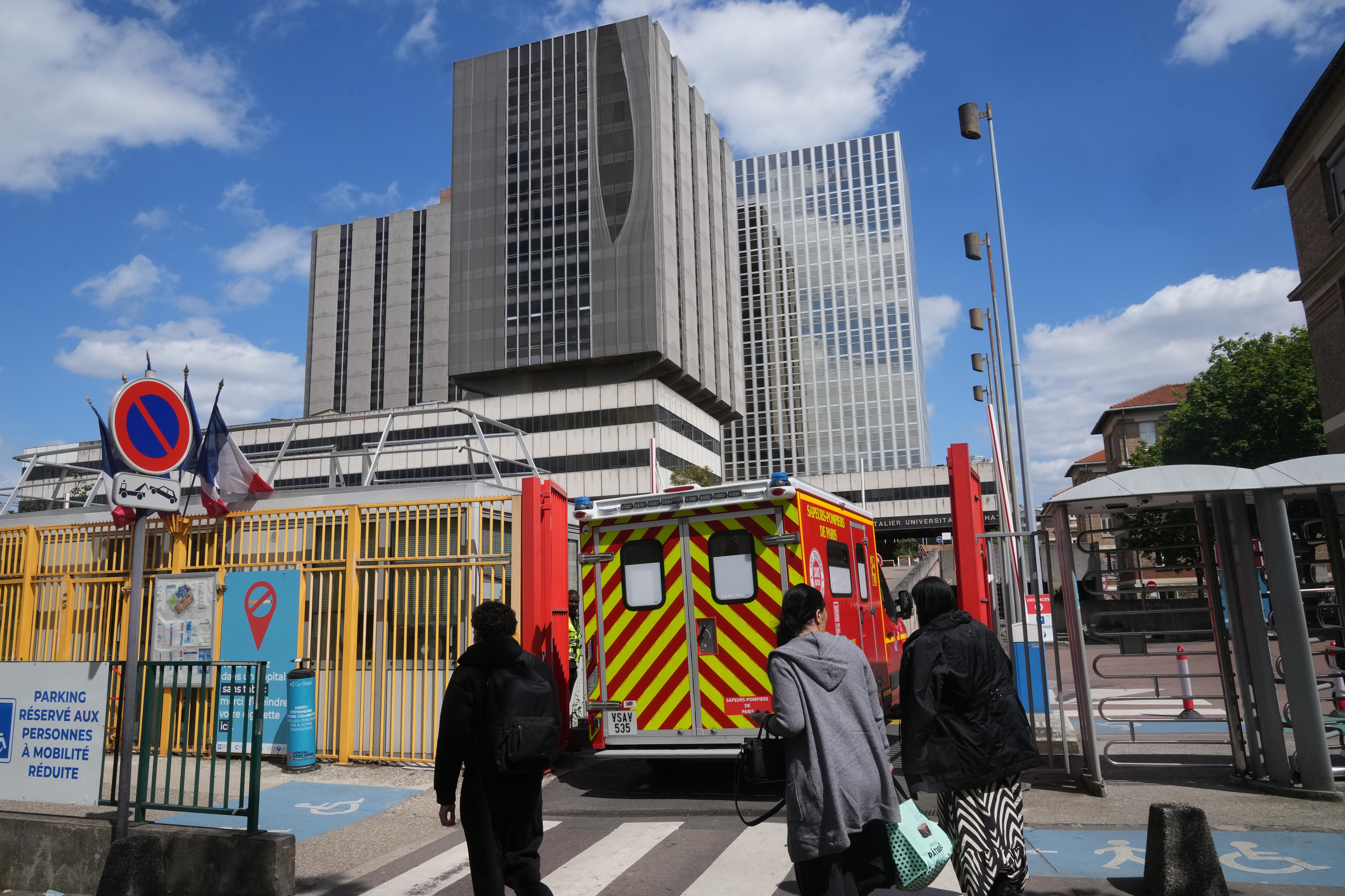
A French woman infected in the deadly hantavirus outbreak on the MV Hondius cruise ship is in critical condition and is being treated with an artificial lung. The outbreak now totals 11 reported cases, of which nine have been confirmed.
The French passenger hospitalized in Paris is suffering from a severe form of the disease that has caused potentially life-threatening lung and heart problems.
In Spain, the passenger who tested positive and remains in quarantine at the Gómez Ulla Military Hospital in Madrid has not shown worsening of their mild symptoms. The other Spanish citizens transferred from the cruise to the same hospital tested negative for the virus, as indicated by the Ministry of Health, as well as the patients in Alicante and Barcelona.
Spanish hantavirus patient isolated at Gómez Ulla continues with symptoms, but stabilized
Health authorities confirm that the patient remains stable and there has been no change in their condition since yesterday, reports Pilar Pérez.
"We hope that they continue in this way without any doubts," stated the Secretary of State for Health, Javier Padilla, in an interview on TVE, the number 2 of Health, who added that the other 13 travellers also in quarantine at the hospital remain asymptomatic.
As he described, the infected patient started on Sunday night "with some respiratory difficulty" which was treated with oxygen therapy, "with this treatment, they began to improve and were already stabilized today," as reported by Efe.
The Secretary of State for Health also explained that "between the second and fourth week of incubation, the appearance of symptoms is more frequent, although symptoms could also appear on the third day of exposure and on day 42. Therefore, this 42 marks the duration of the quarantine."
However, he emphasized, "everything is subject to evaluation by the consensus of the experts from the autonomous communities. This 28-day quarantine will be carried out in the healthcare facility and subsequently other options could be reassessed. From that 28th day, the relevance of carrying out the quarantine at home with continuous medical monitoring would be reassessed," as reported by Servimedia.
The President of the Canary Islands has reiterated on Wednesday that the Government concealed information about the health status of the passengers on the MV Hondius, the cruise where the hantavirus outbreak originated, which has caused three deaths and 10 infections. "There were infected individuals on that ship when they left Cabo Verde and they knew it," stated Fernando Clavijo in the island's Parliament. "Time has proven us right," he emphasized.
In a self-requested appearance, the regional leader accused the Pedro Sánchez Government of sidelining them, withholding and hiding information from them, and trying to make them assume responsibility for this health emergency. To which he added: "They come to your house, displace you, and you foot the bill (...). We took a step aside and collaborated. What we did not do was become accomplices."
The Minister of Health, Mónica García, already responded on Tuesday to Clavijo that, against "the misinformation that has circulated about the US positive case," this citizen underwent two tests when the ship made a stop in Cabo Verde: one that was "inconclusive positive" and another "negative," a test that "was repeated and was negative." "Since we started this crisis, we have provided absolutely transparent information on the epidemiological situation of each and every one of the passengers," she emphasized in the press conference following the Council of Ministers.
She added: "When the ship arrived here, there was no positive case that the WHO or the ECDC [European Centre for Disease Prevention and Control] considered, and there was no person with symptoms. And when I talk about symptoms, I am not only referring to respiratory symptoms, not even when we took their temperature once the ship was anchored, there was not a single person with a fever."
Why hantavirus is a different threat to Covid-19 (and what should really concern us)
"There is still much unknown about the efficiency with which hantavirus is transmitted between people." This is stated by virologist Jennifer Angulo from the Pontifical Catholic University of Chile, in statements to the magazine Nature. Therefore, predicting the total number of cases that may result from the current outbreak is difficult and cannot be compared to Covid. Currently, there are about a dozen cases (including the Spanish patient hospitalized at the Gómez Ulla Hospital). However, there is abundant scientific literature on this virus that can guide decisions in public health matters.
The precautionary principle has been imposed and, following the criteria of the European Centre for Disease Prevention and Control (ECDC), all passengers on the ship are considered high-risk contacts and therefore must undergo isolation and symptom monitoring. The World Health Organization (WHO) recommends a 42-day quarantine for all individuals exposed to the virus. This incubation period is longer than that of SARS-CoV-2.
At this point, there is no scientific evidence that the transmission mode of the Andes virus (ANDV), which is the strain at the origin of the outbreak, has changed. What does seem clear is that this is an unprecedented scenario. As the authors of an article published on May 9 in International Journal of Infectious Diseases point out, "the MV Hondius outbreak highlights deficiencies in maritime preparedness for zoonoses."