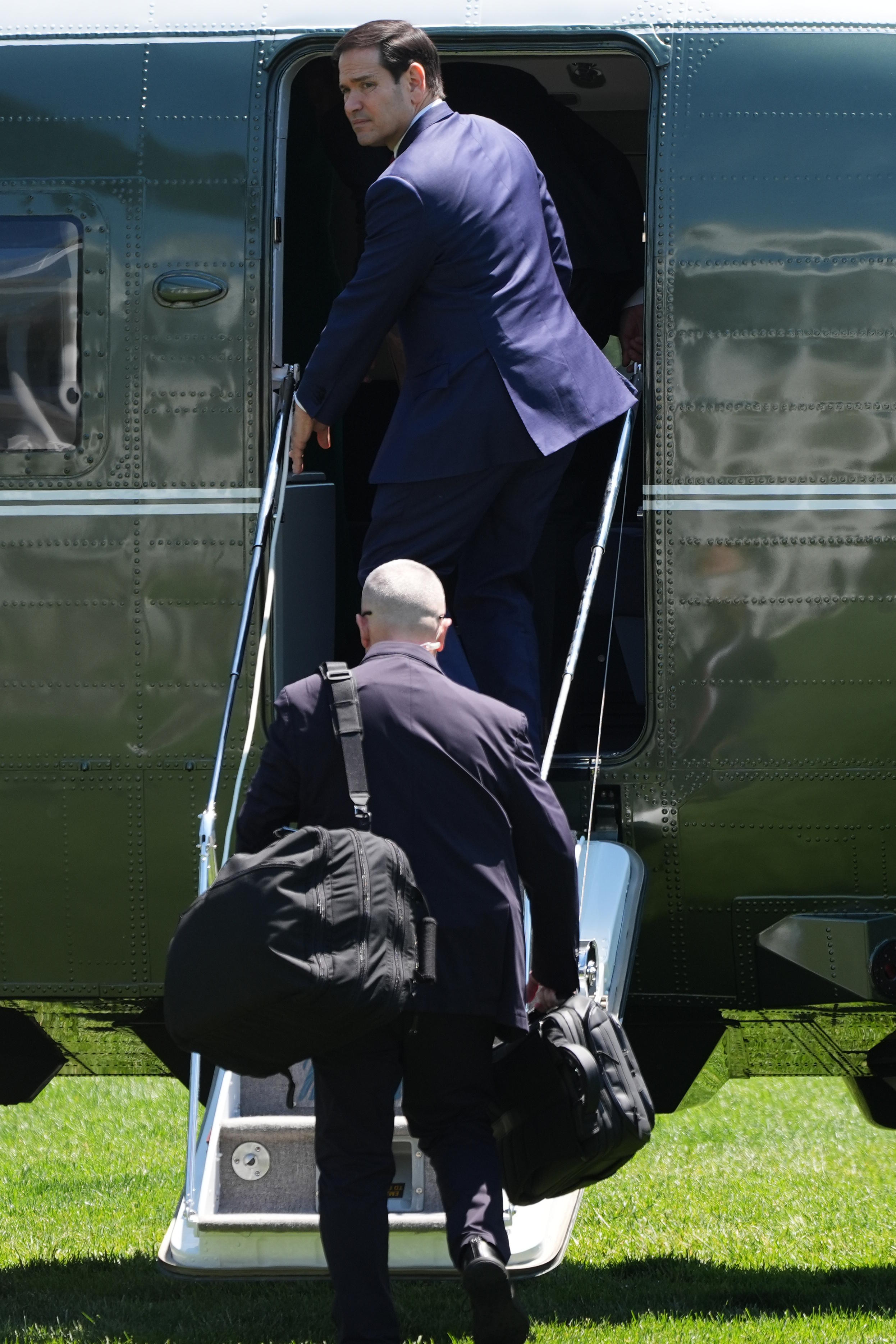
The former Republican senator, son of Cuban exiles, made the crusade against Chinese communism one of the main pillars of his political career. He denounced Xi Jinping as the architect of a new global tyranny. He was the hawk who stirred up sanctions against Beijing, promoted laws against forced labor of the Uighur Muslim minority, and accused the Chinese Communist Party of exporting surveillance, censorship, and repression to the rest of the world.
On Wednesday, a more moderate Rubio was preparing to land in Beijing alongside President Donald Trump. He does so as Secretary of State, seated at the heart of United States power. His arrival does not go unnoticed because it carries a geopolitical irony: he enters a country where he was officially prohibited from traveling due to sanctions imposed on him by Xi's government years ago.
"Now, due to his position within the Trump Administration, he is a more domesticated hawk," jokes an official from the Chinese Ministry of Foreign Affairs, where Rubio has also been publicly criticized. In the Chinese capital, they do not forget that from the Senate, he built a career based on denouncing the Chinese threat almost in existential terms.
For Rubio, China was not just a commercial competitor or a rival power. It was "the most dangerous adversary the United States has ever faced". A phrase he repeated in hearings, speeches, and interviews while warning that the CCP aimed to replace Washington's global leadership.
Rubio was a key figure in the sanctions for the repression against the Uighurs in the Xinjiang region and one of the main advocates of the Uighur Forced Labor Prevention Act, which directly impacted Chinese supply chains. He also led initiatives to punish officials involved in the crackdown on freedoms in Hong Kong following the 2019 democracy protests.
During the pandemic, Rubio was one of the most aggressive voices against Beijing within the Republican Party. He repeatedly accused the Chinese government of withholding information about the origin of Covid-19 during the early weeks of the outbreak in Wuhan and denounced that the CCP had tried to "deceive the world" as the virus spread outside of China. From the Senate, he called for independent investigations into China's handling of the health crisis and criticized the World Health Organization (WHO) for acting, according to him, as a conduit for Beijing's propaganda.
All those statements turned him into a top enemy for the Chinese propaganda apparatus. In 2020, Beijing responded with two rounds of personal sanctions against Rubio. The regime never fully detailed the measures, but these types of punishments usually include entry bans, asset freezes, and restrictions for direct family members.
The Global Times, a nationalist tabloid controlled by the CCP, went as far as describing him as "an anti-Chinese extremist intoxicated by Cold War mentality". Other editorials accused him of "brutally interfering in China's internal affairs" and using human rights as an ideological weapon.
The problem arose when Trump decided to bring him back into the core of his Administration and appointed him Secretary of State. Here, an uncomfortable contradiction emerged for Beijing: how to keep the highest-ranking US diplomat sanctioned while trying to rebuild the relationship with Washington?
The solution was as surreal as it was revealing. Beijing began using a different transliteration of Rubio's surname in Chinese characters. A seemingly minor change but loaded with political significance, aiming to technically separate the new Secretary of State from the senator sanctioned years before.
This maneuver reflected the traditional pragmatic ambiguity of Chinese diplomacy: firmness behind closed doors, towards the official narrative, and absolute flexibility when it serves strategic interests. Official Chinese media do not address how Xi's government swallowed years of incendiary rhetoric from Rubio to allow the Republican to travel alongside Trump.
But the reality is that Rubio has also shifted his tone once installed in the State Department. He still argues that China is the main strategic rival of the US, but now he does not focus the discourse around human rights. He prefers to talk more about stability, trade, and balance of power. Far from direct confrontation, he aligns himself disciplined with the White House and with a boss, Trump, who before taking off from Washington, described Xi as a "wonderful guy".
Rubio is pointed out by polls and conservative media as one of the possible Republican candidates for 2028 alongside Vice President JD Vance. During the trip to China, an image that sparked social media emerged: the Secretary of State, leaning on one of the doors of Air Force One, dressed in the same gray Nike tracksuit that Nicolás Maduro wore when he was captured and taken to the US earlier this year. The photograph, disseminated by the White House itself, had a calculated touch of provocation.