Donald Trump landed in Beijing this Wednesday surrounded by high-ranking American executives and a much more unsettling background noise than during his first visit to China in 2017. Back then, the U.S. president arrived in a capital where Xi Jinping was still consolidating his internal power and where Washington was convinced that the Asian giant could be contained through commercial and diplomatic pressure. Now, the balance has shifted. Trump returns to a technologically more advanced China and, above all, with much more influence on the global stage.
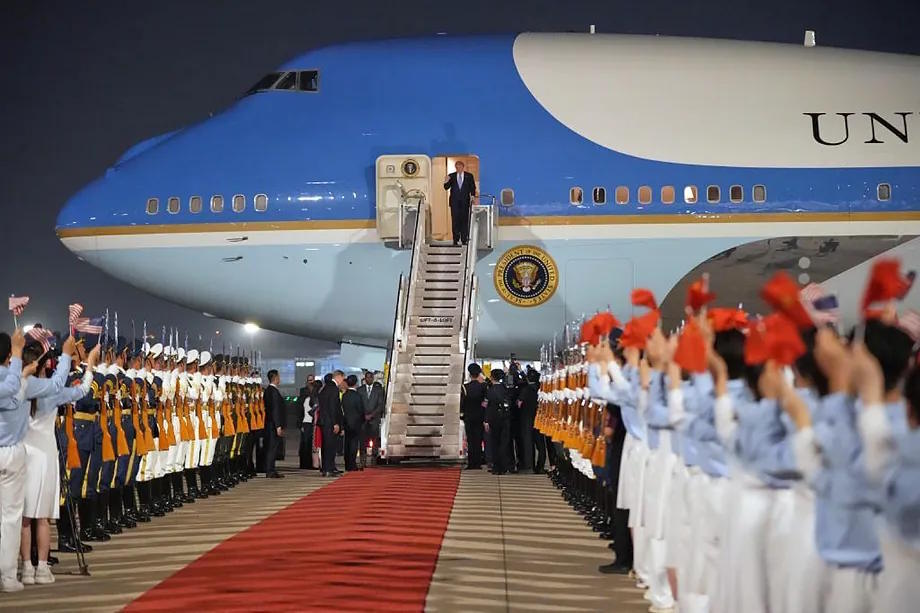
Trump stepped off Air Force One and descended the stairs amidst welcoming cheers from a group of young Chinese, a military band, and the honor guard. On the tarmac, he was greeted by Chinese Vice President Han Zheng, and a girl dressed in red handed him a bouquet of flowers. The "Beast," the presidential vehicle, awaited him at the end of the red carpet. Trump's son, Eric, and his wife Lara disembarked from the plane after the U.S. president.
Beijing has been heavily secured with a large security presence and traffic controls at various key locations, starting with the hotel where Trump is staying, the luxurious Four Seasons, located 700 meters from the U.S. Embassy. Police checks and military presence have also increased around the Kempinski Beijing Yansha Centre, where the rest of the U.S. delegation is staying. The same goes for the tourist attraction Temple of Heaven, an imperial complex that the U.S. president will visit on Thursday after his first meeting with the Chinese leader.
The eagerly anticipated two-day summit between the leaders of the superpowers will be closely watched - and nervously so - especially from Taiwan. Alarms in the self-governing island that Beijing considers a separatist province were raised before Air Force One touched down on Chinese soil.
Trump stated before departing from Washington that he would discuss with Xi the sale of American weapons to Taipei, crossing a diplomatic red line that both Republicans and Democrats had respected for decades: the U.S. never consulted with Beijing on its decisions regarding military exports to Taiwan. "President Xi wouldn't like it if we did, and I will talk about it," Trump affirmed, a seemingly impromptu statement that, nevertheless, raises concerns in Taipei and among Washington's key Asian allies (Japan and South Korea).
Just five months ago, the White House announced a record arms sale package to Taiwan worth $11.1 billion, with an additional program of at least $14 billion already in preparation. According to reports in U.S. media such as the New York Times, sources close to the summit have indicated that Beijing has intensified pressure on the Trump Administration to amend Washington's so-called "declaratory policy" on Taiwan (officially ambiguous language used to publicly describe its position on the island's status) and adopt an explicit stance against any formal independence. This would be a change of enormous geopolitical symbolism and a concession that many U.S. allies in Asia consider dangerous.
Zhang Han, spokesperson for China's Taiwan Affairs Office, stated on Wednesday during a briefing that Taiwan is an internal matter concerning the Chinese people. "We firmly oppose the U.S. establishing any kind of military ties with the Chinese region of Taiwan, and we firmly oppose arms sales. This position is consistent and unequivocal," he declared.
Taiwanese officials acknowledge that they are concerned that Trump may use the Taiwan issue as a bargaining chip within a broader negotiation with Xi. This concern heightened after the White House delayed notifying Congress in February about new military exports to the island following direct pressure from Beijing.
The Taiwan issue is just one piece of a broad and complex summit. Trump arrives in Beijing weakened by the war in Iran, a conflict that has impacted his popularity and triggered a new global economic earthquake. The meeting, initially scheduled for March and postponed precisely due to the conflict in the Middle East, is now taking place with Washington desperately seeking international support.
It is unclear whether Trump will ultimately try to persuade Xi to reduce China's political and economic support for Tehran. In recent years, Beijing has been an economic lifeline for the Iranian regime, especially through oil purchases and the maintenance of alternative financial channels that have alleviated the impact of Western sanctions.
One of the main topics on the agenda will be avoiding the resumption of the trade war initiated by Trump last year. Officials have revealed that there is now discussion of the possible establishment of a bilateral "Trade Board" aimed at managing non-strategic sectors and reducing the risk of new tariff wars.
Washington also hopes to secure commitments for the purchase of Boeing aircraft and soybeans, two key sectors for Trump. However, it remains unclear whether both parties will extend the trade truce reached last October.
"China aspires to cooperate with Washington in a spirit of equality, respect, and mutual benefit," declared Guo Jiakun, spokesperson for the Chinese Ministry of Foreign Affairs on Wednesday, adding without many details that the two leaders would have "in-depth exchanges of views on important issues related to China-U.S. relations, as well as global peace and development." Prior to arriving in Beijing, an optimistic Trump said he expected "great things" from the meeting and described Xi as "a friend" with whom he shared a strong personal relationship.
The summit program includes two formal meetings, a State banquet, and a joint visit to the Temple of Heaven. Accompanying the U.S. president is a powerful business delegation composed of titans such as Tim Cook, Elon Musk, and Jensen Huang, reflecting the extent to which the economic relationship between the two countries remains too deep to be completely severed despite the intense rivalry.