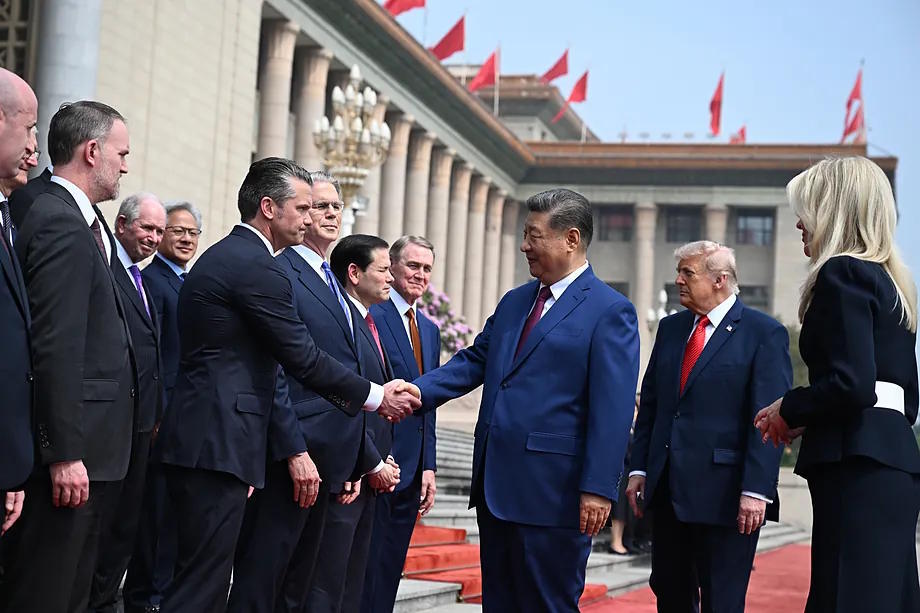
Under a thick haze of Beijing humidity and with the immense Tiananmen Square guarded, Donald Trump was received with all the ceremonial liturgy with which China tries to impress its guests. In front of the monumental facade of ochre columns of the Great Hall of the People, the building where the Communist Party holds its major congresses and receives foreign heads of state, a red carpet ran across the esplanade to the steps of the East Gate, where Xi Jinping stood motionless.
The U.S. presidential limousine, known as The Beast, slowly came to a stop in front of the line of soldiers from the People's Liberation Army. Trump stepped out of the vehicle adjusting his navy blue jacket and walked towards Xi amidst the thunder of a 21-gun salute that echoed over the political heart of Beijing. Both leaders shook hands for several seconds, holding the stiff smile of grand occasions while the flags of the United States and China waved on both sides of the main entrance.
Inside the chamber, under the enormous chandeliers and in front of a long table adorned with red and yellow floral arrangements, Xi took the floor first by addressing one of the intellectual obsessions that have hovered over the relationship between the two powers for years: the so-called Thucydides trap, a theory popularized in American academic circles that an emerging power and a dominant one are inevitably destined for conflict. In a measured and solemn tone, the Chinese president posed the overarching question of the summit: whether China and the United States would be able to avoid that historical fate and build a stable coexistence between the two largest economies in the world.
"I have always believed that our two countries have more common interests than differences," Xi said, looking directly at Trump across the table. "China and the U.S. have much to gain from cooperation and much to lose from confrontation. We must be partners, not rivals." The Chinese leader reiterated several times the idea of "prospering together," a recurring formula in Beijing's diplomatic narrative, and appealed to the historical responsibility of both leaders in a time of "unprecedented changes in a century," another favorite expression of the Chinese ideological apparatus to describe the current transformation of the world order.
"As leaders of two great countries, we must jointly address the questions of our time," Xi continued. "We must find the right way to get along with each other and build a new path for relations between major powers." It was a message directed at multiple recipients. Outwardly, Xi sought to project China as a rational and stabilizing actor in the increasingly chaotic international scenario. Inwardly, he reinforced the idea that Beijing is already negotiating with Washington from a position of strategic equality, something essential for the nationalist narrative promoted by the Communist Party.
Trump responded with a completely different tone: less doctrinal, more personalistic, and clearly aimed at the cameras. With his hands resting on the polished table and surrounded by much of his powerful economic and security cabinet, the U.S. president repeatedly praised his personal relationship with the Chinese leader. "We have a fantastic relationship. It is an honor to be your friend," he said. "President Xi is a great leader and a highly respected man." He then raised the grandiloquent tone that he usually reserves for major occasions even higher: "We are going to have a fantastic future together. Some say this may be the most important summit in history."
Trump insisted that relations between Washington and Beijing "will be better than ever," a statement made after weeks of new tariff threats, reciprocal sanctions, and military tensions around Taiwan. But therein lies one of the peculiarities of the relationship between the two leaders: the ability to alternate between aggressive confrontation and effusive personal praise, while massive economic, strategic, and technological interests move around them.
This reality could be perfectly seen in the composition of the delegation accompanying the U.S. president in the Great Hall of the People. Behind Trump and Xi, on the gigantic staircase of the building, awaited Washington's political core in a visit already considered the most important of the Republican's second term. There were Secretary of State Marco Rubio; Treasury Secretary Scott Bessent; Defense Secretary Pete Hegseth; Trade Representative Jamieson Greer; Ambassador to Beijing David Perdue; Stephen Miller, now one of the most influential men in the White House; as well as Eric Trump and Lara Trump, also part of the presidential trip.
But the most revealing image appeared a few meters back, among businessmen, bankers, and tech executives who observed every gesture of the ceremony aware that much of their business depends on what happens during these 48 hours of meetings in Beijing. Elon Musk raised his phone to photograph the military parade while talking to Jensen Huang, the CEO of Nvidia, in a scene that summarized better than any official statement the true background of the summit: the battle for trade, artificial intelligence, and control of the global supply chains that sustain the world economy.
In an unusual gesture, as shown in images broadcast by Chinese state television, the business leaders of the U.S. delegation entered the meeting room where Xi and Trump were holding discussions. In his opening speech, Trump said he had brought the top business leaders of his country to "pay tribute to Xi and China."
The bilateral meeting lasted more than two hours. Before sitting at the table, and after listening to the national anthems played by the military band, Trump and Xi reviewed the honor guard by slowly walking on the red carpet, constantly relying on their interpreters to exchange brief comments. Trump, visibly comfortable amidst the Chinese ceremonial display that has always fascinated him, even stopped to applaud several groups of schoolchildren waving small American and Chinese flags perfectly synchronized for the state television cameras.
The new face-to-face between the two most powerful leaders in the world, amid current global turbulence, reveals an indisputable line at this moment: despite the trade war, technological rivalry, and military tensions around Taiwan, the two superpowers, still highly dependent on each other, are destined to understand each other. Both Trump and Xi need to project strength and sell results to their respective audiences, although the political urgencies are very different on both sides of the Pacific.
The U.S. president, subject to constant polling and electoral calendar pressures, knows he needs to return to Washington with concrete headlines: significant Chinese purchases of American agricultural, industrial, and energy products, as well as investment promises capable of presenting the visit as a personal economic triumph.
Xi, on the other hand, is playing a different game. In a China where power has concentrated around the Party leader like never before, his internal position does not allow for dissent. Beijing is not in a rush for elections; it has strategic patience. And precisely because of this, Trump arrives at this summit knowing that, this time, he is the one who needs a visible agreement more.
In the geopolitical arena, Washington wants Beijing to use its influence over Iran to push for peace talks and ensure the full reopening of the Strait of Hormuz, the maritime artery through which approximately half of China's oil imports transit. Beijing has observed the Iranian conflict with calculated caution. But the energy crisis also directly threatens China.
The other inevitable major issue is Taiwan. During the meeting, Xi stated that the island is the "most important issue in China-U.S. relations." He added that "Taiwan's independence and peace in the strait are incompatible." For the Chinese president, the Taiwan issue remains the absolute red line of his foreign policy. And for Trump, a potential bargaining chip.
"If managed properly, bilateral relations can maintain overall stability. If managed poorly, the two countries will clash or even enter into conflict, leading the entire relationship to an extremely dangerous situation," Xi declared.
In December, Washington approved a record $11 billion arms package for Taipei, although some of those shipments remain stalled. Beijing has been pressuring for months to even modify the U.S. diplomatic language on the island: it is no longer enough for Washington to "not support" Taiwanese independence; it aspires for the United States to explicitly oppose it. In Zhongnanhai, the complex where the Party elite resides, there is a perception that Trump could be more flexible than previous administrations if significant economic concessions are obtained in return.
Hovering over the entire meeting is also the new technological cold war. The US and China are no longer just competing for trade or military influence: they are competing to dominate artificial intelligence, semiconductors, and global innovation chains. The White House accuses Beijing of massive intellectual property theft in American AI labs; China responds by denouncing the technological blockade driven by Washington.
A very economic agenda
"In a trade war, there are no winners. The essence of the economic and trade relationship between China and the US is mutual benefit and cooperation where everyone wins," Xi told Trump during the talks, as reported by the Xinhua agency.
Trump's visit is marked by a defined economic character. The Republican arrived in Beijing accompanied by the most powerful business delegation ever seen on a US presidential trip to China. On Air Force One traveled executives from Tesla, Nvidia, Apple, BlackRock, Boeing, Goldman Sachs, Citigroup, GE Aerospace, Qualcomm, Micron Technology, Blackstone, and Cargill. Corporate giants with a combined market capitalization exceeding ten trillion dollars and an annual exposure to the Chinese market surpassing 300 billion.
Each executive landed in Beijing pursuing something specific. Elon Musk needs to avoid new tariffs that could destroy Tesla's margins in Shanghai. Jensen Huang seeks licenses that will allow Nvidia to continue selling chips in the world's largest AI market. Tim Cook is trying to preserve Apple's complex supply chain in China, valued at tens of billions. Boeing aims to unlock frozen orders since 2019. Meanwhile, Wall Street is pressing to fully access the Chinese financial system.
More than a diplomatic visit, the delegation seemed like a gigantic corporate rescue mission. And Xi knows it. After years of resisting Trump's tariff pressure and using exports of rare earths - essential for the US military and technology industry - as a weapon, Beijing hosted this summit convinced that time is on its side.