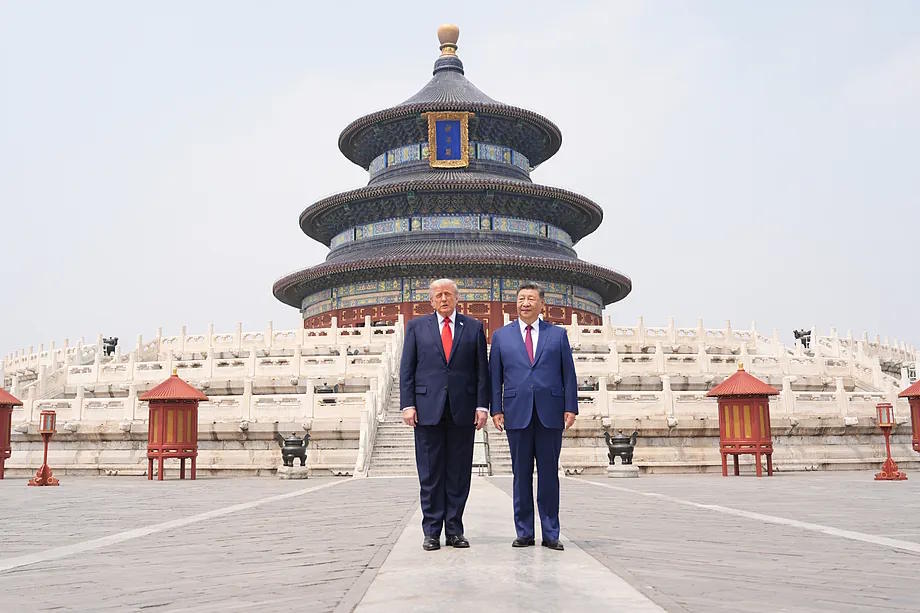
For centuries, Chinese emperors processed through the gates of the Temple of Heaven draped in blue silk, escorted by a silent court amid incense smoke, ritual music, and lit torches. They reached a white marble altar to perform one of the empire's most sacred rituals: the sacrifice to heaven.
There, on each winter solstice, they slaughtered bulls and oxen, offered jade, silk, and wine, and prayed on their knees to ensure good harvests and preserve harmony between the universe and the earth. If the rains did not come or famines ravaged entire provinces, it was not just an agricultural disaster: it meant that the sovereign had lost the divine legitimacy on which Chinese imperial power rested.
The Temple of Heaven was the spiritual heart of the empire. Built in the early 15th century by the Ming dynasty, the complex was conceived as a physical representation of Chinese cosmology: the circular structures symbolized heaven; the square ones, earth. Every number, every step, and every stone followed a mathematical order designed to connect the emperor with celestial forces. While the Forbidden City represented earthly power, this was the place where that power sought the approval of the gods.
Five centuries after those imperial rituals, the old sanctuary welcomed the two most powerful men in the world. Where the blood of slaughtered bulls once served to preserve harmony, Xi Jinping and Donald Trump strolled surrounded by a security deployment that shielded much of southern Beijing.
From early morning, Tiantan Park - as the locals call it - was surrounded by an impenetrable perimeter. Vans stationed on every corner, police, military personnel, plainclothes agents speaking through earpieces. There were also groups of onlookers and tourists crowded behind metal fences trying to guess where the entourages would enter.
After more than two hours of meetings at the Great Hall of the People in Tiananmen Square, Xi and Trump's official convoy crossed central Beijing towards the Temple of Heaven. There, surrounded by dozens of officials, interpreters, and protocol agents, both leaders posed in front of the Hall of Prayer for Good Harvests, the circular building with blue roofs that has become the most recognizable image of the complex.
Images broadcasted by state television showed the delegations of both countries slowly climbing the white marble stairs before entering the temple. The most awkward moment came when a journalist shouted a question about Taiwan to Trump in English. The U.S. president avoided answering and continued walking alongside Xi amidst camera flashes.
Shortly after, when asked about how the discussions had gone, Trump summed up the day in his usual style: "Great. A magnificent place. Incredible. China is beautiful." The scene encapsulated Beijing's goal: enveloping a relationship marked by strategic distrust in the solemnity of Chinese imperial history.
"Trump always brings a lot of noise," said retired man surnamed Zhao, laughing outside the venue. "But Xi knows how to handle it. China is now a country as strong as the United States." A few meters away, a university student who identified herself as Lin claimed that, upon seeing all the entourage and security, she had approached "out of curiosity," in case she could take a photo from afar of Trump.
The Temple of Heaven, where the emperor (known as the "son of heaven") acted as an intermediary between celestial order and earth, has been a UNESCO World Heritage Site since 1998. As Trump and Xi walked along the paths lined with centuries-old cypress trees surrounding the courtyards, the contrast between ancient imperial rituals and modern politics was inevitable. Where ritual offerings once burned, now it is displayed as a stage of fraternity after negotiating tariffs, semiconductors, and military balances.
It is not the first time Beijing has used its historical attractions as diplomatic backdrops to impress Washington. Chinese media recall that Henry Kissinger, the architect of the rapprochement between Washington and Beijing during the Cold War, was a frequent visitor to the site. They say he visited more than a dozen times. Even on his secret trip in 1971, which paved the way for Richard Nixon's historic visit a year later, Kissinger took a break from negotiations to tour this place.
Not far from there, in 2014, Barack Obama held long nighttime conversations with Xi on Yingtai Island, within the Zhongnanhai complex, the heart of Chinese communist power. Three years later, during his first term, Trump received an exceptional welcome in the Forbidden City. Xi and First Lady Peng Liyuan accompanied the Republican and First Lady Melania Trump (absent on this trip) for tea at Bao Yun Lou, a Western-style imperial building constructed in 1915 with funds returned by the U.S. under President Theodore Roosevelt.
Accounts of that visit tell that, in a carefully intimate setting, Trump proudly showed a video of his granddaughter Arabella dressed in a qipao (traditional Chinese dress), singing songs in Mandarin and reciting classical Chinese poetry. The 2017 reception was so extraordinary that it marked the first time since the founding of the People's Republic in 1949 that China closed the Forbidden City to host a foreign head of state.
Today, the atmosphere between the two superpowers is much colder. However, Beijing continues to resort to the same strategy: enveloping contemporary politics in the ceremonial depth of five centuries of imperial history.