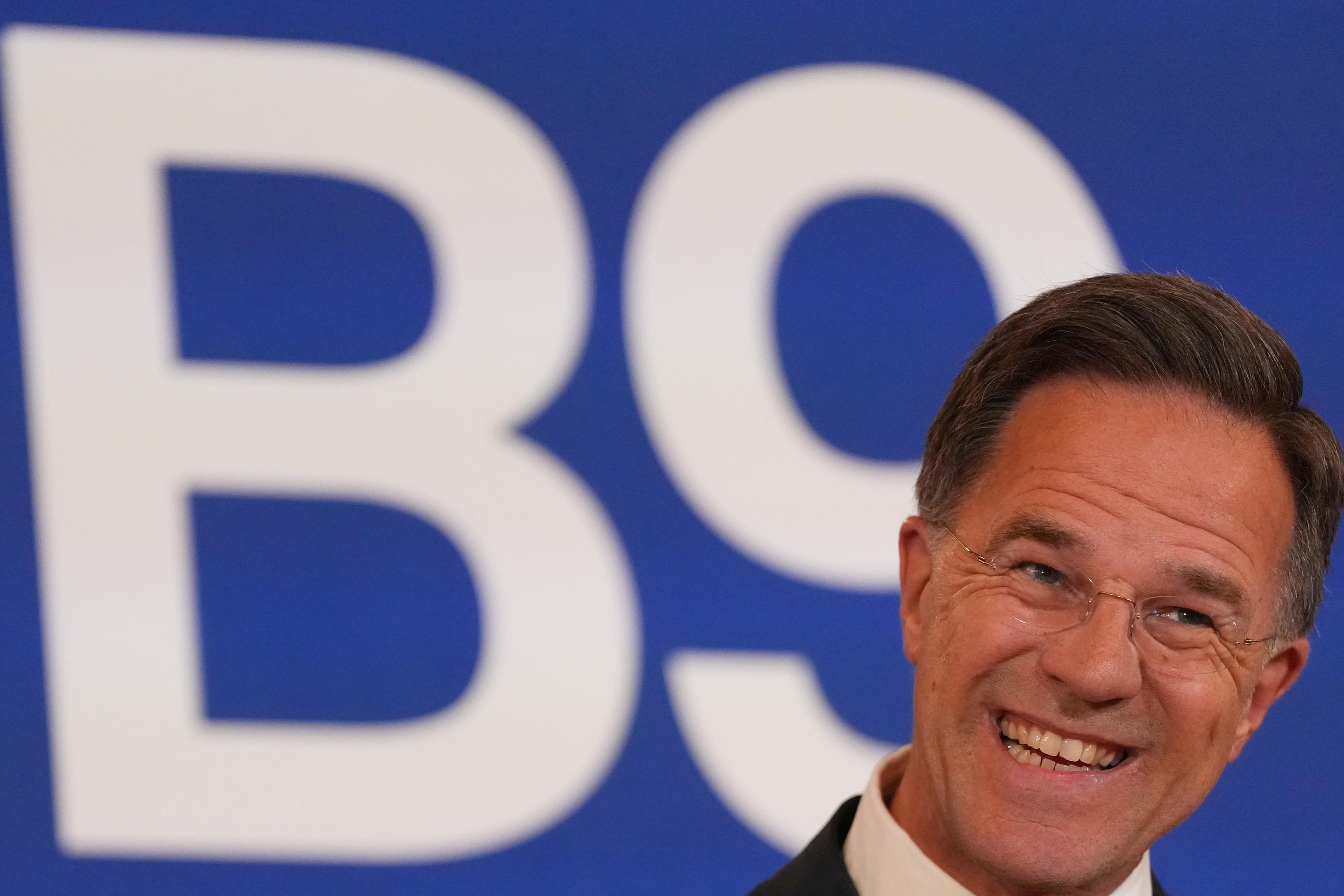
"NATO 3.0 is the next logical step." The Secretary General of the North Atlantic Treaty Organization, Mark Rutte, has confirmed the new era in which the Alliance finds itself. A new era that the Trump Administration already anticipated in February but that has now been fully embraced by the former Prime Minister of the Netherlands from Bucharest on Tuesday.
"A European part of NATO taking on increasing responsibility and care for its own conventional defense, thus enabling the most important ally we have, the United States, to gradually refocus, for example, towards Asia," Rutte has endorsed, thereby addressing an issue that is increasingly discussed in Brussels: if Europeans have to spend more money, they also want more command capability.
Rutte's words were spoken within the framework of the meeting of the so-called B9 group, comprised of Romania, Poland, Hungary, Bulgaria, Czech Republic, Slovakia, Estonia, Latvia, and Lithuania; also attended by the Nordic countries, namely Finland, Denmark, Iceland, Sweden, and Norway. They have jointly issued a statement reiterating what the NATO Secretary General pointed out.
"Today's meeting reflects our shared commitment to strengthen security and defense cooperation across the eastern flank of NATO, recognizing the strategic continuum from the Black Sea to the Baltic Sea and the Nordic and Arctic regions, as well as our determination to make NATO 3.0 a reality by advancing towards a stronger Europe in a stronger NATO. The transatlantic link remains the backbone of our collective security," the statement notes.
Rutte, of course, did not miss the opportunity to emphasize that all this requires more defense spending. Much more. "There is a very serious process within NATO, which concluded last June at the Defense Ministers level, regarding the capabilities we need to defend ourselves 360 degrees against any adversary. Of course, Russia is a particular adversary and there are threats from their side. Basically, the approximate figure needed to defend ourselves is that famous 3.5%," he pointed out. "It was in a range between 3.4% and 3.7%. That 3.5%, plus defense-related spending, brings us to the 5% we agreed upon at the Hague summit," he emphasized.
All allied countries, except Spain, agreed to reach those five percentage points of Gross Domestic Product divided into pure military spending and an additional 1.5% in defense-related investments. The Spanish government claimed it would be able to meet all its obligations by spending 2% instead of 3.5%, but NATO has repeatedly stated that this will not be possible.
Currently, data indicates that Spanish investment is already at 2%, and indeed, the country is fulfilling its obligations. However, the Alliance reiterates that "soon" it will be shown that this is not enough.
"I still believe that one of President Trump's greatest foreign policy successes was the Hague summit," Rutte reiterated, praising the role of the US President whenever he has the opportunity. Regarding the withdrawal of 5,000 US soldiers from Germany, the Secretary General stated that it is a "sovereign" decision of the country but one taken in "close consultation." The priority, as is known, is not to upset the magnate.
Rutte's intervention took place during a press conference in which Karol Nawrocki, President of Poland, also participated. Poland is one of the candidates to host the troops that Trump will withdraw from Germany. "If President Donald Trump decides to relocate US troops from Germany, Poland, of course, is prepared. And I believe it is in the interest of all of Europe, and also in the interest of NATO, for US troops, who are co-guarantors of European security, to remain," he stated. Nothing more, for now.