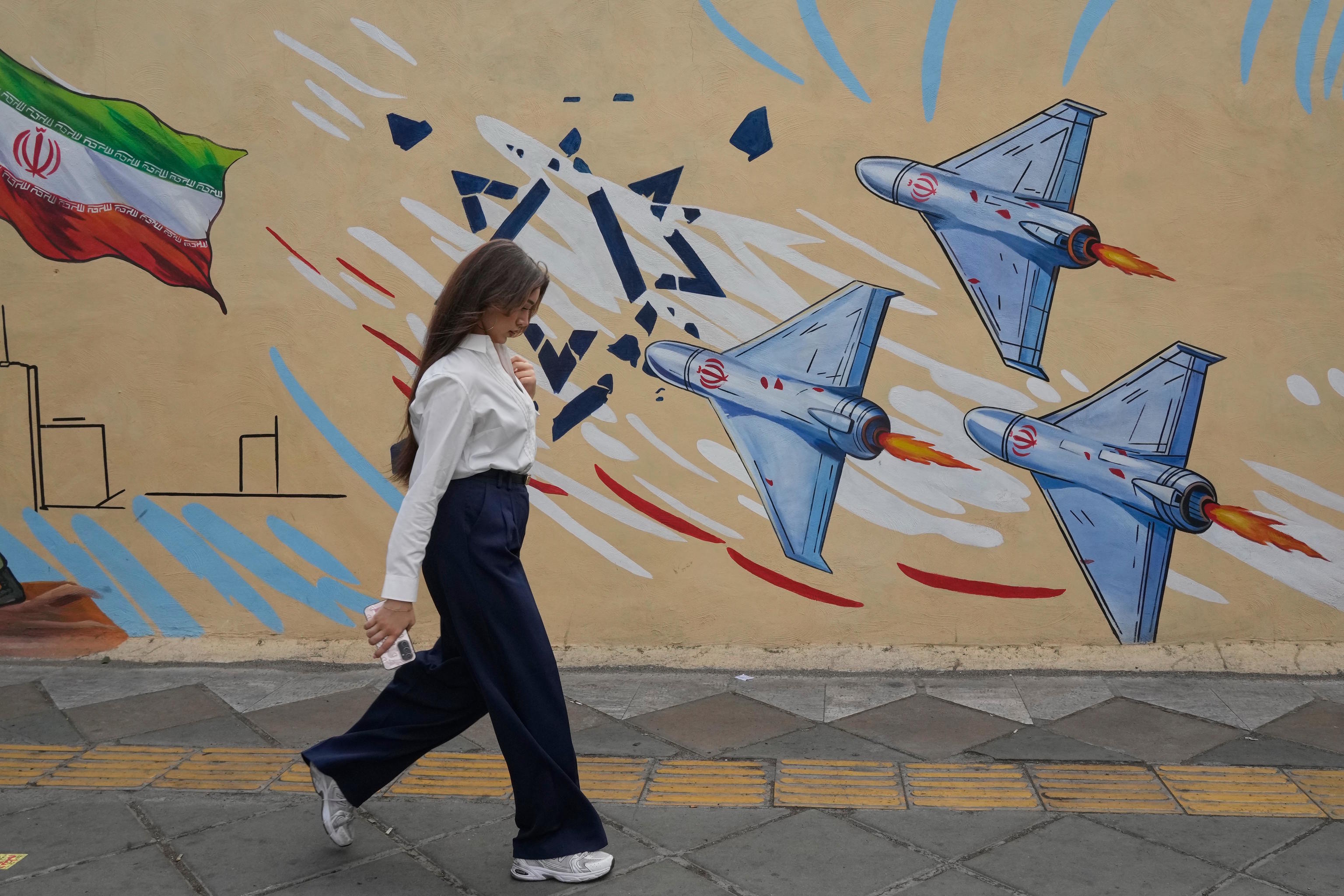
Zohra wanders with her black hair flowing down her back. An unusual sight in Enghelab Square. Here, it is common to see women covered in the traditional abaya (the black tunic worn by more conservative women). This is a space filled with religious paraphernalia, portraits of Ali Jamenei and many others who died in the war against the United States, where the crowd that gathers every night chants "Hit them! You're hitting them hard!" along with the singer Mahdi Rasouli, a melody that has gone viral among regime supporters.
The 31-year-old woman explains that this is the first time she has attended the nighttime gatherings. "I want to make it clear that Iran is also my country and that I am against the war. Why don't I wear the hijab? Because I should have the freedom to wear whatever I want," she explains.
The woman is so resolute that she bids farewell by shaking hands with the visitor, which immediately prompts another attendee to protest. "Tell your foreign friend that here, men do not shake hands with women," she angrily tells the translator.
But Zohra is not alone. In Valiasr Square, Samira directs traffic waving an Iranian flag. The 36-year-old woman also ignores the 1981 law that imposed the obligation for women to cover their hair. An illustrator by profession, she has been attending pro-government rallies since the first week of March. "This is the best opportunity to show this sector of society that we are equal. That we all defend Iran," she asserts alongside another woman who also waves the national flag, but she wears an 'abaya'.
She acknowledges that sometimes other women approach her urging her to cover up, but she remains steadfast. "We cannot change the whole society in a matter of days. Sometimes you have to fight for your freedom, and sometimes, now, you have to fight for your country," she adds.
The presence of girls like Zohra or Samira in the nighttime gatherings of Tehran, which have been a constant since February 28, symbolize a significant misjudgment by Tel Aviv and Washington in initiating this latest conflict, where they publicly stated that the air bombing campaign would reignite the opposition protests from last January.
Far from that, the war campaign has mobilized regime supporters, who gather every night in dozens of squares - around 150 locations, according to Hamidreza Gholamzadeh, spokesman for the municipality of Tehran - to express their support for the government under an atmosphere of Islamic festival, where poems, nationalist anthems, waving flags, praises to the deceased -"martyrs," in official terminology- and the recurring chant of "Death to America! Death to Israel!" intertwine.
According to the aforementioned Hamidreza Gholamzadeh, the nighttime gatherings began "spontaneously" - he emphasizes this, although it is impossible to confirm - on the same night of February 28, when Washington and Tel Aviv launched what they called Operation Epic Fury. "People took to the streets aware that if they didn't occupy them, the protesters (the opposition) would. It was their way of defending the country," he explains in his office.
The gatherings called at nightfall - which have now reached almost 80 uninterrupted days - have spread throughout the country, and it is not uncommon to see similar events in cities like Qom or Yazd where replicas of rockets or drones are displayed, or where attendees are instructed in handling weapons.
In Vanak Square in Tehran, there are more practical activities. Nearly a hundred people wait in line next to the store where free food is distributed.
The authorities have enhanced the scenery in line with their ideology with new murals, where the US is vilified or the alleged achievements of Tehran are referenced. The Vanak roundabout has been adorned with a fist gripping the Strait of Hormuz, alongside a slogan proclaiming: "Trump can't do anything. Iran will forever control the strait".
"We have to fight even with our hands and show that we will not surrender," the announcer proclaims through the loudspeaker, while a sea of fists rises to the sky.
According to a survey by the Iranian Broadcasting Research Center (Irib) - an entity controlled by the regime - 59% of Iranians stated that they had attended these nighttime gatherings at least once, while 33% said they did so continuously.
Although the accuracy of this survey cannot be confirmed, all consulates insist that the public attendance at these events solidified after the message spread on April 8 by the new leader of the country, Ayatollah Mojtaba Jamenei, where he said: "Your voices in the squares will shape the outcome of the negotiations, they will be a decisive factor."
As stated by the official channel Press TV, it became clear that these events were not only "symbolic but components of a national strategy."
For supporters of the Islamic Republic like Professor Shahab Esfandiary from the University of Art in Tehran, these nighttime gatherings are "a new revolutionary moment" (referring to the 1979 uprising that led to the Islamic Republic), which "Western media have overlooked, reducing them to events organized by the State."
Mostafa Azimi, 45, clarifies that he began attending pro-government rallies in the second week of the war, on his own initiative. "I used to pray while listening to the bombings. We will not stop. Trump wants to steal our right to develop our nuclear energy," he explains.
Alaadin Shukeri, 39, has come to Valiasr Square with his wife and two children. His wife and daughter wear the mandatory veil. "These girls do not support the Islamic Republic but they support Iran. That unites us as a nation. It's time to fight for Iran. We will talk about the veil later," he points out, gesturing towards Samira, who continues to display the Iranian flag nearby.
The deployment of loyalists to the government is combined with a significant presence of military and security forces. Uniformed personnel on motorcycles in pairs patrolling the streets, patrols with AK-47s at intersections and bridges, vehicles armed with anti-aircraft machine guns, and surveillance barriers in the middle of avenues are a constant sight in Tehran as soon as the sun sets.
"Beautiful Tehran," asserts a sign just at the entrance to the metropolis, next to the first major checkpoint guarded by militants dressed in civilian clothes, equipped with automatic rifles.
At times, one can come across dozens of security forces stationed on the sidewalks of a major avenue. With their two-wheeled vehicles perfectly aligned and parked in the pedestrian space, while another group stands next to the bus that transports them. "It's a suffocating control," explains an opposition member who wishes to remain anonymous.
The authorities have increased repression since the Washington and Tel Aviv offensive began. According to the Iran Human Rights group, the country's officials have executed at least 28 prisoners since mid-March, while the United Nations estimated that over 4,000 people have been arrested. Official media have acknowledged a campaign to confiscate assets of individuals associated with the opposition. "Punishment has intensified for those who spy and cooperate with the Zionist regime (Israel) and hostile countries," wrote the Mehr agency days ago, estimating around 400 individuals affected by these measures.
Disaffected individuals who protested massively in January and were repressed by security forces, especially on two days - January 8 and 9 - which left thousands dead, according to numerous human rights organizations, have not disappeared from the streets of the capital.
In fact, the dominant aesthetic in the city center undergoes a radical transformation as one drives north through Vallasr Avenue.
The northern neighborhoods of Tehran are a space where the same abayas that are common in Enghelab, Vanak, or Felestin are a rarity. This is an area where the overwhelming majority of women openly defy the regulations that require the use of the hijab.
Some walk with braids and skateboards, or with ripped jeans in European style.
Most surprising is the ease with which women here are willing to express their opposition to the current system. The trio enjoying ice creams, sitting on a bench in a park in the Tajrish district, agree on their opinion about the system led by Mojtaba Jamenei: "We hate the regime."
Simin, 76, is the most vocal. She does not hide her sympathy for Reza Pahlavi, the son of the former autocrat who was deposed in 1979, and explains that like most non-religious Iranian women, they decided to abandon the use of the veil after the popular uprising of 2022, caused precisely by the death in police custody of Mahsa Amini, the young woman who was arrested for not wearing the hijab "properly." Hundreds of people died under the repression of security forces on that occasion.
"Women have won. I burned my veil. We were forced to wear it. That's over," adds Simin.
However, the veteran does not agree with her two friends, aged 65 and 50. She supports the bombings by the US and Israel. She even accuses Trump of being a "loser" for not managing to overthrow the current power and stop the attacks. Her two companions disagree. "We don't like war," says Nushin.
Simin's words and the multiple faces of Tehran reflect the polarization observed in the country, especially after the bloody actions of official forces during the protests last January.
The aforementioned Reza Pahlavi has become the nemesis of the local regime, after supporting bombings against his own country and the actions of the autocracy led by his father. His followers demonstrated on the 10th in various cities in Germany and the UK carrying the flag of the former monarchy's secret service, the Savak, which was also known for its brutality. The videos of those marches have sparked huge controversy on Iranian social media.
"Many people want revenge," indicates another opponent who also wishes to remain anonymous.
The "victory" of women in the struggle against the mandatory use of the hijab, as mentioned by Simin, has been a reality since 2022.
Now it is normal to see signs in shopping centers like the one by Lake Chitgar, warning that "the use of the hijab is mandatory" in this space, and to see groups of women disregarding that notice and walking with their hair uncovered in the area.
Some are even bolder like Melina, a tattoo artist with multiple piercings on her face, long braids, and tattoos covering her neck. She is enjoying a picnic with a group of friends by the lakeshore. She brought Deisy, her dog. Another defiance of the official regulations that banned walking these pets in 2025. For the stricter sectors of this country, dogs are considered "impure animals."
"We do everything that is illegal. It's illegal to bring the dog, we bring it. Tattoos are illegal, full of tattoos. This government is very extremist. I am an atheist because I have a brain and I think," says Amir A., a kickboxing instructor accompanying Melina.
Despite the high personal cost, the more secular society has continued to advance its demands. The struggle over the veil has not been its only temporary "victory."
Women Can Ride Motorcycles Again
Authorities announced last February that they would begin issuing licenses for women to ride motorcycles, thus ending a decades-long de facto ban based on the antagonism shown by the most radical religious sectors towards this idea.
According to one of the many media outlets controlled by the authorities, the Shabestan agency, the logic behind this decision was that women could not ride "while wearing the hijab correctly."
The official Ilna agency was one of those that confirmed the governmental order in February, signed by Vice President Mohammad Reza.
In this case, a growing number of girls had stood out for years by using this means of transportation, without waiting for official approval.
Negara Nasri, 25, started riding her small 50cc motorcycle five months ago. "I started before they announced the driver's license thing," she adds.
"I'm not trying to defy the regime. It's something I need for transportation. But it's true that there are girls who do it to show their disagreement with the restrictions imposed on women," she points out.
The young woman confirms that some of her friends started riding after the 2022 uprising, "although they wore helmets so it wasn't obvious they were women."
With their flashy vehicles parked on a capital avenue, the group of "bikers" calling themselves "Shadows Riders" presents an image that wouldn't be out of place in any European capital.
Kasra SHR (his nickname) serves as the group's spokesperson. He is dressed in the typical black leather jacket, adorned with chains and metal spikes. Beside him is another guy with a similar jacket embellished with the word "Death."
Before speaking, he shows a photo of the club members. They are almost a hundred with 60 bikes, he points out. Of them, around ten are women.
"In the US, girls who hang out with bikers are groupies. Here they are bikers. I could introduce you to one who has so much courage that no one dares to ride with her," he clarifies.
He also confirms that none of those he knows have waited for an official license to ride. "We do everything they say we can't do, and they are the first ones," the boy declares defiantly.
The group has gathered not far from Parkway Bridge, guarded by soldiers stationed behind yet another heavy machine gun. The two realities of the capital coexist just meters apart in a bewildering arrangement where some knowingly ignore the presence of others. At least, in this moment.