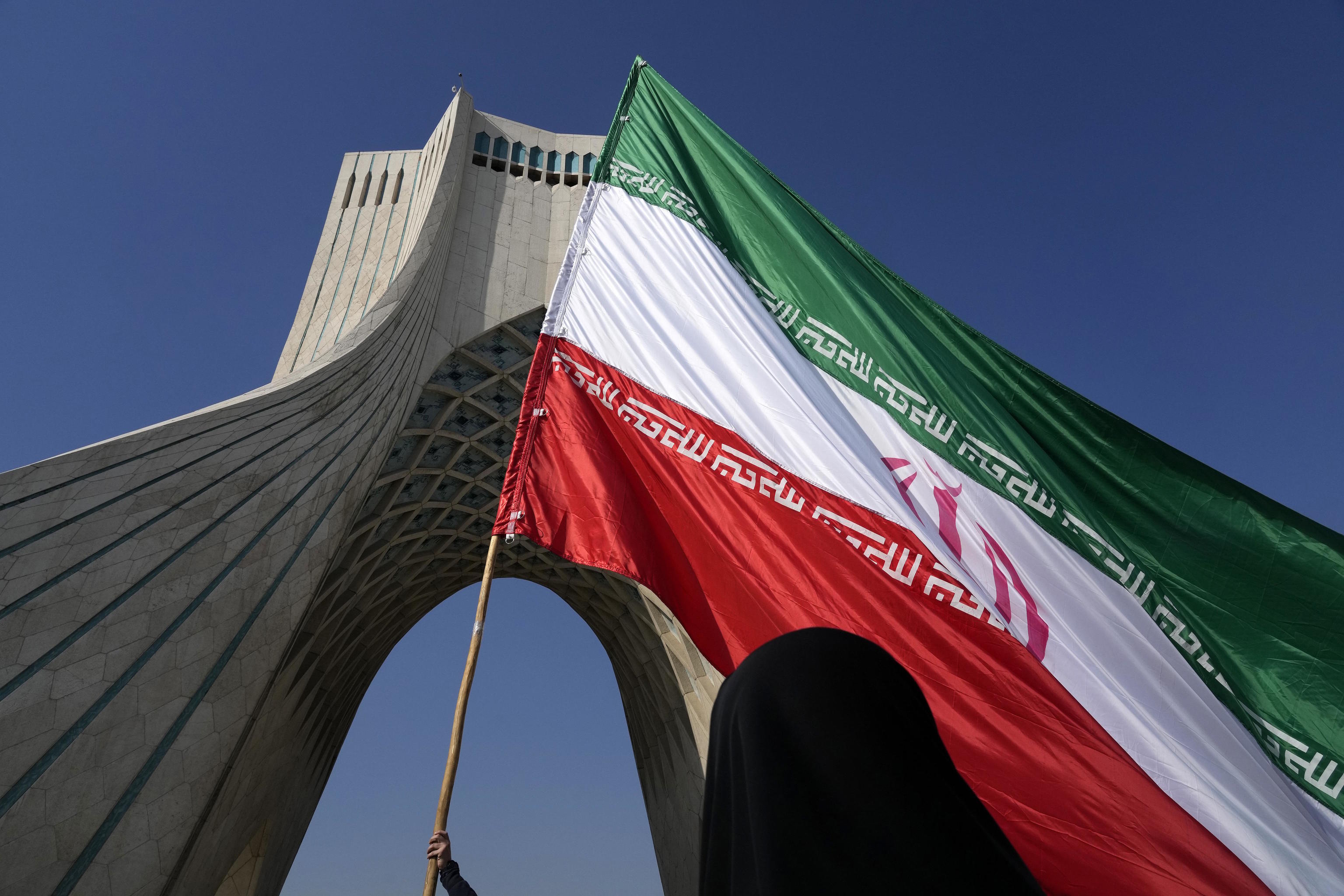
The presenter of Press TV, one of the channels controlled by local authorities, joined the hyperbolic spirit of the night. "Each player has promised to fight for all the martyrs of this war imposed by the United States and Israel. They have tried to prevent Iran from participating (in the World Cup), but they have not succeeded," he was heard saying.
The announcer defined them as an example of "resistance" and "resilience." "They will represent all those who have sacrificed their lives for truth and independence," he added.
The TV commentator was surrounded by thousands of people waving Iranian flags and cheering for the members of the Iranian national team at Enghelab Square, in the center of the capital. The space had been decorated with a huge mural showing the footballers being greeted by the masses and a legend that says: "The men of Iran shine in every arena."
One of the players, Ehsan Hajsafi, read a proclamation recalling that the sports competition will take place while Iran "remains at war" and added: "Under bombings and attacks, we have worked to elevate the flag of our beloved Iran on the international stage. We are proud to wear the emblem of the children of Minab on our chests."
The last reference alluded to the symbolic name given to the sports delegation: "Minab 168." A tribute to the student victims of the U.S. bombing on February 28 against a school in that Iranian town.
Thus, acclaimed by a crowd, the national football team bid farewell to the capital of the country on Monday, traveling to Turkey tomorrow to begin preparations for the World Cup to be held from June in the United States, Canada, and Mexico.
The presence of the Iranian team in U.S. territory has not been immune to the ongoing military conflict between the two countries. Last April, a special envoy of President Donald Trump, Paolo Zampolli, confirmed that he had suggested to FIFA to replace the Iranian team with Italy and suggested that it was the Iranians themselves who were not planning to attend the sports competition.
The U.S. President himself had stated in March on social media that he did not find it "appropriate" for the Iranian team to be present and even issued a veiled threat: "it is for their own safety."
"Why shouldn't we go? We have earned the right to participate," replied Mohamed (who did not want to give his last name), a 58-year-old Iranian present at Enghelab Square.
Like Mohamed, all Iranians consulted agree that for them, the World Cup has become more than just a football event. "Football has been contaminated by politics. FIFA is defending the interests of Israel and the U.S. As soon as Russia invaded Ukraine, they were expelled from all competitions, but Israel has committed genocide and their teams continue to play," commented Ali Dusti, 50 years old.
A fan of Persépolis, one of the top teams in the Iranian league, Dusti added that the presence of their country's team will demonstrate "that we are not afraid to go to the territory of our enemy."
For the aforementioned Mohamed, the players are "our soldiers and they will take the fight to the enemy country."
The political significance that Tehran wants to give to the sports event was evident when President Masoud Pezeshkian personally visited the team's training camp to bid farewell to the players, delivering yet another rallying cry.
"You are not just a football team. You are representing the hope, dignity, unity, and determination of the Iranian nation in the eyes of the world," he told them.
This speech was echoed by General Seyyed Majid Moosavi, the head of the missile units of the Islamic Revolutionary Guard Corps (IRGC), one of the most strategic forces in the country's military structure and particularly active during the recent confrontation.
The Iranian team is scheduled to debut on June 16 in the World Cup, facing New Zealand in Los Angeles.
However, the participation of this country is far from guaranteed. The president of the local football federation, Medhi Taj, stated a few days ago that they have presented a list of 10 conditions to FIFA, including ensuring the issuance of visas for all members of the Iranian delegation.
On April 29, Taj and the general secretary of the local federation, Hedayat Mombeini, were involved in a diplomatic incident at the Canadian border, where they traveled to attend a FIFA conference but immediately returned without entering the territory.
According to the semi-official Iranian agency Tasnim, the altercation was due to the "inappropriate behavior" of Canadian customs officials, who even insulted the Iranian military personnel.
The coach Amir Ghalenoei and the president of the Iranian Football Federation, Mehdi Taj, at the farewell ceremony.REUTERS
The Canada controversy highlighted the practical difficulties that could arise from the displacement of the Iranian team. Taj pointed out that players like Ehsan Hajsafi or Mehdi Taremi, who served in the IRGC, a group considered a "terrorist organization" by the U.S.
The Minister of Sports, Ahmad Donyamali, mentioned weeks ago the possibility that the team might not ultimately participate in the World Cup. "There is no security for our players. Fundamentally, the conditions for participation do not exist," he stated.
Referring to the incident in Canada, a spokesperson for the Iranian football federation, Amirmahdi Alavi, questioned on the 3rd the authority of FIFA to pressure the U.S. to facilitate access for the Iranian team and its entourage. "If you cannot protect the federation president (referring to Medhi Taj), how can we be sure that our players will not face the same treatment?" he asked.
The devotion expressed towards the players last Wednesday is only limited to those who have not spoken out against the Iranian regime. Those who have criticized the regime have faced ostracism and police persecution.
The former Esteghlal winger and former national team member, Voria Ghafouri, was even arrested after supporting the 2022 uprising. Recently, several opposition media outlets reported that authorities had confiscated his assets after he again supported the protests earlier this year.
Another former player, Ali Karimi - once considered one of the brightest stars of Iranian football - has suffered a similar fate, as reported by the local agency Mizan days ago. Dubbed the 'Maradona' of Asia, Karimi has been in exile since 2022 and has recently been associated with the political movement led by Reza Pahlavi, the son of the former Iranian autocrat deposed by the 1979 revolution.
For Mizan, Karimi is "one of the traitors to the motherland who has actively supported the enemy in recent years." The official outlet added that authorities had seized four apartments and two businesses from him.
The same fate befell the former captain of the women's national team, Zahra Ghanbari, who was part of the group of players who sought asylum in Australia in March and then retracted and returned to the country.
The war has radically altered the Iranian reality, and football is far from being an exception. The league had to be suspended, and now local media report on the enormous financial difficulties facing most clubs, an extension of the economic crisis affecting the entire country.
The Mehr agency, also under government control, acknowledged days ago that "several prominent football teams will stop hiring foreign players and coaches for the next season. A large number of foreign players will leave." Among the clubs mentioned were the most well-known names in the local league: Esteghlal, Persepolis, Sepahan Isfahan, or Tractor Tabriz. Mehr even speculated that some teams may have to "withdraw" from competitions due to insolvency.
For Iran, Esteghlal would be the equivalent of Real Madrid or Barcelona. Founded in 1945 under the name of The Cyclists, the club has won 39 national and regional trophies, becoming the most awarded team in the local history of this sport.
Sitting in front of a shelf displaying some of those cups and awards, Ali Tajernia admits that the club where he serves as the top administrative official is "one of those that will have many problems to be able to pay its players' salaries."
"Most of the major Iranian football teams are linked to companies and more than 3,000 companies have been bombed. Not only that. Our main source of income, ticket sales and advertising, has been lost. The situation is very complicated," admits the executive.
One of the stadiums used by Esteghlal, the Azadi, was destroyed on March 4 in a bombing by the U.S. aviation. "It was a facility that used to be used as a support center by the police during matches held at the big stadium (also called Azadi). They are the officers who used to control the public's security. They used that circumstance as an excuse because the day of the attack it was empty. There were no injuries," asserts Tajernia.
The facilities, which were also used for basketball or volleyball games, were reduced to a simple pile of rubble. "They didn't want to cause damage, they wanted to destroy it. Rebuilding it will cost more than 150 million dollars," adds the Esteghlal's leader.
Esteghlal has two Spanish players, goalkeeper Antonio Adan, 39, and forward Munir el Haddadi, 30, who also holds Moroccan nationality. Both were surprised by the start of the offensive launched by the U.S. and Israel in Iran. They had to flee on a rushed journey of over 12 hours by road to Turkey. "We have 8 foreign players. Six of them, including Adan and Munir, we took out on a bus," explains Tajernia.
The precarious state of Esteghlal's finances has forced it to reduce "costs" and thereby cut back on the presence of foreign signings. Adan's contract ends this season and as Tajernai acknowledges, "it will be very difficult for us to extend it." Haddadi's contract is valid for one more year and the executive asserts that "we will try to keep him here."
"The war has been a disaster for everyone. Not only for Iran but for the entire global economy. Football should be apolitical, but how are we going to achieve that if FIFA awarded the Peace Prize to Donald Trump (in December 2025)," concludes Tajernia.