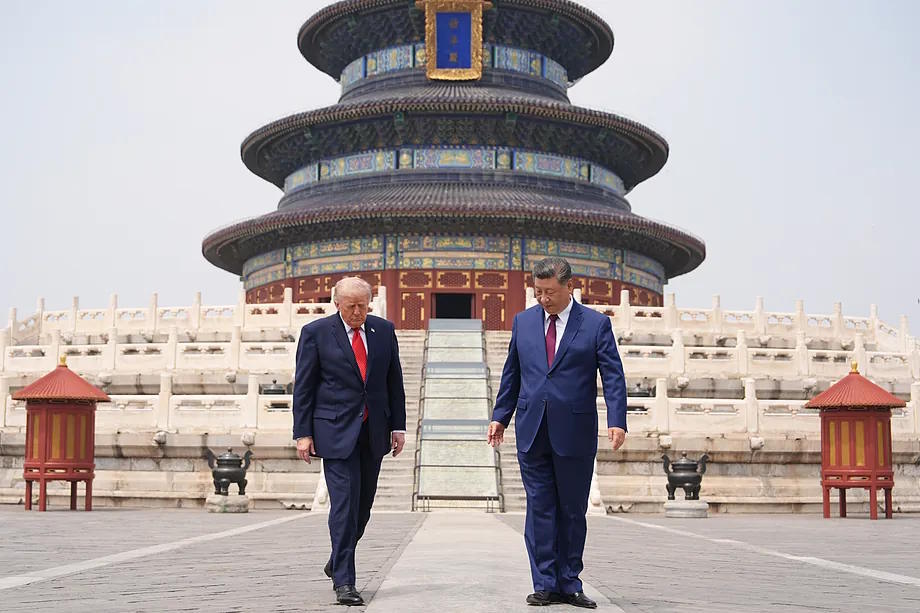
In the imperial grand setting of Beijing, Donald Trump and Xi Jinping met again as two characters from seemingly incompatible political novels. The former, fueled by chaos, speaks as if he were permanently on a television set; the latter moves as if every gesture were reviewed by a committee of historians from ancient dynasties. While the American bursts in like a flattering salesman ready to close deals in front of the cameras, the Chinese leader appears as the high priest of a regime that embraces restraint as a form of power.
The body language of the presidents of China and the United States strolling on Friday through the gardens of Zhongnanhai, the walled compound where the offices of the Communist Party's top leadership and the residences of the main leaders are located, summarizes much of the meeting: Trump offering praise and smiling with his usual expansive expressiveness, and Xi maintaining the composure of someone who never wants to show too much emotion.
The Republican constantly sought physical contact, approaching, leaning forward, trying to generate that personal chemistry he has always used as a diplomatic tool. The Chinese leader, an expert in the art of calculated distance, avoided even the famous "power tug" with which Trump usually draws the hand of other leaders towards him to assert dominance.
During the two-day summit in Beijing, Trump answered questions from the accompanying journalists, gave some interviews, and used his Truth Social platform to boast about having closed "fantastic trade agreements." Or to say that his Chinese counterpart also agrees that Iran "should never have nuclear weapons".
The not-so-spontaneous Xi, who has not granted interviews for over a decade or held an open press conference, preferred to express himself through the solemn statements disseminated by Chinese official media to issue the sternest warning of the entire summit. The message revolved around Taiwan, the issue that Beijing considers the most sensitive and explosive core of its relationship with the U.S. Xi warned that mishandling the Taiwan issue could lead to direct "confrontations" between the two powers. This formulation was carefully chosen to remind Washington that China is willing to significantly escalate tension if it perceives that the U.S. crosses certain red lines.
For the Chinese president, who described Taiwan as "the most important issue" in the entire bilateral relationship, the danger lies especially in any U.S. gesture that Beijing interprets as political or military support for the island's formal independence.
The warning was directed at both the arms sales approved by Trump and Washington's growing strategic support for Taipei. In the Communist Party's view, Taiwan is not simply a diplomatic disagreement but an existential issue linked to national sovereignty and the historical legitimacy of the regime. Therefore, behind the good tone maintained by both parties throughout the summit, Beijing has reminded of something fundamental: Taiwan remains the only issue for which China considers a direct military confrontation with the U.S. imaginable.
Some Chinese officials argue that Trump's visit, rather than aiming for specific concessions, sought to redefine the terms of how the two superpowers should relate. On equal terms. And in this sense, it has been a success. This has been something that has obsessed Xi since taking office in 2012: the coexistence of Beijing and Washington as the great titans of a new, more multipolar global order.
Therefore, during their first face-to-face meeting on Thursday, the Chinese president cited the Thucydides Trap (theory that an emerging power and a dominant one are inevitably destined for conflict) to ask aloud if the U.S. and China would be able to avoid that historical fate and build a stable coexistence between the two largest economies on the planet.