In a scenario marked by global wars, 2025 saw the highest number of executions in the last 44 years, with nations in Asia and the Middle East being the main perpetrators of a punitive practice that increased by 78% compared to the previous year, according to the report by Amnesty International released this Monday.
Out of a total of 2,707 people executed - compared to the 1,518 documented in 2024 - 2,159 were executions carried out by the Iranian regime, as explained by Beatriz Martos, campaign manager against the death penalty at Amnesty International Spain.
The number of executions would be much higher, as the organization ranks Iran as the second global executioner after China, whose actual figures are unknown due to being classified as a state secret. Following them are Saudi Arabia, with 356 executions, and Yemen, with 51.
Throughout 2025, the Iranian regime accelerated this lethal measure, even before the escalation of the conflict in the region. "From January until before the war with Israel, they executed 654 people, and after the 12-day war, over 1,505. We are talking about more than double, and they did not receive any fair trial; many were sentenced for cooperating with hostile governments or alleged espionage," Martos argues.
Death sentences increased to control the population through fear and punishment. "Iran uses the death penalty as a tool to suppress dissent and silence any voice critical of the regime", explains the spokesperson, adding that many of the deaths were by hanging.
In addition to the Iranian case, several countries saw increases: Egypt (from 13 to 23), the USA (from 25 to 47), and Singapore (from 9 to 17). The number of executions in Kuwait nearly tripled (from six to 17). Conversely, there were decreases in Somalia (from 34 to 17) and in Iraq, where, although Amnesty International could not confirm an exact number for 2025, they knew that at least 63 executions had occurred the previous year. Together, the confirmed executions in Iran and Saudi Arabia accounted for 93% of the global total.
Despite the increase, the states carrying out executions are a minority. It is concerning that Japan, the United Arab Emirates, South Sudan, and Taiwan have resumed executions, bringing the total number of countries on this list to 17.
Almost half of the executions, 46%, were for drug-related offenses. This violates international law, which requires reserving the death penalty for "the most serious crimes," such as intentional homicide. "We are mainly talking about small-scale drug trafficking that mainly affects foreign, immigrant populations, for whom sometimes this is the only way to make a living [...] not the big powerful drug lords," Martos pointed out.
Under the narrative of the "war on drugs", nations like Saudi Arabia, China, Iran, Kuwait, and Singapore led the application of the death penalty for these types of offenses. Additionally, Algeria, Kuwait, and the Maldives pushed for legislation to expand its application to drug trafficking crimes, according to the report.
According to international law, it is illegal to execute a person for crimes such as drug trafficking, bribery, abuse of power, or corruption. The spokesperson also considers that practices used in territories like Afghanistan—where crimes like theft are punished by public executions—are deeply humiliating for both the convict and their families.
In Asia, China, Vietnam, and North Korea also impose death sentences for multiple offenses, including drugs. However, human rights organizations face barriers to monitoring. "We do not have exact figures for China, but we estimate there are thousands of executions each year," Martos adds.
United States Doubles Death Penalties
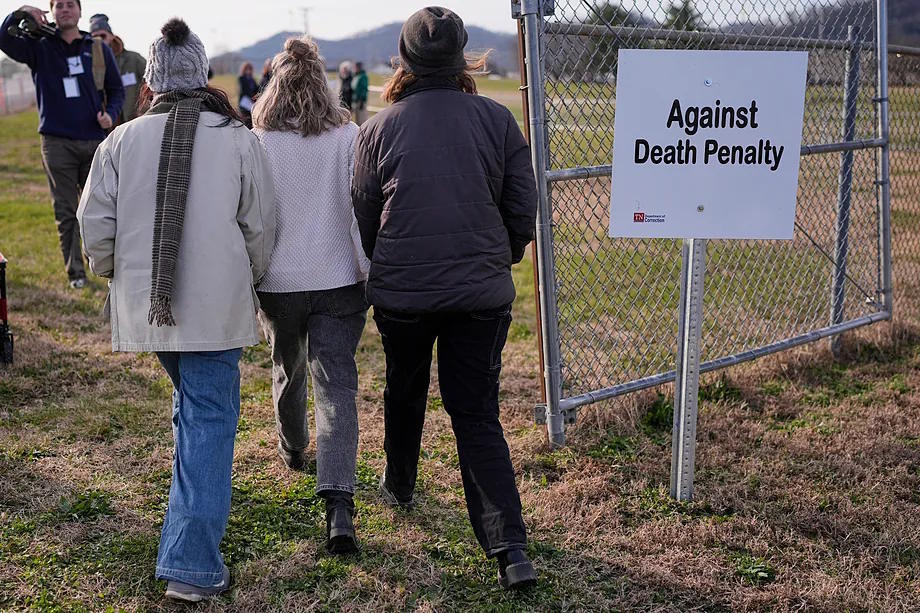
The American continent also saw an increase, mainly focused on the United States, the only nation in the region to carry out the death penalty in 2025. From 25 cases recorded in 2024, the number doubled to 47 in 2025. "There is a bias based on race and socioeconomic resources. The majority of individuals on death row are African Americans and also represent the highest number in previous years," Martos points out, highlighting the system's discrimination.
Globally, the main methods used to end the lives of the condemned are beheading, hanging, lethal injection, firearm, and nitrogen gas asphyxiation. The US has used the latter three, with the highest number of executions (19) concentrated in the state of Florida.
On the other hand, Alabama and Louisiana were the only two states that resorted to nitrogen gas asphyxiation. "We denounce that it can constitute cruel, inhuman, degrading treatment, as it inflicts a great deal of suffering on the convict, who takes a long time to die from the moment they begin to suffocate," states the Amnesty representative.
Each of the countries that carried out executions in 2025 violated international regulations. In the cases of the USA and Japan, they crossed red lines by executing individuals with mental or intellectual disabilities. Globally, the application of the death penalty violated international law by not reserving it for "the most serious crimes." In addition to drug trafficking punishments, sentences were handed down for corruption, blasphemy, and extramarital relationships. They also violated child protection treaties by executing and sentencing to death members of vulnerable populations and minors.
Furthermore, justice systems undermined human rights through irregular processes: trials without the presence of the accused, "confessions" extracted under torture, use of military tribunals against civilians, and automatic lethal sentences imposed by law. This scenario worsened with practices to instill terror, such as public executions.
"It is completely proven that there is no correlation between the increase in the death penalty and the decrease in crime," Martos warns in the face of this grim panorama.
However, despite the record reached in 2025, not seen since 1981 when 3,191 executions were documented (excluding China), the global trend is "improving." Currently, 113 nations have abolished the death penalty. Changes continue, such as Gambia abolishing the death penalty for crimes like murder and treason, or Vietnam limiting its criminal application.
The debate on executions goes beyond numbers and questions the role of the world's criminal justice systems. "The State has a duty to protect the right to life of all individuals," Martos concludes. "When the State, in the name of justice, kills a person, we are not talking about justice, we are talking about revenge," she emphasizes.