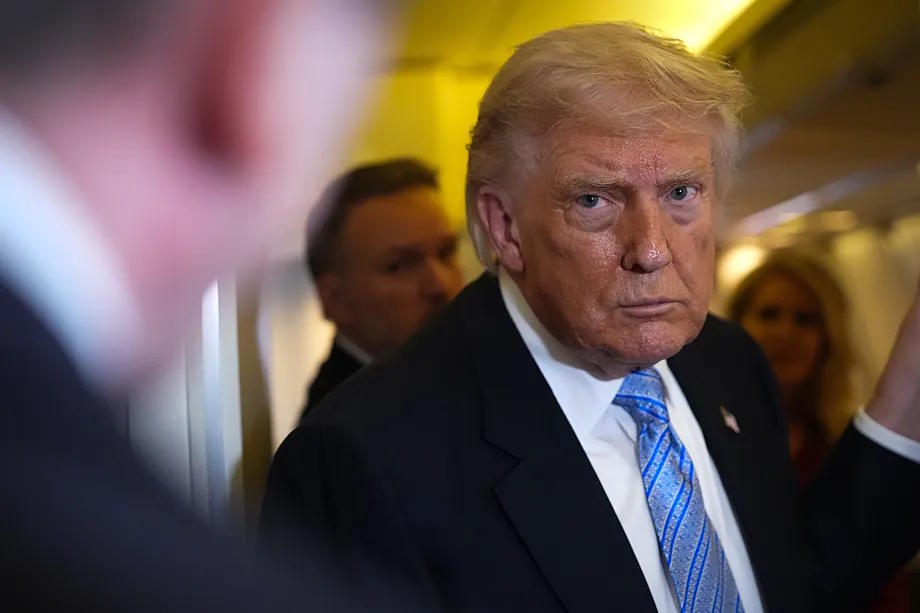
On board Air Force One, as the presidential plane left behind the gray sky of Beijing heading to Washington, Donald Trump spoke to the American journalists who accompanied him on his trip to China. Among all the questions asked, one seemed to make him uncomfortable: "Do you think Xi Jinping is a dictator?". The President of the United States, who had spent two days in the Chinese capital lavishing continuous praise on the Chinese leader - "a great leader," "a friend" - avoided giving a direct answer: "I don't think about that. One deals with what one has. I respect him. He is very intelligent. He loves his country. Whether he is a dictator or not, that is something each one must decide."
Three years ago, former President Joe Biden responded much more directly to the same question after meeting with Xi in California. "He is," the Democrat said at the time. "He is a dictator in the sense that he governs a communist country with a form of government completely different from ours." After those words, Beijing erupted in anger. The Chinese Foreign Ministry described that statement as "an irresponsible political manipulation."
Since coming to power in 2012, Xi has concentrated more authority than any Chinese leader since Mao Zedong. He eliminated presidential term limits, purged internal rivals under a massive anti-corruption campaign, and enshrined his political thought in the Constitution. He is the General Secretary of the Communist Party of China (the position that holds the real power in the Chinese political system), President of the People's Republic of China, and Chairman of the Central Military Commission, the body that directs the armed forces. In 2023, he secured a third term after nearly 3,000 delegates of the National People's Congress, equivalent to the Parliament, unanimously voted for his continuity in elections without alternative candidates.
In any liberal democracy, all this would be enough to settle the debate on whether the leader of a single-party regime is a dictator or not. But in China, they have been trying for years to reformulate even the meaning of the word democracy. Beijing does not reject the term; on the contrary, it claims it in its own way.
State media often cite "democracy with Chinese characteristics". The thesis is as follows: the West uses the wrong metrics. Democracy should not be measured by multi-party elections or freedom of the press, but by effectiveness. By results. By kilometers of high-speed rail, reduction of extreme poverty, street safety, and economic growth.
This is a narrative that the Chinese propaganda apparatus has perfected. The message that spokespersons try to export is that liberal democracies produce polarization, institutional gridlock, and decadence, while the Chinese model guarantees long-term planning and stability.
Despite facing the semantic problem that words like dictatorship or autocracy still dominate the international political vocabulary, Xi's government has tried to appropriate the legitimacy of the word democracy without accepting the essential elements that traditionally define it. That's why the question posed to Trump on Air Force One was much more complex than it seemed. Especially in a country where millions of citizens associate political legitimacy with prosperity and stability more than with ballot boxes and pluralism.
"Why do we need elections like the American ones?" asked a young university student this week during Trump's visit from a modern café near the hotel where the U.S. president was staying. "They spend their time fighting. Just like in Europe." This argument is not uncommon to hear in China. Many citizens view Western politics as a chaotic and exhausting spectacle. The Communist Party's loudspeakers constantly exploit that comparison.
In addition to the verbal caution displayed by Trump, many other Western leaders today also refrain from openly calling Xi Jinping a "dictator." Although in private, European and American diplomats describe the Chinese political system as an increasingly centralized autocracy, publicly almost no one dares to label Xi Jinping as a "dictator".
China has become too important an economic partner to turn every official visit to Beijing into an ideological battle. The many foreign leaders who have paraded through the Great Hall of the People this year - from German Chancellor Friedrich Merz to British Keir Starmer - have carefully weighed every word to avoid any unnecessary clash with the Chinese leader.
This was not always the case. There was a time when public references to repression, censorship, or lack of freedoms were a common part of Western diplomatic scripts. When George W. Bush went to Beijing for the 2008 Olympics, he insisted on attending a Protestant religious service as a gesture of support for religious freedom in China. A year later, Barack Obama used his State visit to urge his then counterpart Hu Jintao to resume dialogue with the Dalai Lama, the exiled Tibetan spiritual leader. Even Trump, during his first term and amid a trade war with Beijing, significantly hardened his tone against China: his Administration imposed sanctions on senior Chinese officials for repression in Hong Kong and for allegations of massive abuses against the Uighur Muslim minority in Xinjiang.
This week, however, human rights apparently barely found space in the summit between Trump and Xi in Beijing. There was time, however, for praise. "You are a great leader. Sometimes people don't like me saying it, but I say it anyway because it's true. It's an honor to be your friend," the Republican affirmed during one of the official meetings. A scene that was hard to imagine just a few years ago when Washington was still trying to combine economic rapprochement with China with grandiloquent speeches about freedom and democracy.