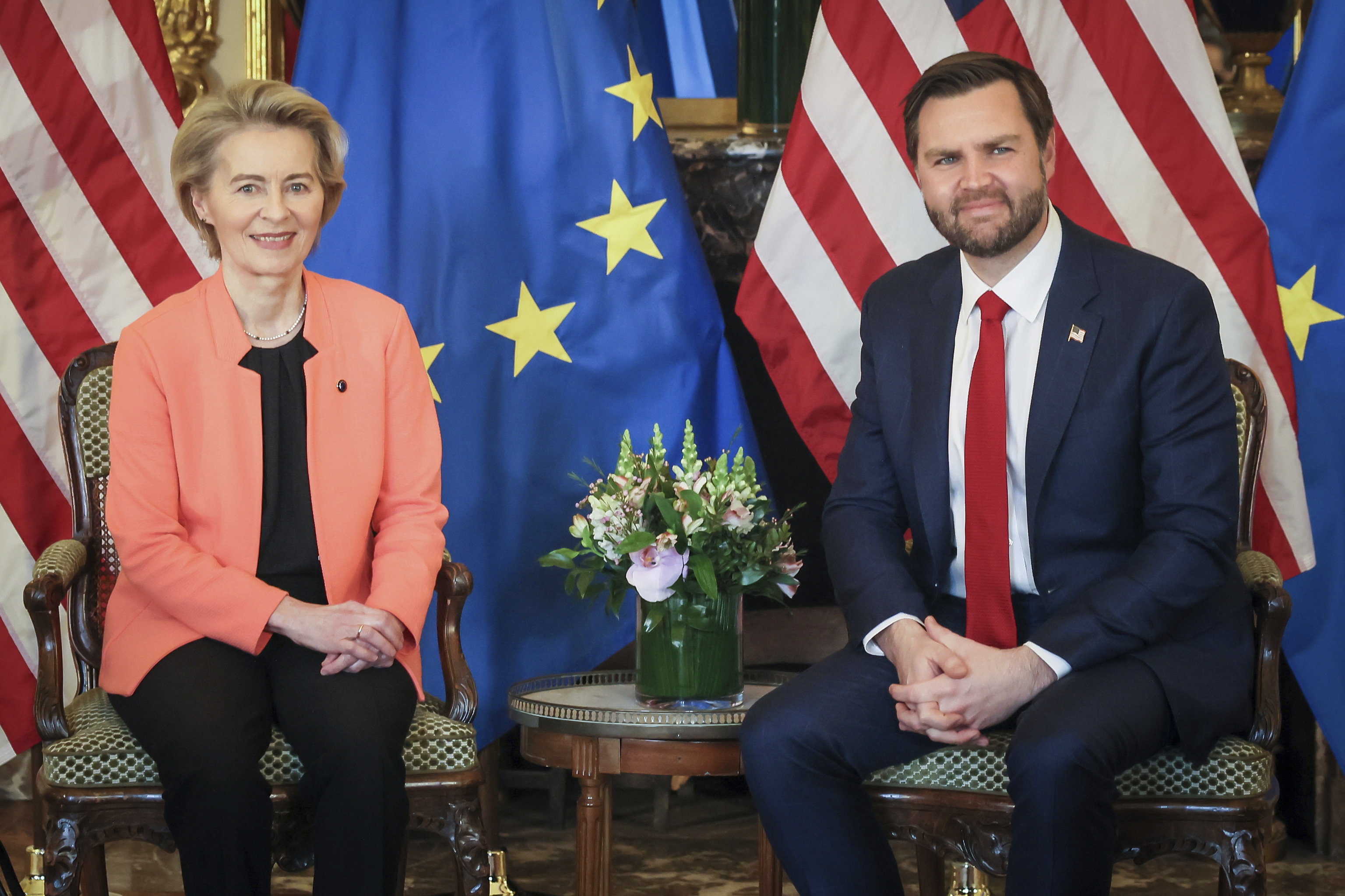
The European Union has dodged the latest tariff threat from the President of the United States, Donald Trump. This morning, the European Parliament and the Council have reached an agreement to unblock the trade agreement, and, in principle, the text could be in force before the July 4 deadline that the magnate had set to impose "much higher" tariffs.
"I welcome the agreement reached by the European Parliament and the Council to reduce tariffs on US industrial exports to the EU. This means that soon we will fulfill our part of the EU-US Joint Declaration, as promised. Now I urge the co-legislators to act quickly and finalize the process," stated the President of the Commission, Ursula von der Leyen, on her social media after the pact.
"Great success for the European Parliament. The European Commission's proposal has been improved in key points. The demands for a stronger safety net have been taken into account. The initial blind approach has been avoided. Clear guidelines," said Bern Lange, President of the European Parliament's Trade Committee.
This stronger safety net is specifically a "specific safeguard mechanism that provides the EU with means to address possible significant increases in imports from the US that cause or threaten to cause serious harm to national producers." In other words: a tool to respond to possible changes in Trump's criteria, something that does not seem at all unlikely given Trump's erratic and changing policies.
The way this mechanism will work is as follows. "Upon a duly substantiated request from three or more Member States, from the EU industry or unions, or on its own initiative," the European Commission must open an investigation "to assess whether the increase in imports has caused or threatens to cause serious harm to European producers." And if there is sufficient evidence, the European Commission "may decide to suspend the application of the regulation in whole or in part."
The introduction of this safeguard has been a point of friction among the different parties, and one of the reasons why the EU has not yet ratified the text that was agreed upon 10 months ago in Scotland. At that time, the pact ratified by Von der Leyen and Trump was almost interpreted as a plunder and, certainly, a defeat for Europe. Since then, that view has softened, either due to the passage of time or because it has been shown that, given the unpredictability of the US, it was the least bad outcome that could be obtained.
And with the unblocking of the agreement, the EU emphasizes its discourse that it is a reliable and, precisely, predictable partner. "An agreement is an agreement, and the EU fulfills its commitments," stated Von der Leyen in the aforementioned social media post. "The European Union and the United States share the world's largest and most integrated economic relationship. Maintaining a stable, predictable and balanced transatlantic partnership is in the interest of both parties," added Michael Damianos, Minister of Energy, Trade, and Industry of Cyprus, the country holding the rotating presidency of the Council.