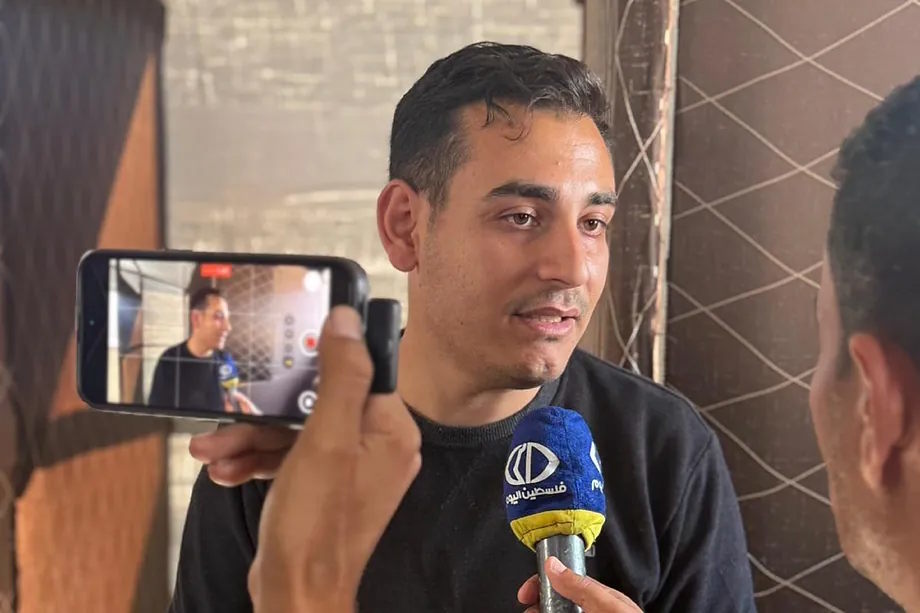
Ezzideen Shehab is a Palestinian doctor and writer. He returned to Gaza a few days before October 7, 2023, and two years after the conflict began, he has become both a victim and a firsthand witness to the devastation, working in destroyed hospitals while treating the wounded under extreme conditions. His book *Diary of a Young Doctor* is a testimony written under siege that seeks to preserve the memory of the victims and give a voice to those whom "the world risks forgetting."
After more than two and a half years of devastation, what is the current health situation in the Gaza Strip?
The health situation in Gaza remains catastrophic. The health system has been severely weakened not only by the destruction caused by the war, but also by ongoing restrictions on the supply of medicines and medical equipment. Essential medicines remain scarce, and critical diagnostic tools, such as ultrasound machines and CT scanners, are still not being authorized for entry. As a result, even basic diagnoses have become extremely difficult in many cases. There are also serious restrictions on surgical equipment, which directly impacts our ability to perform life-saving operations. In addition, international medical missions face significant obstacles. Many foreign doctors scheduled to enter Gaza are denied access at the last minute.
What are the main medical shortages that healthcare workers in Gaza face on a daily basis?
The main crisis is medical evacuation. Thousands of patients urgently need treatment outside Gaza, including children, cancer patients, and people suffering from heart and kidney disease. According to the Ministry of Health, more than 21,000 patients require urgent medical evacuation. However, only a very limited number—around 20 patients per day—are currently allowed to leave. This creates a tragic reality in which patients are forced to wait, sometimes for months, while their conditions continue to deteriorate.
In his book, Diary of a Young Doctor, he says he spends his days "stitching wounds the world will never see." Which of those "wounds" will he never forget, both as a doctor and as a person?
There are many moments like this, and I wrote about some of them in the book. Moments that the war doesn't even know exist. One that comes to mind now happened on a particularly difficult day. The shelling was intense and indiscriminate. An elderly woman passed by the clinic as she fled. She was pulling a small cart, the only one she had managed to get out of her house. She entered the clinic timidly and asked if she could get some medication because her back and feet ached from walking so far and pulling the cart that day. There was a deep sense of fragility in her eyes, a heavy sadness. I asked her, "Where are you going?" She replied, "I don't know. I'm just walking." That day, she didn't really need medication. She needed someone to listen. She needed to talk, to release what she was carrying inside, to feel that someone cared about her feelings. She simply wanted to rest for a few moments in the middle of a long road of suffering. To pause for a few minutes before continuing down that long road of pain. As she left, she turned to me with a small bunch of arugula, wrapped like a bouquet of flowers. It was everything to her. It was all she had; she was a farmer. I accepted it so as not to hurt her feelings, but it was my heart that broke that day. These are the stories no one sees.
You yourself have been a victim of the war, losing 42 family members...
This war has left no one unscathed, with no one suffering irreparable loss. A few days ago, there was a celebration for the recovery of my cousin's son. It was the first joyful family gathering we'd had since the war began. We stood together, smiling and trying to show happiness on our faces, hiding our wounds. We wanted to prove to ourselves, before anyone else, that we could somehow recover. But when we started dancing together as part of our tradition, we could no longer hold back. My father suddenly burst into tears. No one needed to ask why. We all knew. We all wished it hadn't been him who started it. And, strangely enough, we all began to weep. As we danced, something inside us was bleeding. We wept for all those we had lost. We wept for how we had been displaced, scattered in different places after having lived together in the same neighborhood. We wept because our numbers had dwindled so much, after having been a large and extended family. We mourned those who were no longer here. We wept for the pain and the helplessness. And yet, even that wasn't enough.
From your experience in Gaza, how do you assess the international community's response during these years of siege of the Strip?
I believe that people's experiences are what unite them. I think there has been genuine public empathy toward what is happening in Gaza, because no decent human being can accept the death of children under any justification. However, the capitalist system in which we live has turned everything into a commodity. Even opinions and stances can be bought and sold. That's why the empathy we receive often comes from societies that haven't been completely absorbed by the system, societies where people are still connected to their humanity, like the Spanish people, for example. Although I write in English, a large part of my audience is actually from Spain. The problem, however, is that ordinary people are not the ones making the decisions in this world. Power is in the hands of those with wealth and influence, especially among global leaders. And for many of them, human suffering is not a priority.
According to UNICEF, 64,000 children have been killed or maimed in two years of war. How do you see the future for the next generation of Gazans?
Unfortunately, I don't see a promising future for the next generation. They are growing up in an environment without security or food security, in a devastated health system with no hospitals or medical services. They live in poverty, have been out of school for two whole years, and now the schools are destroyed with no sign of reconstruction. They spend their days trying to get water for their tents and gathering wood just to make fires. Given all this, it would be unrealistic to expect any outcome other than more poverty and more lack of education for these children.
Who is your book addressed to: the international community, other doctors, or future generations?
When I wrote these texts, I didn't conceive of them simply as stories. I wrote them as a record of this dark period in human history, as a testament to details that may never be told and to those that remain invisible. In that sense, my writing is not only for today's readers, but for future generations and for history itself.