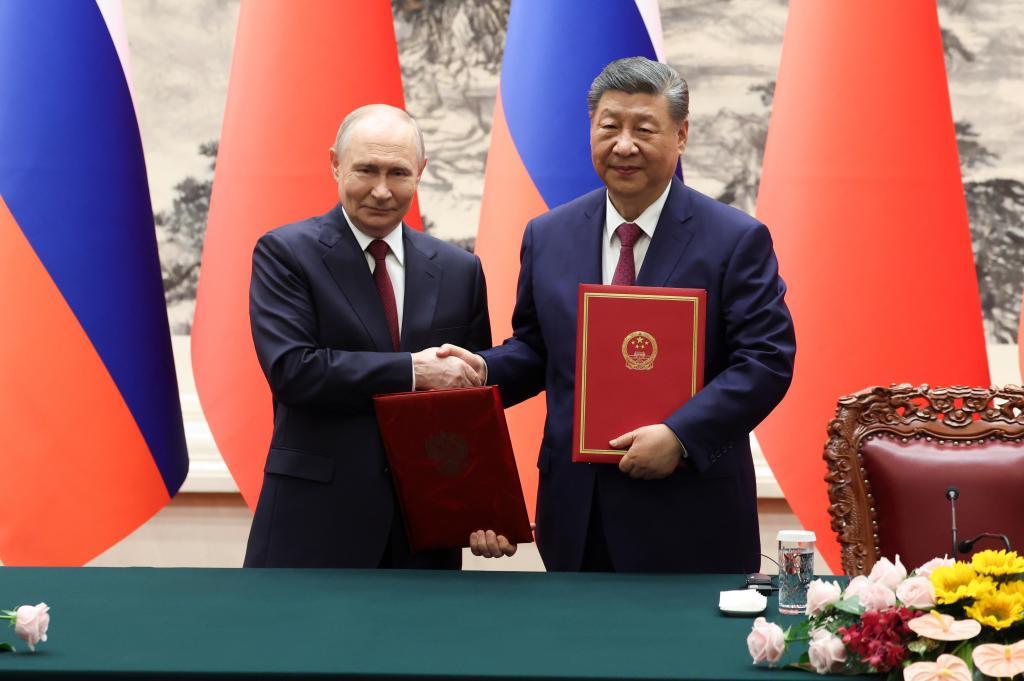
The doors of the Great Hall of the People in Beijing have opened once again for Vladimir Putin. The red carpet laid out in front of Tiananmen Square, the perfectly aligned honor guard, and the military band playing national anthems are part of a meticulously rehearsed choreography, the same one that welcomed US President Donald Trump last week during his visit to the Chinese capital.
Xi Jinping and Putin have publicly displayed their "limitless" partnership, as they defined it shortly before the Russian leader launched the invasion of Ukraine. For Xi, receiving Putin just a few days after bidding farewell to Trump with all honors is a demonstration of diplomatic balance; the ability to engage with Washington on equal terms while still holding hands with Moscow.
In Beijing's power circles, the sequence of state visits is interpreted as a validation of the narrative that Xi has been building for years: China's rise towards an international order conditioned by alternative power centers where the Asian giant acts as an indispensable arbiter. Therefore, the image of Trump and Putin parading through the Great Hall of the People within a five-day span, a symbol of the power of the Communist Party, holds immense value.
Xi and Putin signed a declaration on strengthening their strategic ties (including military and technological aspects) and closed more than twenty commercial and energy agreements. Both countries announced that they will expand joint military exercises and air and sea patrols, according to the bilateral declaration published by the Kremlin. The document also emphasizes the intention to deepen collaboration in military applications of artificial intelligence, an increasingly strategic area in the development of surveillance systems, intelligence analysis, and autonomous combat capabilities.
China and Russia have significantly strengthened their military ties since the start of the Ukraine war, increasing joint maneuvers to demonstrate operational coordination and presence in regions sensitive to the United States and its allies. Last year, Chinese and Russian submarines conducted their first joint patrol in the Pacific, while in 2024 the Chinese coast guard participated with Russia in a mission in the Arctic, an area of growing geopolitical importance due to its maritime routes and energy resources.
During the press conference following the meeting, Putin presented himself as an indispensable energy partner for Beijing at a time of growing uncertainty following the blockade of the Strait of Hormuz. The Russian president stated that Moscow is prepared to "reliably and uninterruptedly guarantee the delivery of oil, natural gas, and coal to the Chinese market."
The vulnerability of maritime routes has increased Beijing's interest in securing land supplies from Russia. For Moscow, in need of new buyers after losing a significant portion of the European market, this growing dependence on China represents an economic opportunity and a geopolitical lever.
The summit between Xi and Putin began in the morning with the Chinese leader resorting to an idea that Beijing has been cultivating for years: the relationship with Moscow is not a temporary alliance marked by tensions with the West, but a long-term strategic friendship. Xi stated that decades of cooperation had further strengthened the ties between both powers and advocated for deepening a "comprehensive strategic cooperation of higher quality" to promote the development and national revitalization of both countries.
Xi once again used a formula reserved for very few foreign leaders when addressing Putin as "dear friend," a treatment laden with symbolism in Chinese diplomacy. "You and I have felt a close relationship, which has determined the deep and fruitful relationship between China and Russia," he said, suggesting that the personal chemistry between them - having met more than 40 times - has been one of the pillars of a partnership that has strengthened as tensions with Washington have increased.
Putin responded by quoting a Chinese proverb - "We have not seen each other in a day, but it seems like three autumns have passed" - before expressing his pleasure in meeting Xi again to "align positions once more." The Russian president praised a bilateral relationship that he described as at an "unprecedented level."
In his opening remarks at the meeting, Putin implicitly denounced Western hegemony. "We defend respect for the sovereign development of states and aspire to build a more just democratic world order," he stated. This is a discourse that Moscow and Beijing increasingly share in international forums, presenting the expansion of institutions such as BRICS or the Shanghai Cooperation Organization as a counterbalance to US leadership.
Putin also emphasized that Russia remains a "reliable supplier" of energy despite international instability. "Amid the crisis in the Middle East, Russia continues to maintain its role as a reliable supplier of resources, and China as a responsible consumer," he said, indirectly referring to tensions around the Strait of Hormuz and the growing importance for Beijing of land energy routes from Russia.
The Russian leader's words come as both countries engage in what are considered decisive negotiations on the Power of Siberia 2 gas pipeline, a project aimed at transporting up to 50 billion cubic meters of Russian gas annually to China and which Moscow considers essential to replace part of the lost exports to Europe.
"Russia and China have reached an agreement on the key parameters of the Power of Siberia 2 project, including both the route and construction," announced Kremlin spokesperson Dmitry Peskov on Wednesday.
The pipeline, which would pass through Mongolia, would connect fields that previously supplied Europe with Chinese consumers. For a Russia hit by sanctions and struggling to fully redirect its energy exports, the project likely represents its main avenue to replace some of the lost income since the invasion of Ukraine.
However, Beijing negotiates from a position of strength. China needs to diversify its land energy supplies, especially after instability in the Middle East and disruptions around Hormuz highlighted the vulnerability of maritime routes. But each delay increases China's bargaining power over an increasingly dependent Russia.
Although bilateral trade weakened last year due to falling oil prices, Russian exports to China have nearly doubled since the start of the war. For Russia, China has become not only an essential energy buyer but also a technological and financial lifeline. Following Western sanctions and the expulsion of Russian banks from the SWIFT system, Moscow, along with Beijing, accelerated the so-called de-dollarization. By the end of last year, according to the Russian Ministry of Finance, more than 99% of bilateral trade was already settled in yuan and rubles.
Xi and Putin have also built a very close personal and political relationship. The "limitless partnership" they signed during the 2022 Winter Olympics did not speak of a formal military alliance but of cooperation without "forbidden areas," based on a shared vision: challenging US hegemony and promoting an alternative international order led by authoritarian powers.
The Ukraine war immediately tested that strengthened alliance. China never explicitly supported the invasion (in official Chinese language, it remains the "Ukraine crisis"), but it also did not condemn Moscow. The US and Europe have accused the Chinese government of selling the dual-use technologies necessary to fuel the Kremlin's "war machine," something Chinese authorities deny. Chinese officials argue that their support has always been carefully calibrated. Xi has tried to prevent the relationship with Putin from dragging China into open confrontation with Washington or Brussels.
During the meeting, Putin once again emphasized coordination with China within multilateral platforms like BRICS. "The complex process of forming a multipolar world based on a balance of interests among all its participants is underway," he stated. For Moscow, this transition to a less Western-dominated international system is one of the main political arguments to justify deepening its relationship with Beijing.
According to the state agency Xinhua, both leaders also agreed to extend the Treaty of Good Neighborliness, Friendship, and Cooperation signed a quarter of a century ago, considered one of the legal pillars of the modern bilateral relationship. Xi stated that the agreement laid the foundation for a lasting friendship and comprehensive strategic coordination, warning that the international scenario is undergoing profound changes with the risk of returning to the "law of the jungle," an expression frequently used by Chinese diplomacy to criticize unilateralism and bloc politics.
In this context, Xi argued that the relevance of the treaty has become even more evident and promised to work with Russia to strengthen "equal-to-equal" strategic coordination. The formula is significant as many analysts observe a growing asymmetry between the two partners: a China transformed into an indispensable power and a Russia increasingly in need of markets, financing, and political support.