The first wave of bombs fell on Bridge B-1 around 2:30 p.m., clarifies Ehsan Karami. The firefighter lives just a few minutes from the massive structure. He arrived at the vicinity of the viaduct along with hundreds of people who began to gather around.
Iran was celebrating Sizdah be-dar day. The last day of the Nowruz festival, a kind of local New Year's Eve.
"I was helping an electrician team cut high-voltage cables. There was a huge traffic jam. Dozens of cars gathered to see what had happened," he recalls at the station where his team is based, just a few meters from the scene.
From here, the damaged structure, which rises above at about 136 meters, can be perfectly seen. The Karaj bridge spanned about 1,050 meters. Iranian authorities said it was the tallest in the Middle East. The projectiles tore off more than half of the cement.
Karami describes the first moments after the initial attack as pure "chaos." What happened next was horror. The second airstrike was recorded at 3:15 p.m., notes Mehdi Ghoreishi, an employee of the construction company.
"I had returned home, and everything shook as if it were an earthquake. I almost fell to the ground. There were several bombs. I heard 8 explosions," recounts the member of the Karaj assistance services.
The 37-year-old Iranian ran out of his house and came across an endless line of vehicles covered in a thick layer of dust. Many of the victims remained inside.
"There were four women aged 30 to 40. One had her arm torn off by the explosion. Another was decapitated. Shrapnel had decapitated her. And a third had a huge piece of metal embedded in her belly. They were all dead," he recalls.
It turned into a walk through horror. "His father had been injured in the first attack and took him to the hospital. They asked for his ID, and he went back home to get it. The second explosion caught him leaving his house and killed him," he adds.
All the firefighters and the aforementioned Mehdi Ghoreishi have different recordings of that fateful day. The videos show the fireballs caused by the projectiles and the screams, and chaos, they generated among the crowd gathered near B1. One of them shows the third attack, carried out by a drone, late at night, as the last explosion sets the suspension cables of the construction on fire.
"This bridge was the enemy's envy, and that's why they destroyed it," opines Mehdi Ghoreishi.
The bombing of the B1 bridge in the city of Karaj, about 50 kilometers from Tehran, on April 2, was one of the most significant moments of the US and Israel's aerial assault on Iran. Donald Trump - in one of his usual outbursts on the internet - had promised to "return" the country "to the Stone Age," destroying its infrastructure.
What is referred to here as the Ramadan War (as it partially took place during that symbolic month for Muslims) has exacerbated the damage already suffered by the Iranian economy, battered by an endless list of sanctions for years, causing around 270 billion dollars in direct and indirect damages, according to the estimate provided in April by government spokesperson Fatemeh Mohajerani in an interview with a Russian agency.
In a statistics-devoted system, Iranian authorities have already provided a detailed account of the damage caused during this war, which - according to their figures - resulted in about 3,500 deaths, over a third of them (1,200) in the capital. The injured were counted in the thousands. Over 33,000, Health Minister Mohammad-Reza Zafarghandi stated this week.
"Almost 50% of the attacks were recorded in the capital," said local governor Mohammad Sadeq Motamediyan, quoted by the Mehr agency.
According to the same official, the bombings caused varying degrees of damage to around 60,000 homes - 122,000 nationwide - 466 industrial centers, and over 11,000 vehicles in the province.
The figures hardly reflect the overwhelming human cost of the conflict or the terrible experience that survivors of these attacks have gone through. Majid Gamsede is one of them and cannot hide his anger.
"Trump and Netanyahu say they came to liberate us. What do I have to do with the government? They killed two families here who used to shout against the Islamic Republic during the January protests," says the 51-year-old Iranian.
The owner of a car wash business miraculously survived by defying all logic. His establishment - where he also lived - is located not far from Risalat Square in eastern Tehran. On March 9, the Israeli air force admitted to having targeted the area under the assumption that a government forces' barracks were located there.
The projectiles hit an official building - no one can explain who used it - but also destroyed dozens of apartments in the same neighborhood. Civilian homes like those occupied by the 12 members of the Mirzaei family. Their faces are still hanging on a wall that remains standing. "We deeply regret the tragic loss of our loved ones," reads below the portraits.
Another nearby banner states: "This is evidence of America's crimes." "Trump, idiot," asserts another.
The bombs began to fall around 2:29 in the afternoon. Majid remembers by the clock he had next to the TV in his house. "There were three explosions," he points out.
"They knew we were civilians and they attacked us"
"They claim they can attack with precision? They can go to hell! (sic). They knew who we were here, they knew we were civilians, and they attacked us," adds the Iranian, unable to contain his indignation.
Both he, his wife, and his son miraculously survived, even though the roof and a wall of the house collapsed.
The attack devastated the neighborhood. More than a dozen apartment blocks were gutted. An excavator continues to collect debris. The charred shells of another twenty cars are lined up at one end of the lot where homes once stood.
"The Mirzaeis were killed while they were eating. The family lived together in the house. The father had built the building and divided the apartments. This girl, Mohaddeseh Mirzaei, was 24 years old. Her husband went out to buy something and that saved his life. This other one was about to get married. Her relatives had also gone out to buy things for the wedding. They survived," recounts an acquaintance of the clan, who prefers not to give her name.
She acknowledges her discontent with the Iranian authorities. Also, her confusion about the actions of the Israeli and American air forces. "They have killed people who were just in the wrong place at the wrong time," she says.
"Our rulers are retarded, but it is the people who are paying the price"
"Our rulers are retarded, but it is the people who are paying the price," echoes Shali, another 50-year-old woman.
The ruins of the Risalat area are replicated in other neighborhoods of the capital. The devastation far exceeds that caused by the 2025 conflict. "That war only lasted 12 days. About 8,000 homes were damaged. Now, in district 4 alone (Tehran has 22 neighborhoods), there were more than 8,000 affected houses," says one of the spokespersons for the Tehran municipality, Hamidreza Gholamzadeh.
The official mentions that around 7,000 people remain displaced and housed in hotels in the metropolis, as their homes were devastated.
Support from volunteers
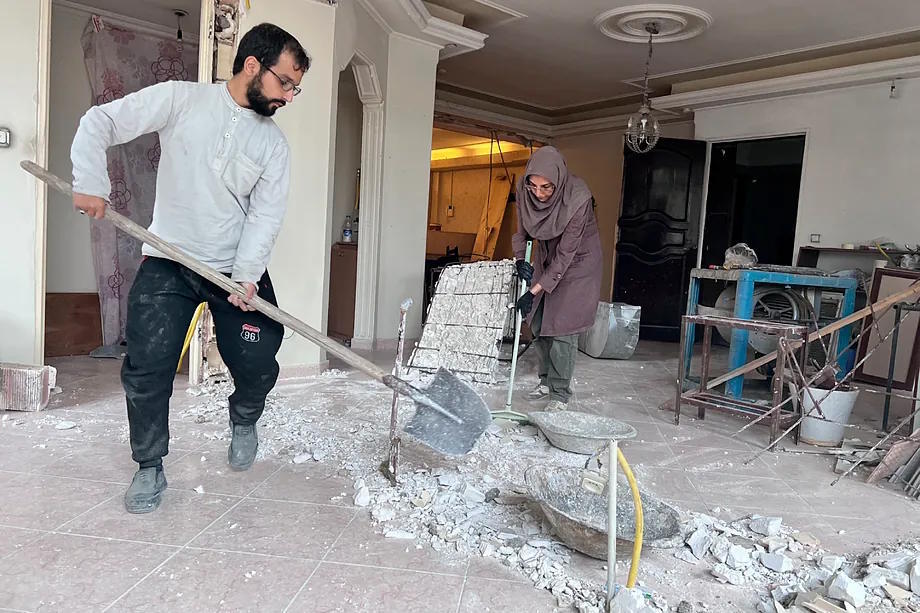
Authorities have received support from thousands of volunteer groups to undertake the reconstruction of the dwellings hit by the bombings. They call themselves "Jihadist Groups," although in this case, the "holy war" (meaning of 'Jihad') is far from the usual warlike concept.
These are groups like the one led by engineer and businessman Said Suleimani, who is trying to rehabilitate the apartment of Shokoofeh Sheikh Hosseini, 65 years old.
The group is clearing the rubble from the floor, which they collect with a shovel and a basin. A pair of young boys are measuring the dimensions of a window frame.
The residence is on the seventh floor, next to Gandhi Hospital, which was also devastated. The target of the airstrike was a local television facility located just across the street, clarifies Hosseini.
The incident went viral when a nurse, now a local heroine, saved several newborn babies by taking them out of the incubators amidst the smoke and chaos caused by the explosion.
Hosseini, the resident of the place, recorded with her own phone another group of people evacuating a patient using a simple blanket.
The Iranian admits that she was also saved by "some divine hand." The shrapnel - hundreds of pieces of glass, metal, and stone - embedded in the walls, refrigerator, or ceiling of her dwelling. The holes are still visible. She, being cautious, sat on the floor upon hearing the planes flying overhead. "I thought they were very close. They were circling. As soon as I crouched down, the explosion happened."
Among Suleimani's colleagues are "teachers, clergymen, or doctors." "First, we clean up the debris, and then we fix the windows, doors, and walls. We have knowledge of masonry and carpentry," says the 45-year-old Iranian. According to his estimate, there are about 12,000 of these "volunteer" groups in the country.
Another member of the repair brigade is engineer Tohere Mamandad, 54 years old. She comes every day after finishing her workday, and when she finishes here, around 8 p.m., she goes to the squares where regime supporters express their support for the Islamic Republic.
Despite the desolation that dominates Hosseini's residence, this is one of those that should be repaired soon. "It has no structural damage," clarifies Suleimani.
Hamidreza Gholamzadeh estimates that 75% of the houses that have suffered this type of "minor" damage have already been rehabilitated.
Propaganda
The airstrike against B1 is now being used by local authorities as an element of their propaganda. During the journalist's visit, a chorus of dozens of people - including several children - was recording a video about the ruins of the infrastructure. The director had them line up perfectly among the rubble scattered over what remains of the structure. A myriad of twisted metal rods protrudes from the pavement a few meters away.
The Karaj Bridge was not even completed. "We started five years ago, but we were missing 1 to 2 months to finish," explains Mojtabah Haji Ghasemi, engineer and member of the Karaj municipality.
The project had required an expenditure of about 30 million dollars, he added.
For Ghasemi, "Trump is setting new parameters where infrastructures are no longer respected. His idea is that if you have power, you can bomb whatever you want. Attacking civilian infrastructure is a war crime."
After the April 2 bombing, Trump himself boasted of the action. "Iran's largest bridge has collapsed. They will never use it again," he wrote on the internet.
A forecast that local representatives radically reject. "We will have to spend another 10 or 15 million to fix it, but we will. I think it will be completed in one or two years," Ghasemi proclaims.
Behind him, the members of the musical group repeat the same verses over and over. "I will clean your blood with my tears. I will rebuild you, homeland, I will rebuild you," they can be heard saying.
Some prefer to set aside the epic. This is the case of the representative of the Tehran municipality, Hamidreza Gholamzadeh. "We have not started to fully rebuild the completely destroyed houses, which are almost a thousand, because we are convinced they will be attacked again. It is better to wait to see the total damage," he concludes.