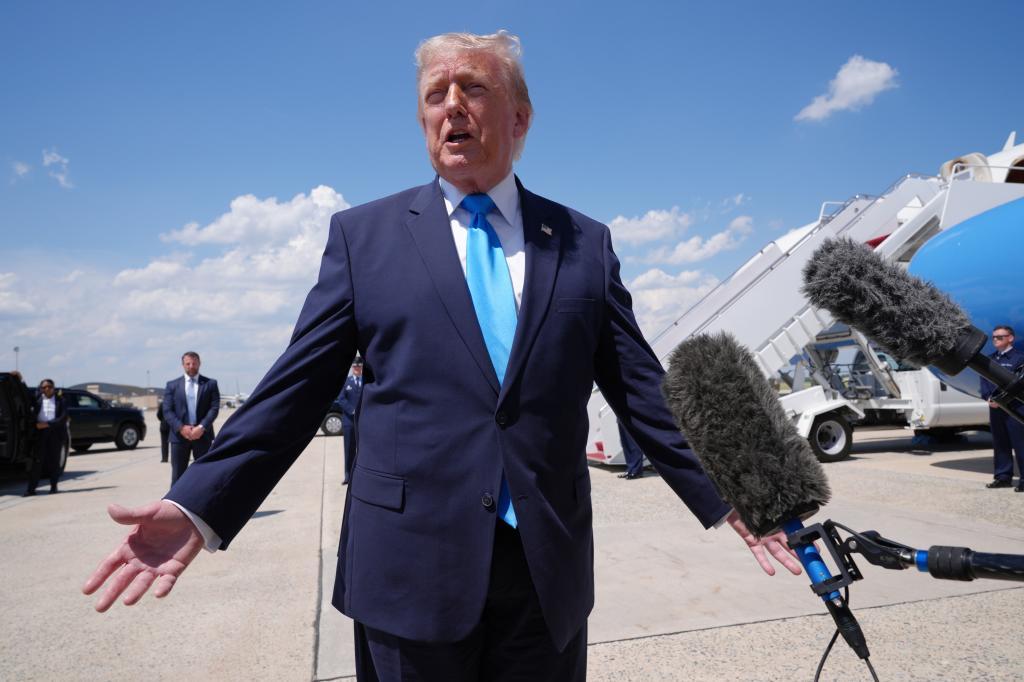
The primaries held on Tuesday night across the United States have made it clear that, despite inflation, rising gas prices, scandals, and Donald Trump's declining popularity in polls, the president still has total, almost absolute, control of the MAGA movement and the Republican Party.
The first rule of politics used to be that if something works, don't change it. And if an elected official wants to run again, their supporters do not question it. Not anymore. At the slightest dissent, Trump, without any mercy or medium-term electoral strategy, pushes punitive primaries. And almost always his candidates win and his enemies lose. "Trump's endorsement is the most powerful weapon in the history of politics, in the history of the world," enthusiastically stated Congress speaker Mike Johnson.
The most evident case involved veteran and popular congressman Thomas Massie from Kentucky's fourth district and candidate Ed Gallrein, a former member of the Navy SEALs who has simply offered absolute loyalty to the leader as his platform in the most expensive primary elections in the country's history. The incumbent, a libertarian who arrived in Washington with the Tea Party in 2012 and has become Trump's main opponent, raised over 12 million dollars. His rival, supported by the president and the pro-Israel lobby, raised over 18 million dollars, astronomical and unprecedented figures for an internal party process in which just over 100,000 people participated.
Massie, opposed to the war in Iran and highly critical of Netanyahu ("I would have conceded earlier, but I had to call my opponent to concede victory and it took me a while to find him in Tel Aviv," he joked last night when accepting his defeat by a 10-point margin), is, in practice, the only Republican politician in open and total conflict with Trump. Daily attacks, disqualifications, and insults are exchanged. The president hates and despises him like few others because he dared to challenge him, contradict him, and pushed through, among other things, the resolution in Congress that urged the Department of Justice to release the Epstein files.
Massie wanted to show that one can have a career in the Republican Party while being against the White House, as used to happen, and has been crushed by a relentless machine. It's not just the dozens and dozens of messages from the president on his social media, interviews, and rallies. A brutal mobilization has been seen, including a quick trip by Trump to Kentucky and the sending of his top ministers to campaign with his rival, with the aim of making it clear that anyone who moves will never be in the picture. Without the leader's support, there is no option.
In Kentucky, by the way, Senator Mitch McConnell is also bidding farewell to politics this year, for decades the most powerful man in Congress, the majority leader who controlled everything and led the opposition to Obama. McConnell made the mistake of maneuvering to avoid a definitive condemnation of Trump after what happened in his first term. Not because he didn't think he deserved it, but because, assuming the billionaire's political career was over, he wanted to capitalize on the base he had built. He miscalculated. Trump returned and for years has humiliated and scorned McConnell like few others, to the point that the party ended up sidelining and belittling him. His replacement will be Trump's favorite, after he forced his only rival to step aside by offering him an embassy in return.
Senator Lindsey Graham of South Carolina, a lifelong hawk with decades of experience in Washington, explained it best this past weekend. Someone who in 2021 said he was "breaking up" with Trump after the Capitol riot, but returned with his tail between his legs when he saw how the winds were blowing. Commenting on the defeat of another senator, Bill Cassidy — one of the few who voted in favor of an impeachment against Trump in the past — in the Louisiana primaries, Graham warned that any Republican legislator who opposes the president can expect the same fate. "Those who try to politically destroy Trump, those who stand in the way of his agenda, will lose. This is Donald Trump's party," he concluded.
"He didn't support me in tough times"
On Tuesday afternoon, the entire national press was waiting for the president's decision on other important primaries, those for the Texas Senate. "The respected Attorney General of Texas, Ken Paxton, a patriot who defends America First and someone who has always been extremely loyal to me and our INCREDIBLE MAGA MOVEMENT, is running for the Senate to represent a place that I love and that I WON three times, with 6.4 million votes in 2024 —the highest number of votes in the state's history, by far!—," he wrote on Truth Social. "John Cornyn is a good man and I worked well with him, but he didn't support me in tough times," he added, explaining why he was leaning towards Paxton and not Cornyn, who is already a senator.
That's it. Paxton, who has been involved in all kinds of scandals over the past two decades, from an impeachment to a brutal and "biblical" divorce after several infidelities, accusations of stock fraud, acceptance of bribes, bribery, workplace harassment, illicit enrichment, or malpractice to try to overturn the outcome of the 2020 elections, is objectively a much more problematic candidate for the Republicans. It is possible, even probable, that he will win, but it will cost the party much more money, which will have to be diverted from other challenging elections. And all because the president's criterion is that Cornyn, even though he eventually complied, was not with him in tough times. "Never doubt President Trump and his political power. Play and you will see the consequences," summarized Steven Cheung, White House Communications Director, in a tweet.
Another extraordinary example occurred in Georgia, in the fight for the gubernatorial nomination. One of the aspirants was Brad Raffensperger, for many years the Secretary of State and responsible for the electoral administration. Trump supported his rival and did everything possible to destroy him because five years ago Raffensperger refused to "find him 10,000 votes" for the president to win his state and keep his chances of staying in office.
The call between them has gone down in history: for Trump's and his lawyers' attempts not to accept defeat and for the politician's steadfast resistance, a deeply conservative figure who never accepted false claims of electoral fraud. Raffensperger has been under attack and receiving death threats for five years. The latest, very serious ones, this month, forced federal agents to intervene and evacuate an airport for a few hours due to a suspicious package.
Trump's overall approval rating has dropped to 37%, the lowest level of his two terms. Almost two out of three voters disapprove of both his handling of the economy and his decision to declare war on Iran, and the numbers indicate that Democrats lead Republicans by 50% to 39% in congressional election intentions, where they could take both chambers. Nevertheless, his approval rating among Republicans remains at 82%, according to the latest The New York Times/Siena poll published on Monday. Untouchable among his own, no matter what happens, no matter what he does.