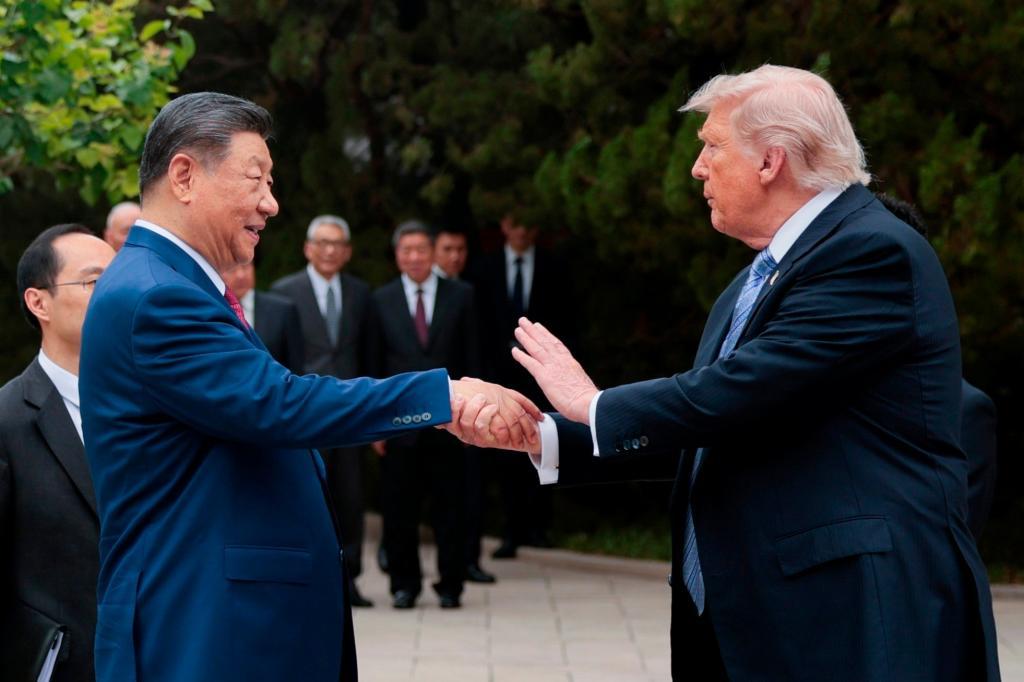
There is a moment during Donald Trump's visit to Beijing that helps explain better than any official statement the place China wants to occupy in the world. The U.S. president walks with Xi Jinping through the gardens of Zhongnanhai, the walled complex where Chinese power breathes, when he asks if that walk is usually part of the protocol with foreign leaders. Xi, according to the scene reconstructed by The Economist, replies that no, that it happens "very rarely." He then adds, with a measured smile, that Putin is one of the few who has also been there. The phrase, more than a courtesy response, was a statement of hierarchy.
Just four days after Trump's departure from Beijing, Vladimir Putin landed in the same city for a visit that has strengthened a political, military, and energy partnership between an increasingly influential China and a Russia increasingly dependent on its powerful neighbor.
Before Trump and Putin, the Iranian Foreign Minister had passed through the Chinese capital seeking support in the midst of the conflict in the Middle East; meanwhile, European leaders appear periodically in the Asian giant with the purpose of protecting their commercial interests.
"We welcome everyone. We talk to everyone. And we do not demand ideological alignment from anyone," comments a veteran Chinese diplomat. In his view, his country has understood before other powers that global influence no longer depends solely on imposing conditions or building blocs, but on becoming the place where even opposing actors end up sitting.
Putin's reception in Beijing on Wednesday almost replicated the protocol reserved for Trump days earlier: red carpet, military honors, and a scenography designed to project diplomatic centrality. But Xi introduced a significant nuance by addressing the Russian president as "dear friend", a formula that sought to underline a relationship cultivated over years and more than 40 face-to-face meetings.
Both leaders took the opportunity to send messages both externally and to their own domestic audiences. Xi defended the need to further tighten coordination with Moscow in the face of a world that, he said, threatens to return to the "law of the jungle." Putin responded by presenting himself as a reliable energy supplier and strategic partner. Together, they agreed to intensify military cooperation through new joint exercises, reaffirming an alliance that has gained weight since the Russian invasion of Ukraine and which is much more necessary for Moscow today than for Beijing.
If the U.S. president's visit focused on stabilizing the most important and dangerous relationship on the planet, Putin's visit was a reminder that Russia is not alone, that Western sanctions have not isolated it, and that the axis with China remains a central piece of its strategic survival. The war in Ukraine has made Russia more dependent on China than the Kremlin would like to admit.
Since 2022, the Asian giant has been Moscow's main trading partner. It buys oil, gas, and coal; it sells machinery, vehicles, electronics, industrial components, and, as Washington denounces, dual-use goods that fuel Putin's war machinery. But the Chinese leader also benefits from the close relationship: he has a useful and loyal partner to undermine U.S. supremacy, coordinate votes and vetoes in the United Nations, strengthen the group of emerging economies of the BRICS, and fuel a narrative of a Global South tired of rules written by the West.
Beijing has also become a mandatory stop for global diplomacy this year. Leaders of countries traditionally aligned with Washington have paraded through its halls: German Friedrich Merz, British Keir Starmer, Irish Micheál Martin, Canadian Mark Carney, South Korean Lee Jae-myung, and Spanish Pedro Sánchez. This Sunday will be the turn of Serbian President Aleksandar Vucic, one of the European partners closest to China.
The succession of visits feeds into the official Chinese narrative an increasingly repeated idea: in an international context marked by wars, uncertainty, and doubts about U.S. leadership, Beijing emerges as an increasingly difficult interlocutor to ignore. "The less reliable the United States becomes, the greater China's attraction will be," summarized a recent editorial in the People's Daily, the official organ of the Communist Party.
The Chinese tabloid Global Times wrote this week that Beijing is emerging as a focus of global diplomacy after hosting visits from Trump and Putin, something exceptional in international politics post-Cold War. The internal message suggests that while the West accentuates its division, China boasts stability and influence; while others improvise, China plans; while Washington threatens, Beijing engages in dialogue.
"Xi Jinping always comes out quite strengthened," says Scott Kennedy, one of the main analysts at the Center for Strategic and International Studies (CSIS). "The meeting with Trump left a major agreement under Chinese conditions, a stabilization favorable to Beijing because China would have managed to reduce tensions without changing essential positions on Taiwan, technology, or the economic model."
Not long ago, China observed the world from the periphery of international leadership. Chinese leaders avoided taking center stage on the global chessboard, prioritizing control of the internal power of the Communist Party. But that position began to change slowly with Xi's rise in 2012, but especially after the global financial crisis, when many leaders in the Asian giant interpreted that the West was beginning to show signs of exhaustion.
Then, Xi began openly talking about "national rejuvenation," an expression that pointed to China reclaiming the central place it had occupied in other periods of history. The new Silk Road arrived, diplomatic expansion towards Africa, the Middle East, and Latin America, military strengthening, a greater presence in international organizations, supply chain dominance, and technological revolution. Now, world leaders no longer just travel to Beijing seeking investments. Xi's regime begins to play a role that the U.S. monopolized for decades: becoming an indispensable interlocutor.