The indictment of former president José Luis Rodríguez Zapatero has opened up external fronts that could be decisive in the coming months. One of them is the role of US in the investigation, with several parallel dimensions: judicial, (geo)political, and symbolic.
In Judge José Luis Calama's ruling, it is explained that "through the cooperation mechanisms available to the National Police, the US agency HSI has made available to the Central Brigade for Money Laundering Investigation the phone extraction of a mobile device belonging to the investigated Rodolfo Reyes Rojas", the Venezuelan partner of Plus Ultra. And that phone, as well as the content of the conversations and emails, has been crucial in reconstructing the events.
Despite clashes between Donald Trump and Pedro Sánchez, the US cooperates with Spain in judicial and police matters, especially in investigations on money laundering, particularly if they involve Venezuela, Russia, Iran, or significant dollar movements.
"HSI Madrid collaborated with the Spanish National Police in an investigation into the laundering of international public funds, which led to the indictment before a Spanish court of Rodríguez Zapatero, former president of Spain. While we cannot currently comment on the details of the criminal investigation, HSI remains committed to working with its international partners to combat global crime, protect our communities, and uphold the rule of law," a spokesperson from the US department told this newspaper.
HSI Madrid is, in fact, the staff of the US embassy in the Spanish capital working for the Department of Homeland Security, who, upon receiving the request from the Spanish Police through the usual channels with advisors on Interior matters, forwards the requests to Washington. Just as their counterparts in France or Switzerland did.
The second dimension is more geopolitical. Washington, especially since the change in administration, has been monitoring any financial structure connected to the Venezuelan chavismo for years. US authorities are closely watching all aspects of the looting.
The US Government's Financial Crimes Enforcement Network (FinCEN), under the Department of the Treasury, recently advocated for freezing the accounts of the small Swiss bank MBaer in US territory due to its alleged involvement in money laundering operations linked to the mentioned countries, specifically operations related to the state-owned oil company Petróleos de Venezuela (PDVSA) and figures like the Colombian naturalized Venezuelan Alex Saab, considered a frontman for Nicolás Maduro.
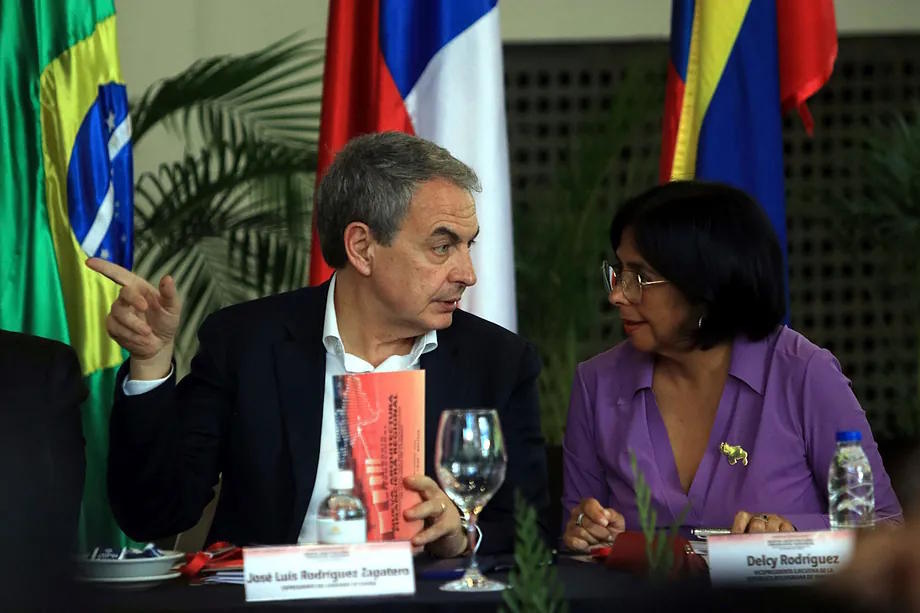
Within this framework, Zapatero, with his multiple connections and interests linked to the Maduro regime, is an extremely uncomfortable figure. His constant presence in the country and his role as a mediator and privileged interlocutor in Caracas, especially with Delcy Rodríguez and her brother, have put him in the crosshairs of the Venezuelan opposition and the Trump administration.
In September, the Deputy Secretary of State, Christopher Landau, stated in X that he would use his "powers" to revoke the alleged visa of the former Spanish president. And he did so, ironically, commenting on a tweet with information from Diario Las Américas stating that Zapatero was conspiring with figures from chavismo like General Miguel Rodríguez Torres and former deputy Eudoro González Dellán to "sacrifice" Maduro and steer a neo-chavista transition, "preserving the power of the Cartel de los Soles". Four months later, Maduro was captured, and the close figures remained, with full collaboration with Washington. Without an apparent role for Zapatero, but with political leaders close to Landau.
All this does not imply that there is a "political operation" against Zapatero, as his supporters claim, but it does help understand why US agencies have been closely monitoring the case long before it exploded judicially in Spain. And all this has coincided with Saab's extradition to US authorities. Therefore, there may be much more information in the future. What is known in the ruling is a response to a specific request, but there may be others.
At the same time, the situation for the embassy in Madrid - which has a new ambassador of Cuban origin very sensitive to the region - is complicated. The relationship with a socialist government and with Pedro Sánchez is precarious. However, as controlled as Washington may have Delcy Rodríguez, a possible arrest of Zapatero - a past mediator in some cases of political prisoners - does not seem to benefit bilateral relations with Caracas. Not to mention that in the embassy and the State Department, they are aware that any "political operation," or even the perception of one, could be useful for Sánchez in electoral terms. Parties like Izquierda Unida and various media voices see Trump's hand behind the judge's ruling.
The third dimension is more than symbolic. It seems indisputable, amid this climate of hostility between governments, that the official participation of US agencies in the case greatly elevates its dimension and potential reach.
The matter enters the realm of international financial networks, sanctions, Venezuela, and the global fight against money laundering. And there, the US plays a central role. The construction of the case, regarding the airline rescue and the role of the former president, has relied heavily on the communications found on the phone of Rodolfo Reyes Rojas. And there are potentially many other loose ends.
So far, everything had focused on Hugo El Pollo Carvajal, the former head of Venezuelan military intelligence who has been making accusations for years about Zapatero's links with chavismo. Carvajal, arrested and extradited to the US for drug trafficking, has been promising evidence as part of his negotiation with authorities. These accusations have not been proven, there are archived complaints, and he himself has retracted some. But it has become clear that Delcy Rodríguez is willing to do whatever is necessary - or sacrifice whoever is necessary - to save herself.