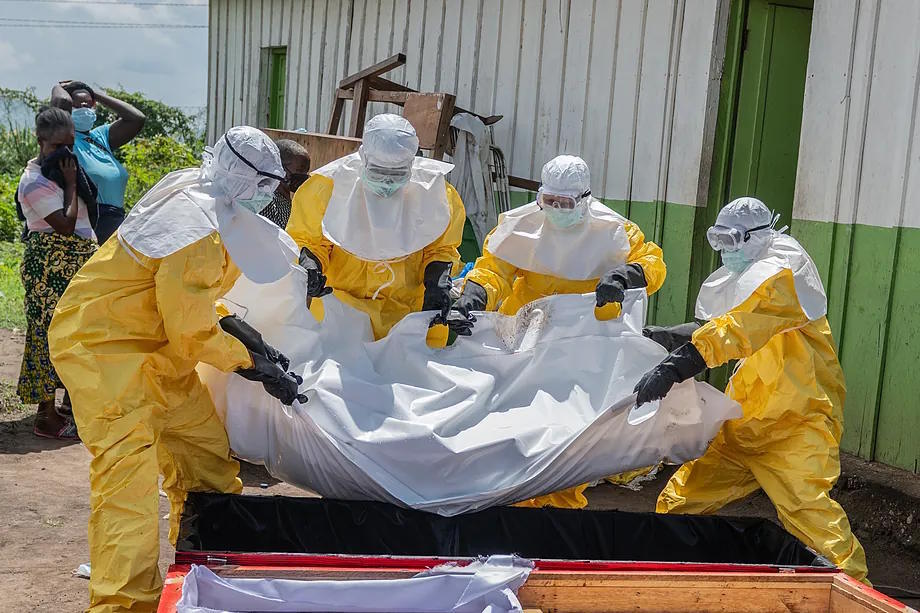
Concern over Ebola is increasing due to the scale it is reaching in the outbreak detected in the Democratic Republic of the Congo. According to the latest official figures, 516 suspected cases have been reported in the African country, including 131 deaths. Among them, 33 cases and four deaths have been confirmed by laboratory analysis.
The affected provinces at the moment are Ituri (health zones of Bunia, Rwampara, Mongbwalu, and Nyankunde) and North Kivu (health zones of Butembo, Katwa, and Goma). In Uganda, 12 suspected cases and two confirmed cases have been reported so far.
"To date, in Ituri, health authorities have recorded over 500 suspected cases of Ebola, but we know that there are likely many more cases in the community," stated Florent Uzzeni, emergency coordinator for MSF (Doctors Without Borders) in Ituri, who emphasized that "it is too early to estimate the extent of this epidemic".
"Isolation units are full, so people cannot go to hospitals for treatment," he added.
The World Health Organization (WHO), which declared the outbreak a Public Health Emergency of International Concern on May 16, has expressed concern about its "scale and speed." Additionally, it confirmed that the outbreak, caused by the Bundibugyo virus, spread undetected for several weeks because the available tests could only detect another much more common variant of the virus, known as Zaire.
Currently, epidemiological investigations and laboratory analyses are being conducted to attempt to reclassify suspected cases and deaths. Among the confirmed cases is a healthcare worker from the United States who has been transferred to Germany along with six high-risk contacts.
At present, the global risk is considered low, according to WHO.
"Considering the information available at this time, the probability of exposure and infection for Spanish individuals traveling or residing in affected areas is very low. If imported cases were detected in Spain, the probability of secondary transmission in our country is considered very low, as we have the appropriate diagnostic capacity to detect cases early and implement relevant control measures," stated the Ministry of Health.
From the dry phase to the wet phase: transmission keys
Luis Buzón, spokesperson for the Spanish Society of Infectious Diseases and Clinical Microbiology (SEIMC), explains that "the sequencing of the strain involved suggests that this outbreak appears to be due to a zoonotic jump, a spill-over, where the Ebola virus (Bundibugyo strain) would have reached humans from an animal reservoir, leading to subsequent human-to-human transmission from the cases."
The key now is containment. Key measures include "preventing the spread of the virus, strict surveillance of case contacts during the incubation period (21 days), and strict isolation of suspected and/or confirmed cases, as well as control of funeral rites related to the burial of deceased cases, given that corpses are extremely contagious." In principle, it would be simpler if not for the context of a country with few resources, dispersed rural areas, and its own political conflicts. "It is essential to remember that Ebola is not transmitted through the respiratory route or during the incubation phase in the absence of symptoms," Buzón emphasizes.
Isolation goes hand in hand with close contact tracing, "here traceability is fundamental," the SEIMC expert reminds. These 21 days can result in the onset of the disease or not. "During the asymptomatic phase, there is no contagion, but monitoring is necessary, and at any sign, referral to a center should be done quickly, and strict isolation of cases should be carried out." In the dry phase, when nonspecific symptoms such as headaches and muscle pains appear, contagion is lower. Once the wet phase arrives, "everything becomes more complicated." Here, diarrhea, vomiting, and even hemorrhagic phenomena occur. "In this phase, transmissibility is at its maximum, and all possible prevention and isolation measures must be taken," he explains.
Buzón insists that "the resources in these countries are not the same as in states with healthcare systems equipped to deal with severe and highly contagious infectious diseases." Along with this lack of resources, he points out how burials there are "the source of outbreak growth through handling of corpses, let's not think it's like here." "Nothing to do with it," he emphasizes.
A healthcare system weakened by armed conflict
The outbreak has erupted in an especially vulnerable part of the world. The region has long been threatened by armed groups that control part of the territory and cause constant population displacements, complicating efforts to track the outbreak.
In Bunia, where tons of medical supplies have been airlifted, residents say that masks are harder to come by and that some disinfectants that used to sell for 2,500 Congolese francs (approximately one dollar) now cost four times more, reports AP.
"It is a very complex area, firstly because it has been in conflict for a long time, and the healthcare system is extremely weakened," notes Miriam Alía, vaccines and epidemic response manager at MSF Spain. According to her, both epidemiological surveillance systems and general access to healthcare are very deficient. "It is an area where we constantly see epidemics, such as cholera or measles," she emphasizes.
Previous Ebola epidemics have also occurred "and we know that it is very complicated to implement all intervention plans, especially regarding surveillance and contact tracing," Alía adds.
MSF has already deployed several health units in each affected province, but it is challenging to implement "all epidemic control devices" at each of these points. "A coordination team is required for each site, an epidemiological surveillance and contact tracing team, an alert monitoring, a treatment center for each site, and also an effective and rapid sample transport system, which is currently lacking," she continues.
This is the seventeenth Ebola outbreak in the Congo. The last one occurred in the Kasai province between September 4 and December 1, 2025, caused by the Zaire variant. A total of 64 cases (53 confirmed and 11 probable) were recorded, including 45 deaths.
Until now, the most extensive and complex Ebola outbreak was the one that occurred between 2014 and 2016 in West Africa, mainly affecting Guinea, Sierra Leone, and Liberia, resulting in 28,600 cases and 11,325 deaths, also caused by the Zaire variant.
The major challenge: a variant without a specific vaccine or treatment
Regarding the Bundibugyo species behind the current outbreak, two previous outbreaks caused by that variant are known, one detected in Uganda in 2007 and another in the Democratic Republic of the Congo in 2012, with a fatality rate ranging from 30% to 50%.
The last outbreak caused by the Bundibugyo virus occurred between August 17 and November 26, 2012, in the Orientale province of the Democratic Republic of the Congo, with a total of 59 cases (38 confirmed and 21 probable), including 34 deaths.
The main issue with this variant is that, unlike the Zaire species, there is neither a vaccine nor a specific treatment to combat it.
According to Vasee Moorthy, special advisor to the WHO Chief Scientist's office, a vaccine to combat the Bundibugyo virus may not be available for at least six to nine months. The specialist mentioned two candidates in his speech: a version of the Ervebo vaccine against the Ebola virus specifically designed for the Bundibugyo virus, and another vaccine based on one developed by the University of Oxford.