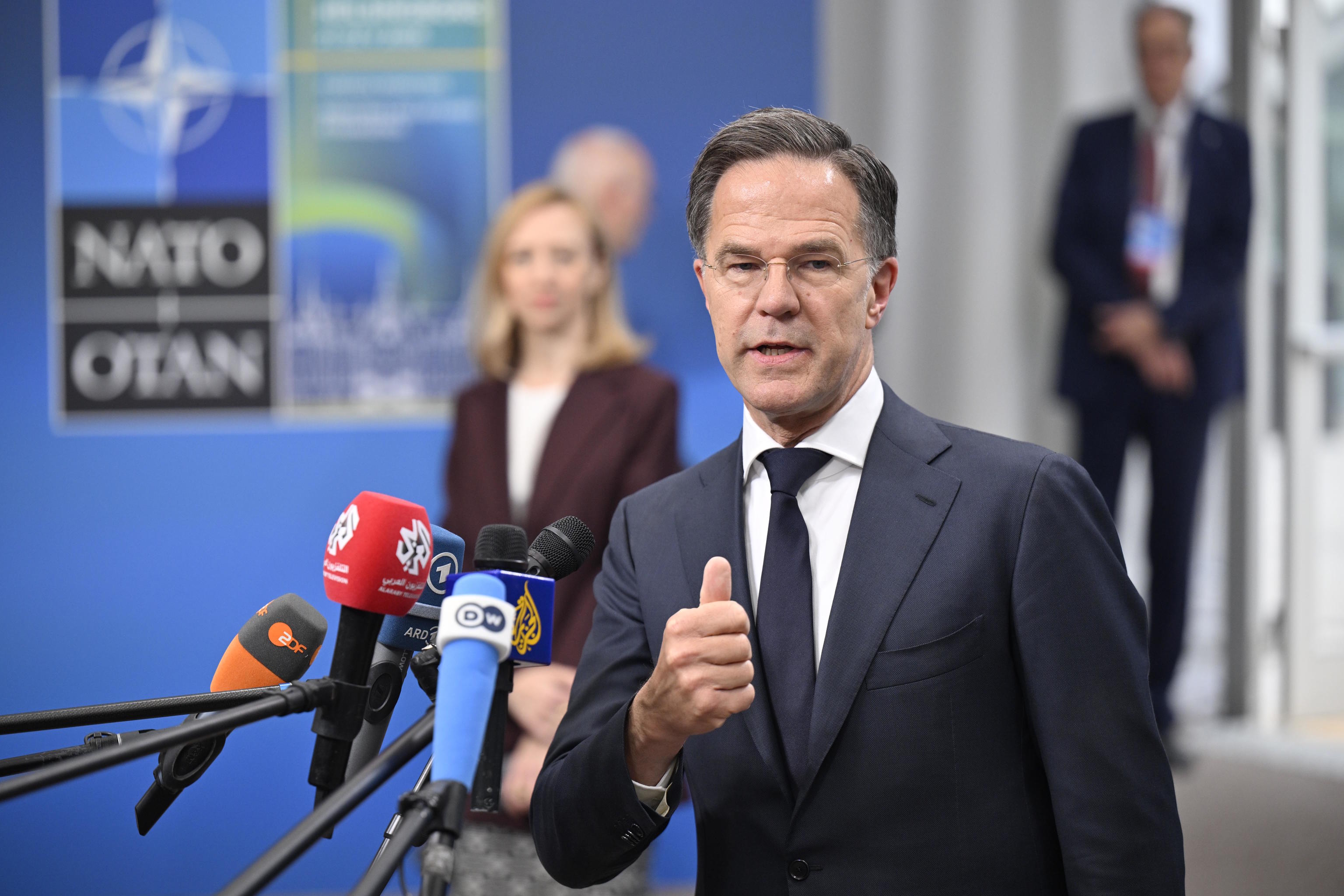
NATO defense, especially in Europe, no longer faces a problem of low investment. The issue now is that there is not enough production for the available money, and this situation will only worsen as countries continue to increase their military spending. The High Representative of the Union for Foreign Affairs, Kaja Kallas, pointed this out a few weeks ago in Brussels. And yesterday, NATO Secretary-General Mark Rutte was not only very clear about it but also encouraged private companies to seize the business opportunity.
"I worked in a commercial company for ten years, not in the defense industry, but in a commercial company," Rutte began from Helsingborg (Sweden), where the meeting of Foreign Ministers of NATO is taking place on Thursday and Friday, referring to the years he spent at the multinational Unilever.
"Companies are there to seize business opportunities. Right now there is a huge business opportunity because in NATO we are spending a lot more," he continued. And even more. "The United States is spending more. But look at Europe and Canada, they are reaching almost the same level as the US in total defense spending. Tens and tens and tens of billions every year, hundreds of billions in the coming years," he emphasized.
The message to the European industrial sector is very clear. More production lines, more capacity. And for this, it is essential for the financial sector, the banks, to also get involved. "The financial sector also understands this. Yesterday I had a meeting with a wide variety of financial organizations, banks, and companies to discuss this, to see what they can do to support the defense industry. It is something we have a problem with here, but also in the US. The United States has exactly the same problem," he explained.
Therefore, US President Donald Trump is already pressuring companies to manufacture more. He has forced them to "quadruple" their production, according to Rutte, who then had his usual compliment and show of admiration for the magnate. "I spoke with one of those CEOs a couple of days later, and he was still shaking after that meeting at the White House," said the head of the Alliance.
This will be one of the main issues discussed at the Ankara summit next July. Not Trump's ability to scare, or maybe also. But what will surely be addressed is how to increase production. The discussion on spending, as mentioned, will not be as crucial as last year, although it will surely once again cause friction or even discussions in the case of Spain. Foreign Minister José Manuel Albares, who will be in Helsingborg on Friday, reiterated this week that the Government does not plan to go beyond 2.1% of investment, a figure that is far from the 5% agreed upon in The Hague.
Another key point is the assumption of more responsibilities by Europe in its defense. The so-called European pillar of NATO, which ultimately motivates countries to spend more and requires greater production. Rutte, also here, justified the continent's departure that Trump has already initiated, and reiterated an old argument.
"Do not forget that in Europe we live among 550 and 600 million people. The United States has 350 million. And there is also Canada. Our main adversary [referring to Russia] has a population of between 120 and 140 million. A situation cannot arise where around 600 million people have to defend themselves against a country with between 120 and 140 million inhabitants, with an economy the size of the economies of the Netherlands and Belgium combined, and cannot do so without overly depending on another country of 350 million inhabitants. So it is correct to rebalance this so that the United States can also pivot more towards other theaters," he explained.
What Trump "will announce later this week and next, I think is absolutely acceptable," he added. And what he will confirm is that he will withdraw 5,000 soldiers from Germany, although he later corrected himself last night and stated that he will send those same troops to Poland. But the threat of military capability withdrawal remains very present.