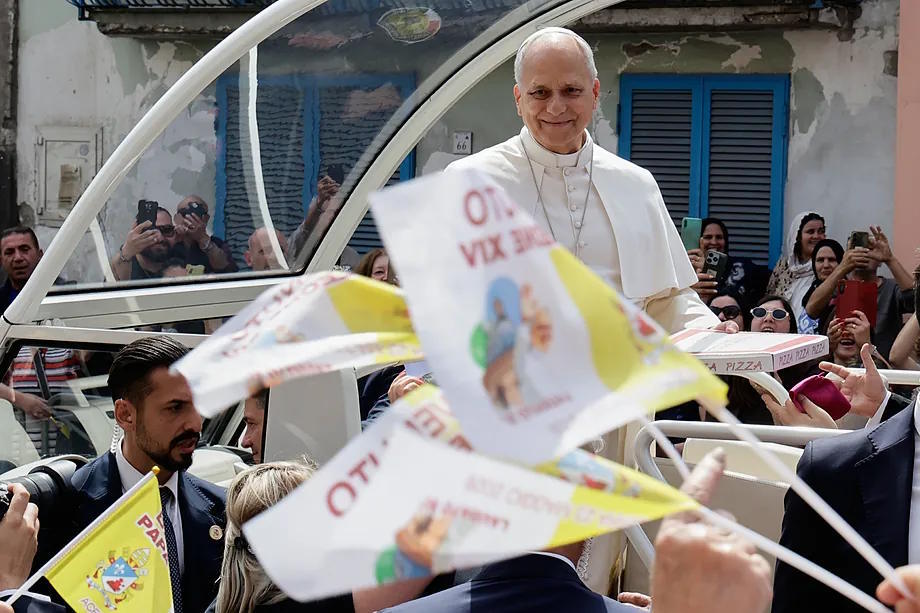
Pope Leo XIV presents today his first encyclical, the first solemn document addressed to bishops and faithful with which he lays the foundations of his apostolate. The Holy Father concluded this text a year after taking office, and the transcendence and influence of it beyond the Church are already taken for granted. However, Leo XIV will demonstrate through gestures the importance he gives to the document. Two events will take place today: the date of signing the text is the same as 135 years ago when Pope Leo XIII sanctioned Rerum novarum; in addition, the Vicar of Christ himself will attend the press conference for the publication of the text, in an unprecedented gesture in the Vatican.
Leo XIV's attendance at the presentation of his encyclical is something new that none of his predecessors had done. The Pope will invite members of the Diplomatic Corps accredited to the Vatican and Italian politicians to the meeting, as well as bishops and cardinals. He will also be accompanied by two people from his closest team: Víctor Manuel Fernández, prefect of the Dicastery for the Doctrine of the Faith, and Michael Czerny, prefect of the Dicastery for Promoting Integral Human Development.
Also present will be three important lay figures for the Pope. First, Christopher Olah, a 33-year-old Canadian scientist and founder of Anthropic, an Artificial Intelligence company committed to the ethical use of new technologies. This young man has become 'persona non grata' to the government of Donald Trump, as in February he decided to limit the use of Anthropic to the US Army, which led Trump to prohibit the use of this AI by federal agencies. A case that is in litigation.
But Olah's presence reinforces the clash between the first American Pope and the country's president, whose majority of voters are Catholics. Trump has directly attacked Prevost on several occasions. His words provoked criticism from Giorgia Meloni, president of Italy and the main ally of the Democrat in Europe; as well as Prevost calmly stating that he is not afraid of the American administration. The invitation to Olah is a sign that the Holy Father seems undeterred by the president of his home country.
Also participating in the meeting are Anna Rowlands, theologian and professor at the University of Durham in the United Kingdom, and Leocadie Lushombo, professor of Political Theology and Catholic Social Thought at the Jesuit School of Theology at Santa Clara University in California. A group of personalities from different fields beyond the Vatican to show the transcendence that Leo XIV aims to achieve with his encyclical.
For now, it is known that Magnífica humanitas is dedicated to "the care of the human person in the age of artificial intelligence." The first magisterial text of a higher degree by the Holy Father is inspired by the one sanctioned by Leo XIII, considered the pillar of the Social Doctrine of the Church. If the predecessor of Robert Prevost addressed the major problems caused by the Industrial Revolution, the current representative of the Catholic Church faces the same questions, with the challenge of Artificial Intelligence as a foundation.
The Pope has a degree in Mathematics, knows algorithms, uses his mobile phone, and believes that it is essential for the Church to participate in the technological debate. Therefore, it is not surprising that AI will be the focus of his first encyclical, as Leo XIV has spoken about the threats of the indiscriminate advancement of this technology more than a dozen times since being elected as the successor of Saint Peter. Before the European Parliament, he warned that "human genius masterpieces are at risk of being reduced to a training ground for machines"; last October, in an audience with Jesuits, he insisted that advances like AI "are redefining our understanding of work and relationships, and even raising questions about human identity." And on Friday, he was much more forceful in a tweet: "We are witnessing an eclipse of the meaning of what it means to be human, as demonstrated by the rampant implementation of technology at the expense of human dignity," the writing began. "It is necessary to regain an understanding of the true meaning and greatness of humanity as conceived by God. The challenge we face today is not technological but anthropological, and I hope that the Encyclical Letter that will be published in a few days can help address this challenge," he insisted.
If Leo XIII sought answers in faith to the challenges of the Industrial Revolution, his successor now does the same with Magnífica Humanitas. Like then, the Pope wants to emphasize that advances must go hand in hand with the human being, as the person is the center for the Church. "In this era of artificial intelligence, I encourage everyone to commit to promoting forms of communication that always respect the truth of the human being, towards which all technological innovation must be oriented," he said a few weeks ago to the faithful gathered in St. Peter's Square in the Vatican. A message that Leo XIV will promote in order to provoke reflection and stir consciences.