Japan is a country that loves cars and travels a lot by train. No other place in the world has as much passenger volume per kilometer of track. Its railway network is divided among dozens of companies, mostly private, and has a huge impact on urban development. The blame lies with a fairly permissive land law that has facilitated the construction of many neighborhoods along the railway lines to provide cities with quick access to urban centers.
Active since 1964 and a pioneer worldwide, its high-speed line, named Shinkansen, has never had a fatal accident due to derailment or collision, is punctual, and in its carriages, loud voices -generally from the vocal cords of some Western tourists- are reprimanded with princely courtesy.
The train from Nagoya stops in Mishima, a municipality of about 100,000 inhabitants. The next 25 kilometers to Woven City, the most futuristic city in the world, must be traveled by road.
We are in Susono, Shizuoka Prefecture, which sounds like a film noir police station from Akira Kurosawa set in a hot summer. If you want a more specific geographical orientation, just look up. Woven City is located at the foot of Mount Fuji, a national symbol that still has snow on its summit at this time of year.
EL MUNDO is the first Spanish newspaper that has been able to cross the doors of this colossal project built by Toyota.
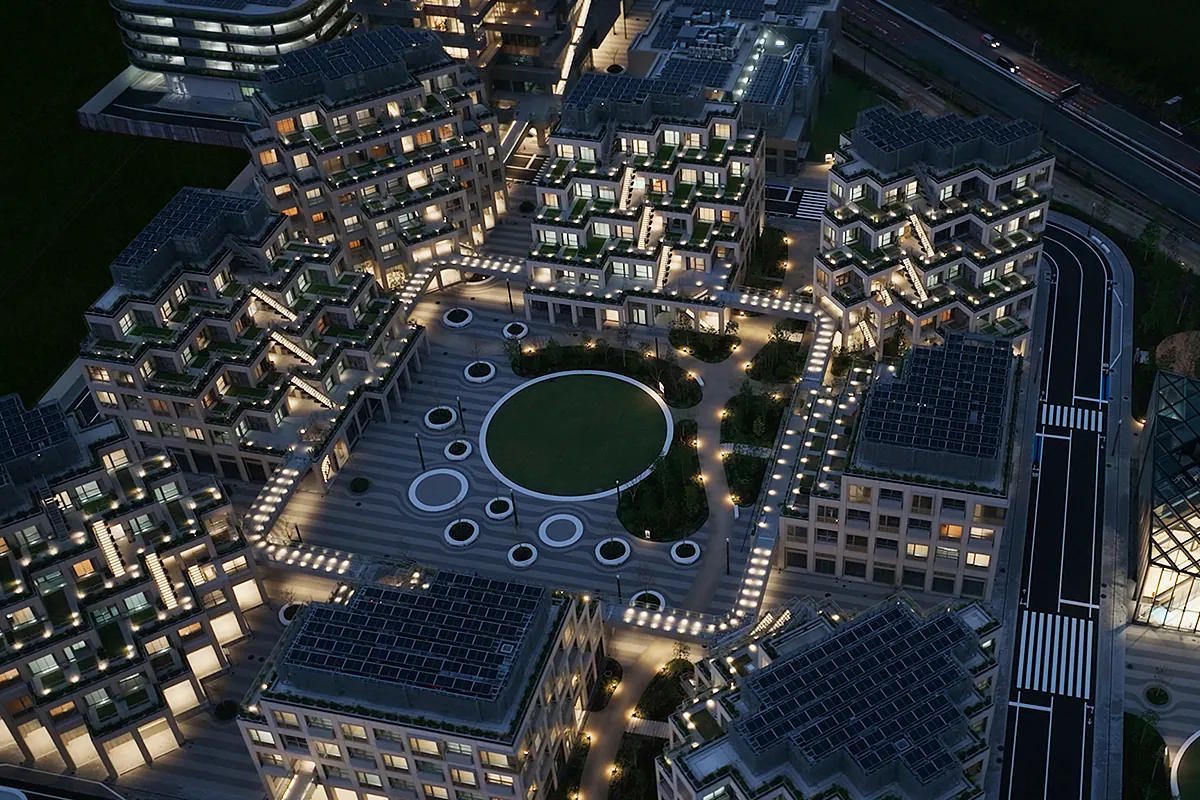
Since last September, when the first phase of the works was completed, this newly founded enclave has welcomed its first hundred inhabitants of the planned 2,000. Its planned area covers 70 hectares.
The census of the woven city -as it can be translated from English woven city- is divided into two clearly differentiated groups. On one hand, there are the residents, called weavers, and on the other, the inventors, that is, engineers and scientists from both Toyota and other companies, startups, and institutions.
How do these inhabitants coexist? Woven City is actually a laboratory dedicated to exploring new mobility solutions where, for the first time, research is tested in a real urban context. The city is a gigantic experiment in which the viability of a product, a method, or an idea is tried to be demonstrated. In short, some invent while others test the inventions.
Despite the rainy day, very much in the style of Blade Runner, this development has nothing to do with the cyberpunk aesthetics full of neon lights so characteristic of Osaka, which inspired Ridley Scott's movie. Nor does it resemble the alternative future projected by Japanese manga culture. It does not imitate Neo-Tokyo from Akira, the maritime and ultra-technological New Port City from Ghost in the Shell, nor does it resemble Tsutomu Nihei's architectural version depicted in Blame!. The design of Woven City is more sober, neat, and, above all, orderly.
"We want to transform this city into a place where people say 'let's try' and a place where we can move forward, even if we fail," said Daisuke Toyoda, senior vice president of Woven by Toyota, at the city's media opening last April.
The disruptive nature of the concept of learning by making mistakes in such a perfectionist culture as the Japanese is fascinating. But for that, the project's spirit is based on a hierarchy system in innovation built from the bottom up. So much so that a child's gaming experience provides as much information to the creators as a test from an engineer at the best polytechnic university.
This is confirmed daily by Jota Oishi, product team leader at Toyota, who lives in the city with his family. His 10-year-old son acts as a technological inspector. Every day, the child checks the operation of the software of the robots he interacts with and reports when it gets stuck.
"If children's curiosity drives them to correct mistakes that we haven't detected, it means they are capable of conversing with developers on equal terms," says Oishi. "This concept is not only positive for him but also for the parents."
There is no more ruthless judge than a child with a toy. Every parent knows that.
The layout of Woven City allows walking, moving on electric scooters, and in autonomous vehicles.
If successful, the inventions being worked on at the Woven City Invention Center could become a reality over the next decade in Madrid, Chicago, or Bangkok. The goal is for these experiments to become the "new normal."
What does this test site really consist of? It is best explained with everyday examples. A resident who has not yet reached his home can adjust the lighting and heating with his home automation apps and using only a biometric control system to open the door. When he goes out, he will find three types of lanes, each with its rhythms and services. Instead of the traditional road hierarchy we know, where cars dominate the public space of the cities we know with an iron hand, here there are three divisions. One is exclusive for pedestrians, while another allows movement by individual and ecological means, as exemplified by a three-wheeled scooter prototype. The third lane is dedicated to vehicles, with a special role for the Toyota e-Palette, a battery-powered kiosk-shaped autonomous model that allows various tasks: from catching up on office work, going to the doctor's appointment, to buying food.
Along the way, one may encounter an autonomous robot capable of towing cars by taking control of their navigation systems, which could have countless applications in the future, such as transporting medication for elderly people in rural areas with difficult access.
"Woven City is concerned with balancing experimentation with the best architectural and landscaping practices, ensuring that technology does not impose on the human experience but, on the contrary, supports spaces that are pleasant, continuous, and socially attractive," explains architect Giulia Frittoli from New York, partner at BIG studio and project manager for Toyota Woven City. "The goal remains to continue learning, perfecting, and ultimately achieving a more seamless integration between mobility, landscape, and everyday urban life."
Not everything in Woven City is just sky or Mount Fuji, as if it were a work of the lemmings -those city builders born from 90s video games-, the environment also invites you to look down. In its underground world, there is distribution logistics, hydrogen infrastructure, and rainwater filtration systems.
But let's go back to the surface. This visitor entered a café and tried what could be called the first spy café of his life. It tasted quite decent, it must be said. Customers of this establishment who authorize it can be scrutinized by AI to analyze their behavior based on camera recordings. It is an experiment by a coffee shop chain that aims to find a correlation between the type and mode of coffee with the customer's concentration levels shortly after consuming it, whether reading a book or checking their mobile phone. In Woven City, they will soon know what type of coffee is best for staying alert and being more productive.
This type of citizen collaboration with inventors also poses a challenge for the crucial management of personal data. Therefore, the city is working on a system known as Data Fabric, which can protect the privacy of any of the various active applications.
This is proof that in Woven City, big data is as palpable as oxygen. It is felt in everything. In the vending machine without buttons or in the hamburger project created to balance all necessary nutrients with only 547 calories categorized with the transparency of a Murano glass. Even in homes monitored by an air conditioning company with air filters and humidity measurement to make them pollen-free in the midst of a sneezing pandemic due to hay fever, which affects 40% of Japanese people.