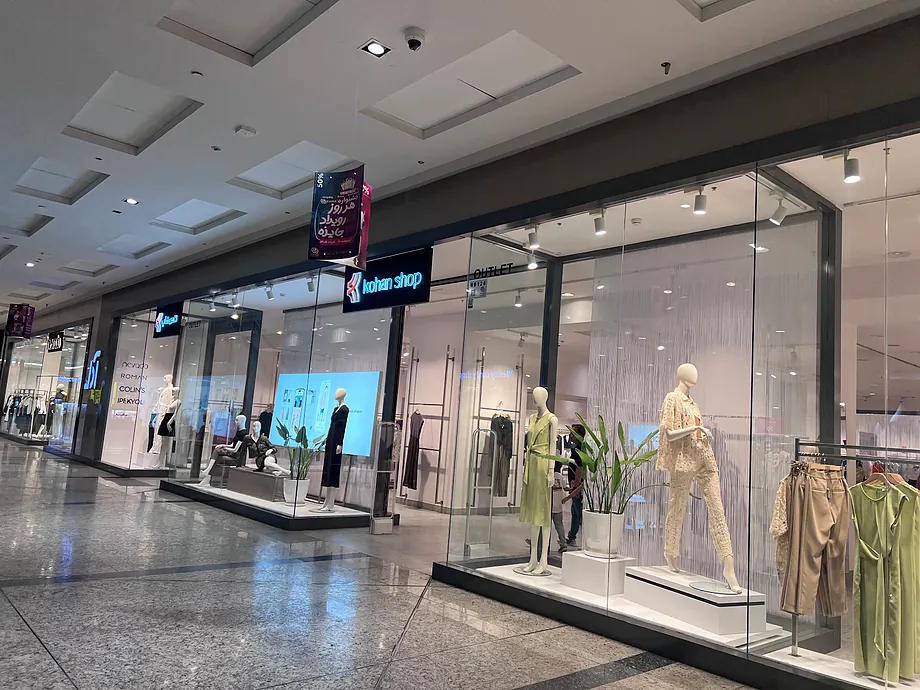
From the outside, the Mall Iran is a mammoth structure located next to Lake Chitgar. A space so vast that it could fit 4.5 Vaticans inside or the entire principality of Monaco, as claimed by the local broadcaster, Press TV.
The statistics related to the project - inaugurated in 2018 but still unfinished - are as overwhelming as the project's intention. The self-proclaimed largest shopping center in the world currently covers 1.95 million square meters. Inside, one finds an ice skating rink, tennis courts, a small stadium, a lake, an indoor garden, libraries, art galleries, and endless corridors filled with over 2,500 stores, each more extravagant than the last, installed in the complex.
But visitors who roamed the enormous space on the past 15th - a festive day in Iran, suitable for gatherings in these types of places - noticed a basic element missing: customers.
Ashraf Sadegh, who has been running a handbag store in the facilities for five years, says this is not an unusual sight. "Now weekends are like weekdays. Five years ago, we were full. Now, at best, I have an average of seven customers per day," says the 47-year-old Iranian.
"Why? People don't have money to buy, and prices have skyrocketed. Do you see this handbag?" she says, pointing to a product from a local brand. "Three days ago, it cost 2.5 million (tomans, about 28 euros), now I had to raise it to three million (just over 30 euros)," the lady asserts.
For the local regime, the Iran Mall is a symbol of the ambition cherished by the Islamic Republic, and therefore, the country's embassy in Australia took it upon itself to disseminate videos of the interior of the shopping center as a propaganda element during the last war with the United States and Israel.
However, the fate of the Iran Mall project holds all the symbolism necessary to allude to the precarious situation of the local economy. The work of the well-known businessman Ali Ansari - owner of properties in Europe, including the island of Mallorca, and Britain worth 400 million euros, as reported by the Financial Times - the construction of the Iran Mall ended up bankrupting the Ayandeh Bank, also founded by Ansari.
After accumulating over 5 billion dollars in losses, largely due to its unwavering support for the development of the commercial complex, local authorities decided to dissolve the financial institution last year.
The disappearance of the Ayandeh Bank and the absence of customers at the Iran Mall reflect the economic precarity facing the Persian nation, exacerbated by the war initiated by Israel and the United States, and the subsequent double blockade suffered by the Strait of Hormuz, vital for the country's supply and the sale of its oil.
Official statistics admit that the current annual inflation stands at around 53.7 percent and in the case of food, it exceeds 115 percent. The brutal blow of the conflict to an economy that had been languishing for years translated into the dismissal of hundreds of thousands of workers within weeks.
Alireza Mahjoub, Secretary-General of the Iranian national workers' union, known as Khaneh Kargar, acknowledged the "direct" loss of 130,000 jobs and another 600,000 "indirectly."
An estimate that was even more pessimistic coming from the number two at the Ministry of Labor, Gholamhossein Mohammadi, who said the conflict had left about two million workers unemployed, adding to the other two million the country was already facing before hostilities began.
Regime-controlled media promote a narrative that tries to counter this perception. According to economist Hossein Razavipour, quoted by the Irna agency, claims of the "collapse" of the local economy are "propaganda and psychological warfare." "The losses are significant," he admitted, but he believed that the new payment system for the transit of the Strait of Hormuz that Tehran aims to formalize will serve as a counterbalance to the crisis, and the hypothetical revenues it generates will help finance the return to normality.
An opinion that radically contradicts that of the also economy expert Hossein Raghfar. Sitting in his office at the Zahra University in Tehran, the professor starts the conversation with a devastating statement: "The Iranian economy is not functional, and this is not only due to the losses accumulated during the war. The main problem lies in the mistakes of the economic policies of successive governments, which are undermining social stability."
Raghfar describes the downward trajectory of local finances as not starting in 2026 but much earlier. He places it in 1993 when he says President Akbar Hashemi Rafsanjani decided to adopt a "neoliberal" orientation in economic matters, leading to a system dominated by hierarchs and oligopolies.
Start of the Tehran Stock Exchange session.JAVIER ESPINOSA
The university professor provides a damning description of the system instituted by the Islamic Republic, which he defines as an "absolutely corrupt" structure, "controlled by oligarchs, largely former generals and their relatives, who have created a network of influence to plunder the state."
"The January protests (where security forces killed thousands of protesters) were not unusual either. We have had 85 bread riots (referring to riots motivated by scarcity) in these 37 years. Sanctions are a problem, but the main issue is the government and its political shortsightedness," he adds.
With 30 percent of the population below the poverty line - according to his estimation - and a currency devaluation "unprecedented in the country's history," he adds, "the collateral effects of the crisis are enormous: prostitution, child labor, or insecurity have multiplied due to increased thefts."
The US and Israel's airstrikes not only targeted military objectives but also aimed to further undermine the country's economic capacity, hitting industrial centers as significant as its two main steel factories: Mobarakeh in Isfahan - the largest of its kind in the Middle East - and Khouzestan in the city of Ahvaz.
An official from the second facility, Mehran Pakbin, admitted to Iranian media in April that the bombings had forced the factory's closure, which will need between "six months and a year" to resume production.
That same month, local authorities banned steel exports - Iran was among the top 10 global steel producers before this conflict - effectively confirming the significant damage suffered by this industrial sector. Mobarakeh and Khouzestan accounted for around 35 percent of Iran's total steel production.
Industry officials have tried to counter the most alarming reports - Israeli Prime Minister Benjamin Netanyahu boasted of having eliminated 70 percent of Iranian steel production - and stated that "it is incorrect to say that production has completely stopped," in the words of a senior executive in the sector, Nader Soleimani, cited by the semi-official Isna agency.
The havoc has spread to several refineries like South Pars, Lavan, and Siri, which were attacked, with the extent of the damage they suffered still unknown.
An Iranian representative, Esmael Saqab Esfahani, recently acknowledged that the country already faced a clear deficit in meeting local fuel needs. According to the figures he provided to Iranian media, before the war, the country was forced to import between 20 and 25 million liters of gasoline daily.
A senior official in the local administration, Mohamed Mehdi Hadavi, quoted by Mehr agency, acknowledged the significant economic damage caused by the conflict. "It has paralyzed or interrupted production lines in many industrial units, leading to reduced production capacity, layoffs, and disruptions in supply chains," he pointed out.