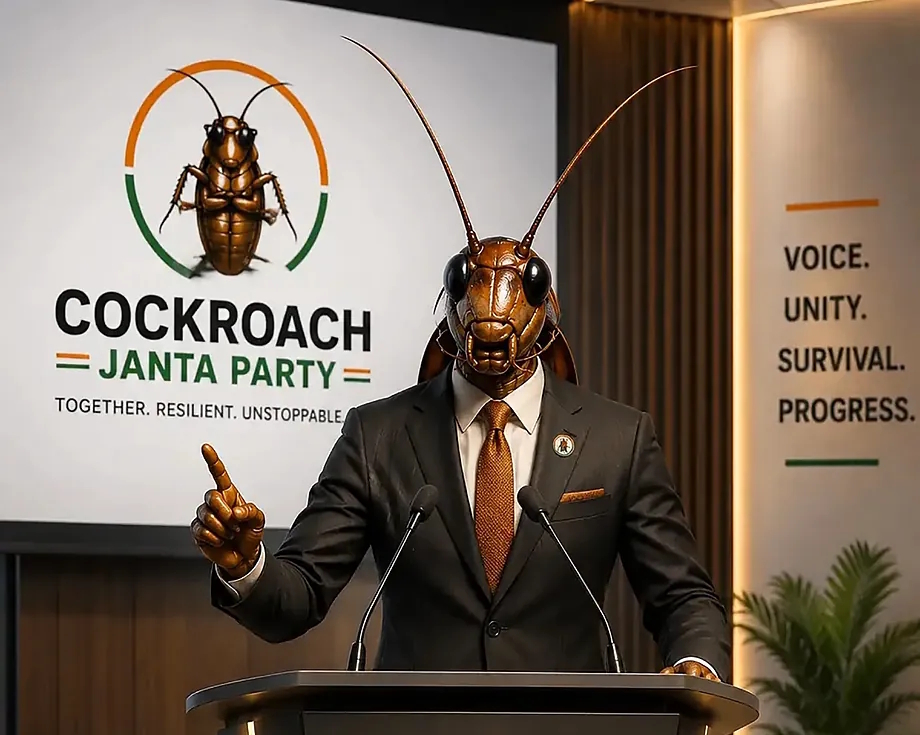
It all started as a joke after an insult towards young Indians came from the highest levels of the judiciary. And as often happens in the era of TikTok and generational disenchantment, the joke ended up becoming a political banner.
When the judge of the Supreme Court of India, Surya Kant, stated this month that there were young people "like cockroaches" who couldn't find jobs and ended up attacking institutions through social media or activism, he probably didn't imagine that he was triggering the birth of one of the strangest political phenomena that have erupted in the world's most populous country.
His words unleashed a digital storm. Then came the response: if the unemployed are cockroaches, then cockroaches can also organize to confront power.
Thus was born the Cockroach Janta Party (CJP), freely translated as the Cockroach People's Party. A satire in the form of a political party, founded by the young Abhijeet Dipke, a student in Boston, communication strategist, and former collaborator of the reformist Aam Aadmi party. What started as a joke ended up, in a matter of days, becoming a community with tens of millions of followers on various social networks, citizen petitions, and a discourse capable of channeling years of accumulated frustration.
In less than a week, the CJP's Instagram account surpassed 15 million followers and later exceeded 20 million, surpassing even the ruling Bharatiya Janata Party (BJP), the party of Prime Minister Narendra Modi and the largest political machinery on the planet in terms of membership (claiming to have around 140 million).
Dipke insists that there was no master strategy behind the viral phenomenon. "None of this was intentional," he stated. According to him, the movement's growth reflects something deeper: unemployed youth, hit by inflation, recurring scandals of public exam leaks, and a growing perception that institutions do not offer social mobility.
India is one of the world's fastest-growing economies and boasts global technological leadership, but millions of graduates remain trapped in unemployment or in informal jobs under terrible conditions. Recent data places youth unemployment among the country's greatest structural challenges.
In that context, the cockroach ceased to be an insult and became a symbol. A resilient insect, capable of surviving in almost any hostile environment. The message was clear: if the system considers a generation a plague, that generation can appropriate the stigma.
Humor, edited with AI, was used as a political weapon: thousands of memes, fake rallies, satirical videos against corruption, campaigns ridiculing politicians. But beneath the irony, real demands emerged: transparency in employment data, educational reforms, and criticism of the deterioration of space for dissent. The movement even pushed campaigns to demand the resignation of the Education Minister following controversies over leaks in civil service exam papers.
The phenomenon has also now revealed something common in this country: state censorship against digital platforms critical of Modi's government. The official CJP account in X became unavailable over the weekend within India following a legal request, although it remained visible from other countries.
Dipke has denounced that the official website has been blocked and claims that both his personal account and profiles linked to the movement have been attacked or hacked. The founder directly accuses the government of acting in a "dictatorial" manner.
Authorities have not provided a public explanation for all the reported blocks. In India, the removal of digital content can be done through orders supported by technology legislation and reasons of national security, a mechanism that digital rights organizations have been questioning for years due to its opacity. The temporary disappearance of accounts and the website's crash sparked new criticism from opposition sectors. Many argue that India, which prides itself as the world's largest democracy, needs spaces for satire and dissent.
Meanwhile, the movement continues to grow. Some international analysts already describe it as the first genuine political rebellion of the Indian Generation Z; others, more cautious, see it as pure digital theater destined to evaporate with the next viral cycle. There are even public figures who have warned against turning an internet trend into a real political project.