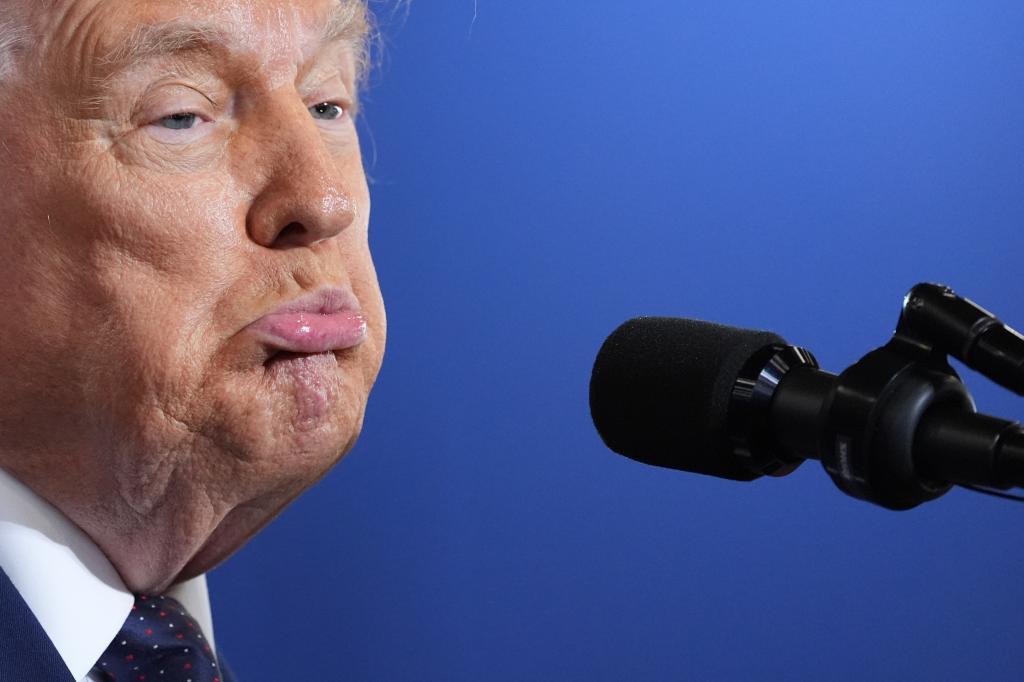
On Sunday, during a teleconference that President Donald Trump held with the main leaders of the Persian Gulf, the Arab and Muslim world, within the framework of the peace negotiations with Iran, the American surprised his interlocutors with an unexpected idea-proposal-request: that all of them immediately join the Abraham Accords, his first-term major diplomatic initiative for their neighbors to normalize relations with Israel. The silence, as reported by media outlets like Axios, was immediate and uncomfortable, to the point that Trump even joked about whether the line had dropped or if there was still someone on the other side.
Hours after the rumors, the White House dispelled any doubts, confirming that the proposal is real, firm. Well, more than a proposal, it's a demand. "Negotiations with the Islamic Republic of Iran are going smoothly! There will only be a great agreement for all or no agreement at all and back to the battlefield stronger than ever, and no one wants that! During my conversations on Saturday with President Mohammed bin Salman Al Saud of Saudi Arabia; Mohammed bin Zayed Al Nahyan of the United Arab Emirates; Emir Tamim bin Hamad bin Khalifa Al Thani, Prime Minister Mohammed bin Abdulrahman bin Jassim bin Jaber Al Thani, and Minister Ali al-Thawadi of Qatar; Field Marshal Syed Asim Munir Ahmed Shah of Pakistan; President Recep Tayyip Erdoan of Turkey; President Abdel Fattah El-Sisi of Egypt; King Abdullah II of Jordan, and King Hamad bin Isa Al Khalifa of Bahrain, I stated that, after all the work done by the United States to try to solve this complex puzzle, it should be mandatory for all these countries, at the very least, to simultaneously sign the Abraham Accords," Trump wrote in a lengthy message on his social media.
The United Arab Emirates and Bahrain are already part of the Accords (along with Morocco, Sudan, and Kazakhstan), Trump's and later the United States' major bet to pacify the Middle East in the last decade. Before the outbreak of the Gaza war in October 2023, following the savage attack by Hamas, there were very advanced negotiations for more countries, especially Saudi Arabia, to join and normalize relations with Israel. But since then, it has been impossible.
During that year, the Biden Administration worked intensively on a major tripartite agreement in which there would be Saudi recognition of Israel in exchange for more U.S. security guarantees for Riyadh and civil nuclear cooperation for the Saudis. Crown Prince Mohammed bin Salman publicly stated in September 2023 that the talks were "getting closer every day." But the Israeli punitive operation in Gaza, as well as the extension of bombings to Syria, Lebanon, Yemen, Iran, etc., dashed any possibility of short-term understanding.
Now Trump, in his usual style, puts it on the table, but also makes it much more difficult. Because it's not an aspiration, but an order. "The mentioned countries are Saudi Arabia, the United Arab Emirates (who are already members!), Qatar, Pakistan, Turkey, Egypt, Jordan, and Bahrain (who are already members!). One or two may have reasons not to do so, and that will be accepted, but the majority should be prepared, willing, and able to make this agreement with Iran a much more historic event than it would otherwise be (...) It should start with the immediate signing of Saudi Arabia and Qatar, and all others should follow their example. If they do not, they should not be part of this Agreement, as it shows ill intent," the American insisted, fond of passive-aggressive tactics in international politics.
In his message, Trump stated something even more bizarre: "after speaking with numerous leaders of the mentioned stature, they have expressed to me that they would be honored, once our Document is signed, for the Islamic Republic of Iran to join the Abraham Accords. That would be something special! This will be the most important agreement that any of these countries, great but always in conflict, will ever sign. Nothing in the past or future will surpass it. Therefore, I strongly request that all countries immediately sign the Abraham Accords and that, if Iran signs its Agreement with me, as President of the United States of America, it would be an honor for them to also be part of this unprecedented global coalition."
The Peace negotiations, in a loop for months, have so many facets that it has been impossible to resolve until now. It's not just about ending bombings, the stockpiles of weapons, the nuclear issue. It also involves much more in the region, like the situation in Lebanon. The first ceasefire proposal almost failed because Israel tried to exclude Lebanon, where it has never stopped bombing. Iran, which has always had a very clear interest in the country, with its proxy Hezbollah, has continuously demanded that any truce be extended to the entire region.
Yair Lapid, leader of the Israeli opposition, strongly criticized the outlined agreement these days, calling it "detrimental to Israel, the region, and the citizens of Iran" and explaining how he believes it would not serve to halt the Iranian nuclear program, allowing the Islamic Republic to eventually find a way to build a bomb.
According to Iranian state media, a delegation of high-ranking officials traveled to Qatar on Monday to advance efforts to end the war. Among them, Iranian Foreign Minister Abbas Araghchi; Parliament President and chief negotiator, Mohammad Bagher Ghalibaf; and Governor of the Central Bank of Iran, Abdolnaser Hemmati, who have been the U.S. counterparts in the only face-to-face round at the highest level to date, in Islamabad.