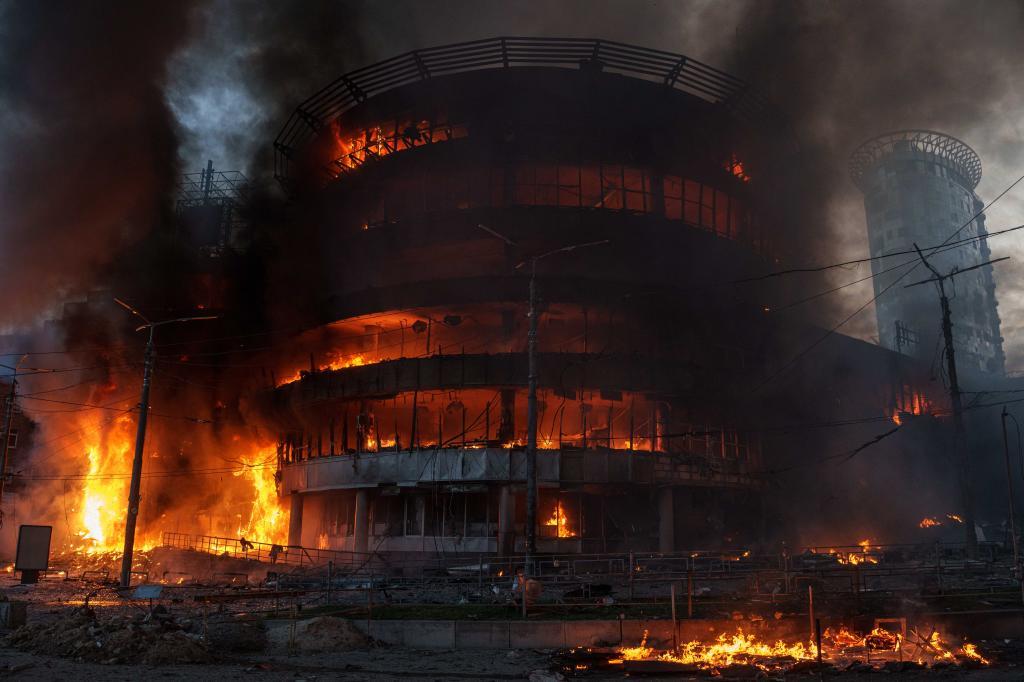
In the worst bombing remembered in Kiev since the Russian invasion began, the Kremlin tried yesterday to send two messages. The first was aimed at what Moscow calls the "centers of power" in Ukraine, that is, the places where decisions are made, such as the government district of the capital, which suffered damage. This attack aimed to soften the negotiating position of the government of Volodymyr Zelensky and punish the Ukrainian population, as it has been doing since 2022.
The second message was for European allies in the form of an intermediate-range ballistic missile, the Oreshnik, a projectile that costs 600 million dollars and has a range of 6,000 kilometers (designed to reach European targets) and can carry six nuclear warheads. In this case, the warheads were not armed, so they fell on community garages in the suburb of Bila Tserkva. This is the third one Russia has launched on Ukraine.
Minutes later, rescue services were searching for survivors, firefighters were extinguishing the fire, and the city's residents were getting ready for work, just like on previous occasions, where the people of Kiev have become accustomed to living with horror and sleepless nights. Throughout Sunday, European governments doubled down on their support for Ukraine and denounced Russian brutality and the senseless path that the Kremlin is taking towards a victory that is slipping further away each day. The two messages that Putin's regime sent achieved the opposite of what they intended, which is not new.
The attack, the largest to date, involved over 600 drones and almost 100 missiles, with an 87% interception rate by the air defense, especially against Shahed drones and their old cruise missiles, although ballistic and hypersonic missiles remain much harder to intercept. The bombing has so far resulted in four deaths and over 100 injuries. How is it possible that an attack of this magnitude only resulted in four fatalities? The intelligence services of several European countries and the US warned Kiev about the Russian preparations for a "potential massive bombing," allowing the population to prepare in advance and seek shelter in the network of shelters that Mayor Vitali Klitschko has extended throughout the capital. "Putin can't even pronounce the word 'victory'," said President Zelensky, but "he continues to hit residential buildings with his missiles."
One of the most well-known cafes in the Shevchenko district was hit by missile debris. Its windows shattered, and the tables and chairs turned into a pile of dust and splinters. Despite the destruction, a waiter continued to serve coffee through a window as usual, as the coffee machine was still working. A sign was hung at the entrance: "Open, as usual." Hundreds of people were waiting in line.
Among the Kremlin's targets was the Chernobyl museum in the Podil district, which the missiles partially destroyed. It is curious that Moscow, responsible for the atomic accident in the former USSR, is now focusing on a museum that aimed to honor those who sacrificed their lives to mitigate the effects of the disaster they caused.
The bombing, although more severe than previous ones, actually reflects the same frustration since the early weeks of 2022: the impossibility for Z troopsto even achieve their secondary objectives (taking over all of Donbas), as they have already given up on conquering Kiev or replacing Zelensky with a Kremlin-friendly president like Viktor Yanukovych, which is what Putin was aiming for back in February 2022.
The year 2026 has been particularly damaging to Russian forces, both far from the front lines and nearby. On one hand, Ukraine's long-range attack capabilities have multiplied. Their bombings on refineries, oil terminals, and air bases have become common. Now, thanks to the introduction of a new drone called the Hornet, of American origin, Ukraine is successfully targeting all Russian logistics in the form of trucks and trains about 100 kilometers from the front lines with deadly precision. On the battlefield, Russian casualties have exceeded 35,000 each month, while volunteer recruitment no longer reaches those numbers, making it impossible to replace so many fallen soldiers without resorting to forced mobilization, something the Kremlin is trying to avoid at all costs.
Additionally, March marked the first month since 2023 in which Russia lost ground to Ukraine, and April continues the same trend. Ukrainian forces have taken advantage of the chaotic Russian supply situation to launch a local offensive south of Zaporizhia, recapturing the key city of Stepnohirsk and now threatening the vital Kamianske, which took the Russians two years to conquer. In the Donbas region, the same can be said for the efforts around Liman, which has changed hands several times. Now, a Ukrainian counterattack threatens to encircle the Russian forces trying to take the city, in an operation reminiscent of the Russian failure in Kupiansk, in the Kharkiv region, where Russian soldiers who managed to enter the city were besieged, cut off from communications, water, food, and ammunition.
Even Russian military bloggers, the only ones authorized by Moscow to access the front lines, have changed their tone. From frustration, they have turned to irony.