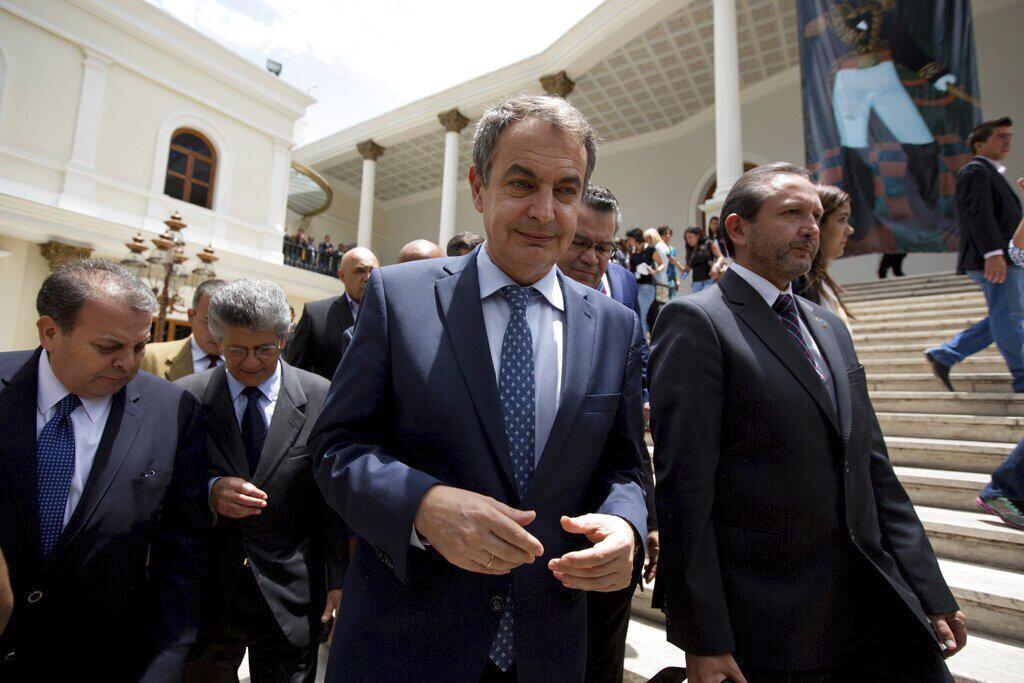
In mid-2016, a decade before Judge José Luis Calama from the National Court accused José Luis Rodríguez Zapatero of alleged influence peddling and acting as an intermediary within an international network linked to the Venezuelan oil business, the former Spanish president was already playing ping-pong in southern China.
The scene took place in Shenzhen, the city transformed into a symbol of Chinese technological capitalism. There, Zapatero visited the headquarters of Tianjiu Sharing Group - internationally known as Tojoy - a company dedicated to connecting entrepreneurs with major investors. The socialist took off his jacket to play a match with Lu Junqing, the company's founder and a veteran network builder of influence. Since the 1990s, Lu had been cultivating relationships with former prime ministers and Western political figures useful for the internationalization of Chinese companies.
That meeting was more than just a courtesy gesture. The former Spanish president then joined the company as an external advisor. In posts shared on WeChat - similar to WhatsApp - Tojoy explained that Zapatero would help open the Spanish market to the group. The images showed smiles, a ping-pong match, and references to future golf sessions to celebrate the "cooperation agreement."
That was one of the first visible episodes of a relationship that would soon expand to many companies and organizations close to the Chinese political apparatus. A couple of years later, Zapatero and Lu coincided at a dinner with other senior executives at the luxurious Kuntai Royal Hotel in Beijing. According to business sources, at that event, other Chinese companies showed interest in the consulting and strategic advisory services increasingly openly offered by the Spaniard, including the Xiamen Gangwei group, a conglomerate with interests in investment and international trade.
After leaving La Moncloa in 2011, Rodríguez Zapatero began to be sought after in China as a regular speaker. During his years in government, he had cultivated a close relationship with Beijing. Within the Chinese Communist Party (CCP), his advocacy in Europe to lift the arms embargo imposed on China after the 1989 Tiananmen massacre was particularly valued. Other gestures were also well received: the withdrawal of Spanish troops from Iraq or his opposition to the war promoted by Washington.
Starting in 2016, Zapatero began to frequently appear at forums organized by entities used by Beijing to expand its global influence. Universities, business meetings, and conferences became a regular part of his agenda in China.
Spanish diplomats stationed in Beijing then observed two distinct profiles of the former president. One was Zapatero acting as an informal intermediary between Spain and China. The other was the private advisor working for companies closely linked to the political structures of the Asian giant.
In 2019, Chinese media reported Zapatero's participation in a business forum accompanied by Daniel Romero-Abreu, founder of Thinking Heads, a Spanish company specializing in corporate reputation, institutional relations, and representation of public figures. They met with businessmen and leaders linked to the Chinese political apparatus, including Liu Shiying, founder of the President Reading Club, an influence network linked to the CCP that connects senior executives and political figures. Some sources claim that Rodríguez Zapatero also met with Li Su, president of Hejun Consulting, one of the largest private consulting firms in the country, which later commissioned the former president for reports on Europe and Latin America.
The relationship with Romero-Abreu grew over the years to the point where, in order to open more doors in China, the former president encouraged the entrepreneur to establish the Gate Center, the pro-Chinese think tank whose advisory board is chaired by Zapatero himself. In the judicial ruling of the Plus Ultra case, both the Gate Center and the Thinking Heads group are mentioned in relation to a series of financial transfers. According to the document, Romero-Abreu allegedly acted as a financial front for the former president, channeling over a million euros through his companies to Zapatero and his family circle from 2020 to 2025.
The ruling describes Gate Center as an organization "linked to José Luis Rodríguez Zapatero and Daniel Romero-Abreu Kaup" that sent €352,980 to the former president and another €171,727 to Whathefav SL, the company managed by his daughters, Laura and Alba Rodríguez Espinosa. According to data from the National Fraud Investigation Office cited in the resolution, Thinking Heads also made 37 direct transfers to Zapatero totaling €649,552, plus two from Thinking Heads Americas LLC - another of Romero-Abreu's companies - for €31,766. The group also paid €12,297 to Whathefav. Thinking Heads maintains that all these payments were for "consulting services, advice, conferences, and editorial work" provided since 2014.
The connections of Gate Center once again lead to China. Zhang Fengyi, an entrepreneur and co-founder of BG Capital, a firm focused on managing private funds primarily in Chinese bonds, is listed as responsible for Asia at the think tank. Sources claim that Zapatero provided advisory services to this company. Photos released by BG Capital show the former president visiting the group's headquarters in Beijing in 2023 accompanied by Zhang. In recent years, Zhang has appeared alongside Zapatero at various business events and diplomatic forums held in China.
Another recurring name is Pan Feng, a former official of the Chinese Ministry of Commerce and director of the China-Europe Center in Shanghai, a platform aimed at connecting European companies with Chinese partners. In May 2024, during a trade fair held in Madrid, Zapatero and Pan announced the creation of the Europe-China Economic Cooperation and Development Council (ECECDC), another organization focused on promoting business links between both markets. Months later, during the official visit of Pedro Sánchez to China, Pan participated in a meeting in Shanghai with several Chinese entrepreneurs, the Spanish president, and Minister José Manuel Albares. Among the attendees were companies that finance the ECECDC, including Huawei. The Ministry of Foreign Affairs clarifies that "Minister Albares has never held a bilateral meeting with that Chinese businessman."
That same year, Zapatero appeared in Beijing with Pan Feng at a meeting with Yin Li, the secretary of the Communist Party in the Chinese capital. The leader had visited Madrid months earlier, where he was received at Ferraz by Zapatero himself and by the then Secretary of Organization of the PSOE, Santos Cerdán. In the meeting in the Chinese capital, the Spanish ex-president was also accompanied by the Spanish ambassador, Marta Betanzos.
In addition to the official photograph of that meeting, there was another group picture from another subsequent forum - a meeting organized by think tanks - showing Rodríguez Zapatero, Pan, Ambassador Marta Betanzos, and some Chinese entrepreneurs close to the former president. One of them was Yan Zhangjian, founder of QLTEK, a Chinese manufacturer specializing in industrial laser machinery. The company later announced Zapatero's addition as an advisor for its international expansion.
Shortly afterwards, Yan travelled to Madrid to hold meetings with Zapatero and Pan Feng. He also met with a delegation from Rhein-Koester Intelligent Technology, a company specialising in the development of smart factories in China and Germany. According to business sources, this company invited Zapatero to visit its facilities in Qingdao in June last year with a view to exploring opportunities in Spain. A statement from the company summarised the meeting as follows: "Zapatero expressed his hopes of establishing a long-term strategic partnership." Just another link in a network of relationships woven over the years by the accused Zapatero.
Sánchez visits the Pope and sidesteps the scandal
Pedro Sánchez will sidestep the onslaught the opposition is already preparing over the Zapatero case for Wednesday's government question time in Parliament, with a meeting with the Pope as a prelude to the Pontiff's visit to Spain.