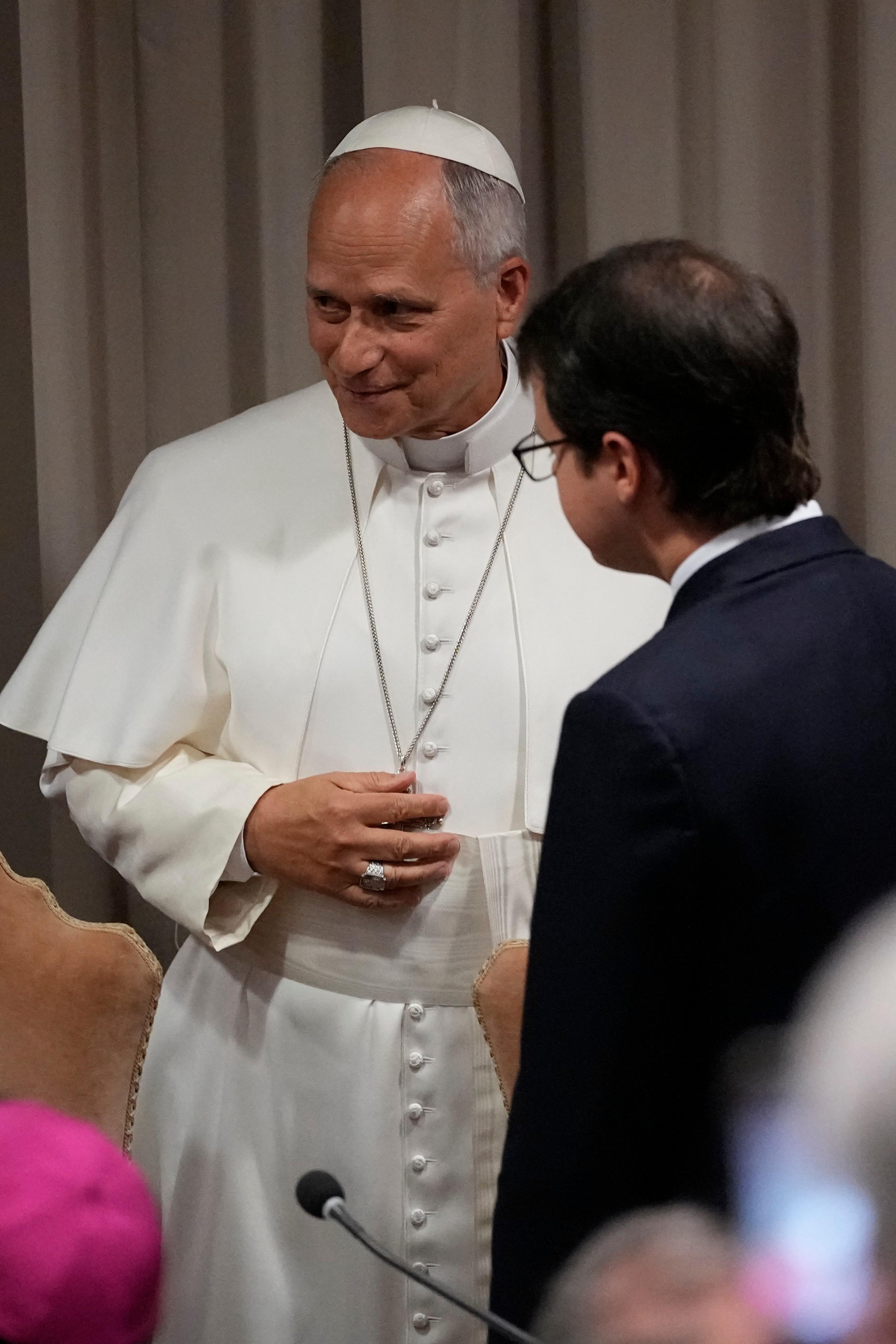
If anyone managed to steal some spotlight from Pope Leon XIV during the publication of his first papal encyclical, it was Christopher Olah. The previously almost unknown co-founder of Anthropic had a prominent role in the presentation of the papal text, both for the content of his speech, in line with the words of the Supreme Pontiff, and for his mere presence at the event.
Olah was the sole representative of the companies that, as the Pope himself names in his text, "monopolize knowledge, experience, data, and decision-making capacity" in the world of AI, those that "define the conditions for access, visibility, interaction methods," and "even the economic opportunities" derived from that technology, in the words of Pope Leon XIV, who points out that this is a power that has nothing above it.
Having Anthropic among them is a success for the company's communication strategy and the defense of the humanistic values it advocates. It is worth noting that other tech giants like Microsoft or IBM have signed the ethical codes promoted by the Church, but the startup has not.
Both Olah and his more public co-founder Dario Amodei, CEO of Anthropic, were former employees of OpenAI who founded the new company when they felt that the company they worked for was deviating from its original mission and neglecting technology safety.
Although conceived as a company from the beginning, its goal has been to uphold the flag under which OpenAI was created and lead the creation of a positive AI for humanity under control.
Therefore, if a company had to stand alongside the Pope in the presentation of Magnifica Humanitas (the title of the encyclical), all signs pointed to the company founded by Claude.
Olah's intervention did not disappoint and undoubtedly would not have come from a director of OpenAI, Amazon, or certainly SpaceX. The executive, leading the firm's interoperability team, had previously participated in other meetings with representatives of faith on behalf of his company. Last March, he hosted a delegation of Protestant and Catholic leaders at the company's offices to discuss the relationship between technology and religion and how Claude could help the faithful in their spiritual development, as reported by The Washington Post.
Neither the tech company nor the Church overlooks the role that the Church can play as a prescriber, nor the role that AI can play in a digital environment that is enabling new ways of interacting with religion and removing physical barriers.
Thus, Olah's speech was not groundbreaking compared to the Pope's, and he joined the call for greater technological regulation, with a rebuke to governments for their inaction included. "We need more sectors of the world (...) to do what His Holiness has done here: take this seriously, observe closely, and help guide events in a better direction," emphasized the executive, referring to the political class.
In his speech, he pointed out the existence of "perverse" incentives for laboratories such as the need to stay ahead or generate commercial returns, or even the ego of being the best scientists, which can cloud the vision of what is right or wrong in the world of AI.
"No matter how sincerely any of us try to do the right thing - and I believe many of us do - we will always be influenced by those incentives," Olah stressed.
The co-founder of Anthropic's words came less than a week after Donald Trump refused to sign AI regulation out of fear that the United States would fall behind in the race to lead this technology with China. Anthropic is currently in conflict with the U.S. government, as it revoked access to its technology considering it was not ready for use in autonomous weapons and banned its use in mass surveillance operations. The conflict has escalated to legal action, with the U.S. government threatening to exclude the company from all federal contracts.
Anthropic's footprint in the encyclical
This is precisely one of the crucial topics of Anthropic that has left a mark on the encyclical, as the Pope also takes a stand against these autonomous weapons and the massive use of AI in conflicts. "The development and use of AI in warfare must be carried out under the strictest ethical constraints (...) to prevent an arms race," notes Leon XIV.
Furthermore, the encyclical contains several mentions of the need for AI to be under the control of powers above companies and to be developed with strict controls to ensure that its advancement brings progress and improvements for humanity, not new dangers.
In those paragraphs, it is impossible not to see an allusion to the situation with Mythos, Anthropic's powerful cybersecurity model, so potent that the company decided not to release it following numerous requests from companies out of fear that it could be used for cyberattacks.
Last Friday, the company revealed that the 50 partners who had access to the program uncovered over 10,000 security flaws in just a few weeks, thousands of them critical. Anthropic used the model to analyze open-source software and found another 5,000 security vulnerabilities in foundational programs for millions of companies. Nevertheless, the company still does not allow European companies access to the model.
In economic terms, the Supreme Pontiff is particularly concerned about the job destruction that AI will bring, another aspect that Anthropic has extensively studied and vehemently warned about the future impact on job elimination, a concern shared by the Pope and for which neither party finds a solution in their texts, beyond the need to adapt workers' skills to the new era.