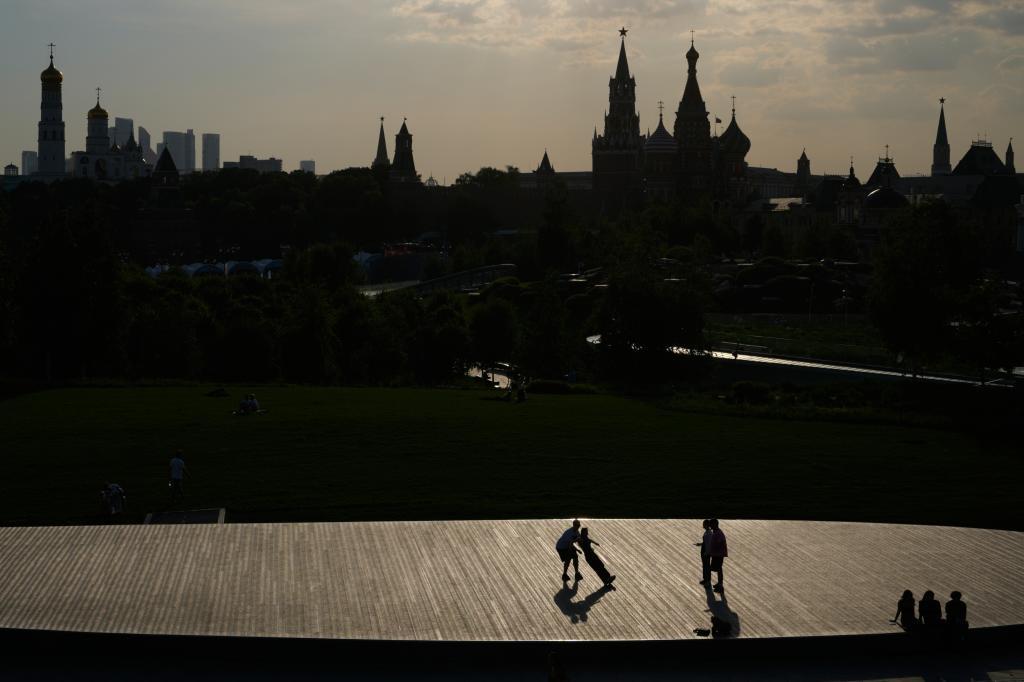
In one of the most widely spread memes during the fall of 2022, a collaborator of the Russian propagandist Vladimir Solovyov's program imitated the sound of an air raid siren live, like the ones that had been sounding in Kiev for months. The rest of the guests laughed in front of the cameras, including the host himself, for whom the bombing of Ukrainian cities seemed like a subject of mockery. These days, many Ukrainians have revisited that video. Only now, more than four years after the start of the so-called Special Military Operation, the city under attack is Moscow.
In reality, the air raid sirens still do not sound in the Russian capital due to a political decision. Although the feared Ukrainian drones are already flying over Moscow's sky, the Kremlin avoids activating the alarms to prevent increasing anxiety among Muscovites who have lived through war as something distant for years. Following the attack on the past 10th, in which several drones managed to surpass the air defenses and reach targets in the capital, social media was filled with videos of citizens panicking at the explosions and the buzzing of these new technological terrors.
The sanctuary of Moscow has been the latest to be exposed to Ukraine's reach. Over the past year, long-range weapons manufactured by Kiev have destroyed oil loading terminals, warships, refineries, and factories linked to the Russian military industry. However, the capital seemed impregnable until this spring. In reality, since the strange flight of Mathias Rust, that German pilot who landed his small plane in the middle of Red Square in 1987 to the surprise of the Soviet authorities, the skies of the Russian capital had been shielded by several layers of anti-aircraft defenses and radars.
For years, Vladimir Putin's regime deployed a complex multi-layered anti-aircraft ring to keep Moscow away from war. But that strategy is starting to show cracks, just like the battered Russian economy. For many analysts and military historians, Russia maintains a clear strategic advantage over its adversaries: its immense territory, practically impossible to invade in its entirety. However, that same vastness also represents a weakness.
The country is so vast that it is impossible to protect all its strategic targets and close every possible avenue of attack. According to open-source analysts, Moscow and its surroundings have around 130 anti-aircraft defense positions. The core of the system consists of about a hundred Pantsir-S1 systems, several Tor units, and about two dozen S-300 and S-400 batteries.
What has changed for 16 drones to penetrate that defensive ring? The key is not in the sophistication of each device, but in the volume. The dynamics respond to the attrition strategy that defines this phase of the war: saturating and exhausting enemy defenses through massive waves of drones. In other words, launching so many devices that the anti-aircraft batteries, no matter how numerous, cannot intercept them all.
The Security Service of Ukraine (SBU) detailed that the targets of the May 17 attack were the Gazprom-operated Moscow refinery, the crude oil pumping plants of Sonechnogorsk and Volodarskoye, and the Angstrem semiconductor factory. These are not random targets: all are part of the energy and industrial infrastructure that sustains the Kremlin's war effort.
Additionally, the Pantsir-S1, specifically designed to detect and destroy low-flying drones, has become one of Ukraine's main targets. In February 2026, the SBU's Alpha unit claimed to have neutralized approximately half of Russia's operational Pantsir batteries, with an estimated cost of between 15 and 20 million dollars per system. This would explain Ukraine's growing ability to penetrate Moscow's airspace and the daily increase in the number of drones reaching the region.
"Moscow will no longer be able to sleep. The enemy built a wall composed of multiple anti-aircraft defense elements... we had to open a door to cross it," stated Robert Brovdi, known as Madyar, commander of Ukraine's Unmanned Systems Forces. There is so much concern in the Kremlin that they have banned flights up to 5,100 meters, which will come into effect in July, affecting light aviation, small business jets, and other civilian flights.
The saturation strategy is not new. Russia has used it throughout the war, and Ukraine has ended up copying it. But to do so, it has needed to massively increase drone production. One of Putin's declared objectives at the start of the invasion was the "demilitarization" of Ukraine. The reality, more than four years later, is that the invaded country's arms industry has become one of the most advanced and dynamic in the world. Several European countries, and even the United States, are already observing and testing systems developed by Kiev to incorporate them into their own armies.
The highlight of this process is the Antonov AN-196 Liutyi, whose name means "fierce" or "furious" in Ukrainian. This drone, conceived as a local response to the Iranian Shahed-136 -massively used by Russia in Ukraine and by Tehran against targets in the Middle East-, was designed based on the experience gained with the Turkish Bayraktar drones, protagonists of the first months of the invasion. The Liutyi can carry up to 75 kilograms of explosives over 1,000 kilometers, although in a few months its range would have been extended to 2,000 kilometers. Countries like Germany, Sweden, and Lithuania finance part of its production, allowing Kiev to launch swarms of hundreds of drones against Russian defenses.
"There will be a deliberate psychological effect on the Russian leadership and, potentially, on the population," stated Justin Bronk, senior air power and technology researcher at the Royal United Services Institute in London. The attacks on the capital will make Muscovites increasingly feel like they are living in a war, which may lead them to "wonder why they are not being protected."
Similarly, Nigel Gould-Davies, former British ambassador to Belarus and analyst at the International Institute for Strategic Studies, believes that "the fact that Ukraine reminds Moscow's population that it remains vulnerable will likely intensify the existing sense of insecurity." Now, while Russia hits Kiev almost every night with long-distance attacks, Ukraine has also begun to strike back at the heart of Russian power.
"Ukrainian forces are surpassing Russian forces in innovation both in military technologies and in the application of these new technologies in effective operational concepts that can help Ukrainian forces break free from positional warfare," writes George Barros, director of the Institute for the Study of War (ISW).
A survey published this week in Russia reveals that, for the first time since the start of the invasion in 2022, citizens are more concerned about attacks on Russian territory than about the situation on the front lines. The percentage of respondents who claim to perceive anxiety among people in their surroundings has risen to 50%, four points above the previous maximum, recorded in August 2024 after the Ukrainian incursion in the Kursk region. Additionally, it is worth noting that these data come from a foundation controlled by the Kremlin.