A few days are left for the pope of Trump to visit Madrid this weekend, and social media is buzzing with insults and warnings about the arrival of the far-right. Franklin Graham, a Baptist pastor, son of Billy Graham, one of the most prominent and respected religious figures of the 20th century, stirs controversies wherever he goes, yet fills stadiums with 30,000 people like in Argentina with Milei. He has defined homosexuality as an "abomination" and inclusive education as "filthy garbage"; publicly pressured domestic violence victim Naghmeh Panavi to return to her husband and defended a US Supreme Court justice accused of sexual assault. He has led invocations at both presidential inaugurations. He has shown himself as a vehement supporter of a president whose moral character has room for improvement, excusing him for sharing his image on social media dressed as Jesus Christ, and stating that "he has been raised by God" and "it is important that we do everything possible to try to get him reelected."
On May 30 and 31, he will gather thousands of evangelical people at the Vistalegre Palace in Madrid for the spectacular Festival of Hope, where he travels to parts of the world that do not attempt to ban him (as attempted by locations in the UK and Germany), amid the enthusiasm of hundreds of evangelical churches, the official neutrality of FEREDE (Federation of Evangelical Religious Entities), and the opposition of many scandalized pastors and Protestant representatives by Graham's methods and message.
"I feel ashamed because it represents an alliance of the Church with power, particularly with economic power, which has nothing to do with what we consider the Kingdom of Heaven to be, which is about Justice, diversity, defending human rights. It adopts a feudal system of thought that not only goes against homosexuals but also against women's freedom and reinforces a heteropatriarchal model contrary to the Bible," says Alfredo Abad, president of the Permanent Commission of the Evangelical Church (IE) to Crónica. "Populism has a religious aspect and is a strategic positioning with a very important role not only in Trump's rise and maintenance (who faces accusations of pedophilia with Epstein's papers, of dishonest enrichment, and has ended with the division of powers), but also in other places, as happened with Bolsonaro in Brazil or in other countries in Latin America," he adds.
"He is using the shield of religious freedom to deceive us all and hijack my evangelical faith for his benefit, the benefit of a billionaire whose accounts are opaque and who promotes the interests of the American far-right," vehemently describes Kenny Clewett, former pastor, master in Theology from the Trinity Evangelical Divinity School in Chicago, who, in search of purity, usually attends a branch of the Church of Philadelphia, mostly followed by gypsies "who take care of people's needs." Clewett adds: "He says he is pro-life, but does not criticize the wars in which the US is killing children. He says he is pro-family and has never cared about the migrant families that Trump separates, and he says he is pro-morality, and at no time has he mentioned the moral atrocities that the leaders he represents are involved in."
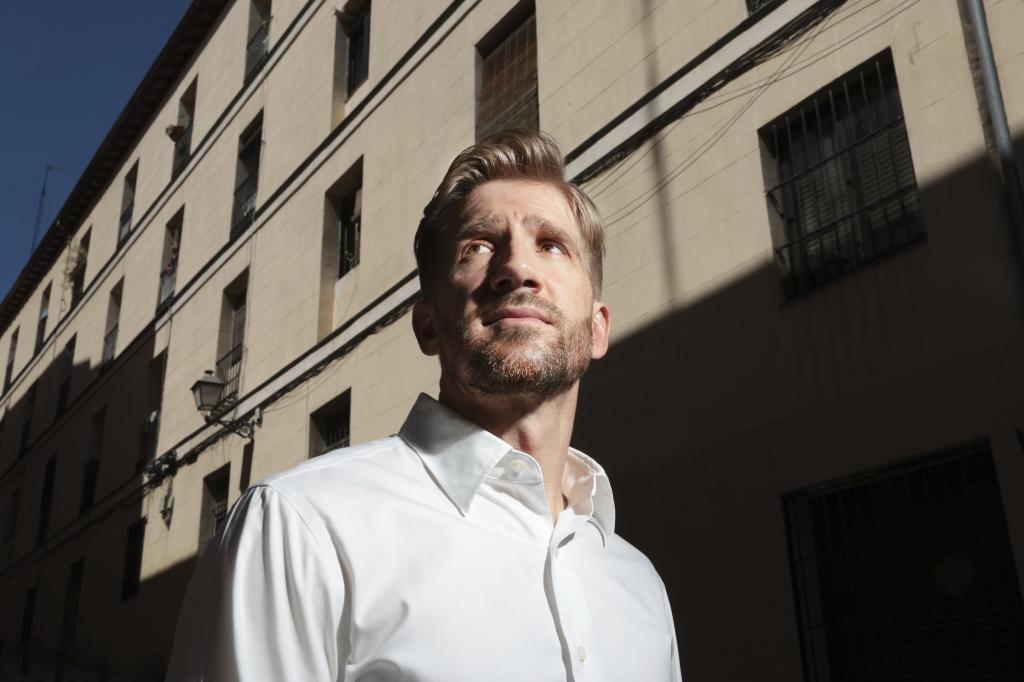
Pastor Franklin Graham, president of the Billy Graham Evangelistic Association, during the presentation of the Festival that will take place next weekend in Madrid.
His opinions are echoed with varying intensity by more dissatisfied evangelicals. "This event falls within freedom of expression and freedom of worship, but I do not agree with the form or the substance," says Marta López Ballalta, pastor of the IE in Barcelona and its general secretary. "I do not believe in large mass calls, but in serving society where God has placed us. Our church is not proselytizing and does not hold large events for conversions. Also, I am afraid that he will use the Madrid platform as a loudspeaker for positions that go against the Gospel." "Complex problems are not solved with slogans but with work," she adds, "humans, in distressing situations, need something to hold on to, so to those who want to attend Graham's event, I say: enjoy, but be careful with the populist message."
Damaris Ruiz, who served for 10 years as a representative in FEREDE and now holds positions in the Reformed Protestant Church and the Bible Society, slides along a similar line. "These types of pastors use a large number of resources, including people, for suggestion. These are events that harm us, that deviate from the message of Jesus preaching love for others when they justify leaders who need evangelicals to remain in power."
ON THE RISE
This is not the first time that Franklin Graham has organized a religious event in Spanish territory. He also did so in Barcelona in 2015. The difference is that currently, in Spain, the number of people professing the evangelical religion has almost exponentially increased for various reasons. Because the number of migrants from South America has increased (where there are countries with 30% of citizens with this vocation); because, according to FEREDE, evangelical churches are doing their job well and, according to Antonio Montañés, professor of Anthropology at the Complutense University, "due to the gap that Catholicism —which needs to reconfigure itself— has left in Spain for some time."
In short, according to data from the Observatory of Religious Pluralism, in 1998, only 0.2% identified with this confession, and by 2018, the figure reached 2%. Currently, the number of believers is not estimated, but the number of evangelical places of worship amounts to 4,770, below mosques but above other minority religions. And events with 35,000 people have been convened that until recently would have been inconceivable, like the one recently led by footballer Dani Alves, seeking redemption.
The organization that has prepared Graham's visit to Madrid is called Decision, founded by Juan Blake, an American who passed away in 2018 and worked with the Billy Graham Evangelical Association of Pastor Franklin's father (BGEA), who in the US is considered a "national hero" of the evangelical religion. He is a man who lectured to 2.2 billion people worldwide. He had a close relationship with 13 US presidents, both Republicans and Democrats, from Truman to Barack Obama, and his sympathies, far from his son's political preferences, were Democratic.
After Blake's passing, his son-in-law, Pastor José Pablo Sánchez, popular for his appearances on TVE, took over Decision, now led by his own son-in-law, David de Lago. About 900 churches and several organizations like Comima or the Assemblies of God fraternity requested Pastor Graham's visit from BGEA, but Decision provided the venues and organizational resources. Pastor Sánchez mentions that Graham's humanitarian work earned him an award from Zelenski. "To give you an idea, Samaritan's Purse, his NGO, invested 1 billion in humanitarian aid in 2024. Father Ángel, with Mensajeros de la Paz, allocated 7.5 million euros."
—Do you agree with the political ideology he promotes?
—If I only had to collaborate with people who think like me, I wouldn't collaborate with anyone. Within the evangelical field, there is a great diversity of political positions, and we believe there is a greater good in helping people who are suffering to have hope.
—The money comes 100% from private donations. There is no public funding like in the case of the Pope, which in 2011 cost Catholics and non-Catholics 23 million euros.
FEREDE, which serves as an interlocutor with the government and receives public funds, is officially keeping its distance because it wants to make its political neutrality clear to its members of diverse ideologies, at a time when both the PP and Vox have reached out to it in an attempt to gain electoral advantage. "This is a private initiative in which FEREDE has played no role. We consider it essential to clarify that evangelical churches in this country are autonomous and have no vertical hierarchical structures or popes," and one of their defining characteristics is "the firm defense of the state's secular nature and the separation of the religious and civil spheres."
APOLOGIZING
In response to questions from Crónica, FEREDE notes that, in the case of Pastor Yadira Maestre, who preached at an election rally for President Ayuso, she was reprimanded and had to apologize "for the harm and confusion caused by her participation."
However, it might be worth noting that Pastor Sánchez, honorary president of Decisión, serves as coordinator of Puedes, an organization affiliated with FEREDE, and that Federation leaders—such as its executive secretary, Carolina Bueno, and its president, Esteban Muñoz—have attended events announcing Graham's visit, as reported in the Federation's official publication, and have congratulated the organization.
"FEREDE should distance itself more clearly from this type of event," demands Alfredo Abad. Kenny denounces bluntly: "After all, they are all Spanish, white, and have held power for years. There are neither Roma nor Latinos in their governing bodies despite them being the majority of the faithful."
THE WAVES
It is truly difficult to explain the nuances of the evangelical world with precision. There are many different streams within this Protestant faith, which has been present in Spain since the 19th century and whose traditional representatives recall their struggle against Francoism. From Baptists to Pentecostals. And within each stream, there are different interpretations. Their pastors do not need to be ordained because they believe in the "universal priesthood of believers"; their structure is horizontal. However, with globalization, their world has been shaken by the arrival of the controversial neo-Pentecostals. Millionaire apostles who mobilize millions of people, interests, and money—not always of clear origin or destination—and advocate Prosperity Theology, according to which the relationship with God is transactional: the more one gives financially—evangelists give a tenth of their salary to their church—the greater the material blessing. A paradoxical concept in a world that originated in the refusal to pay for papal bulls in exchange for divine favors.
According to Professor Montañés, representatives of this movement include Guillermo Maldonado in the U.S., Cash Luna in Guatemala, and Edir Macedo in Brazil, all of whom have branches in Spain (he attributes the Maldonado movement to Yadira Maestre). Professor Montañés warns of the inevitability of this movement. "I categorize them as waves—moments when there is a very significant surge that slightly changes the dynamics of Christianity. From 2000 to 2010 was the era of Pentecostalism, and from 2020 to 2025 is the era of Neo-Pentecostalism. And this wave surpasses all the others," he says.
FEREDE and Decisión attribute the fact that some people classify Graham—who, like Martin Luther King, comes from a Baptist background—as part of the neo-Pentecostal movement to a profound lack of understanding of the evangelical faith. However, there are experts who, while clarifying that "he is by no means neo-Pentecostal," detect, at least in his stage presence, neo-Pentecostal overtones with which they disagree.
Probably, all these clarifications matter little because they are technicalities that cannot withstand the enthusiasm for experiencing the arrival of a star of the faith. The Vistalegre Palace will be packed to the brim.