The first thing that catches the eye when entering the Communist Party neighborhood committee building are not photographs of leaders or political slogans. They are two framed boards hanging on a dark wood wall. They seem like administrative records, but they contain a different kind of statistics. On the first board, written in black brush strokes, are the 11 living neighbors who have surpassed 100 years. The oldest is 105.
The second panel, the most numerous, written in red ink, lists the nonagenarians. Born in 1931, 1933, or 1935; people who survived the Japanese invasion as children, the famines of the Great Leap Forward, Mao Zedong's Cultural Revolution, and then witnessed the rise of modern China.
Another surprising detail when looking at the boards is that all the elderly share the same surname: Shentu. We are in Shen'ao, a small village hidden among the hills of China's Zhejiang province that now promotes itself as one of the places with the highest concentration of long-lived elderly in the giant Asian country.
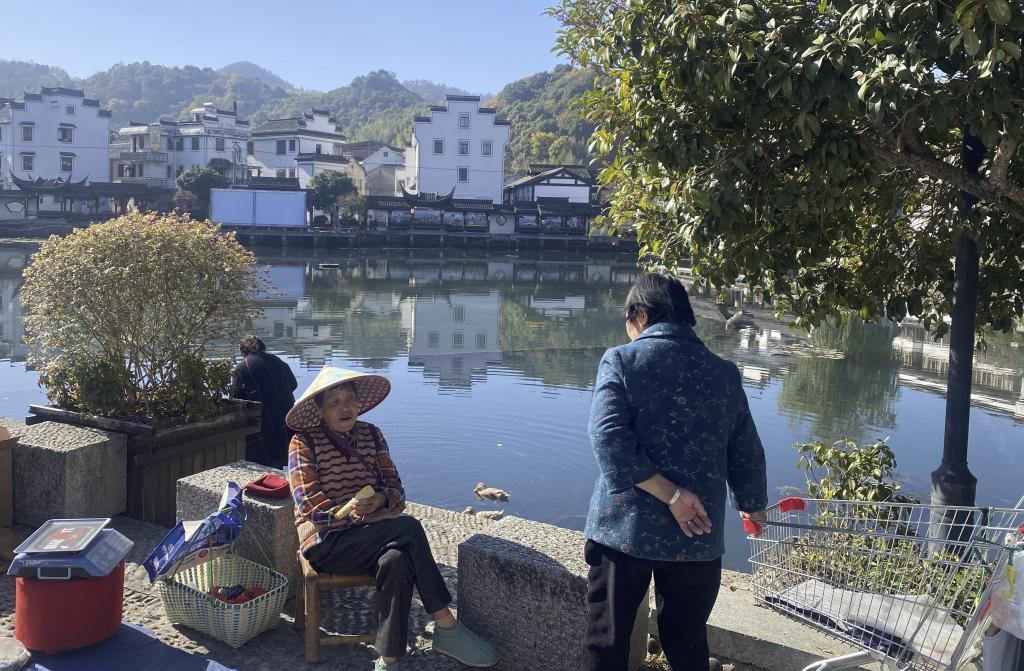
Mid-morning, a group of elderly women sell fruits and vegetables by the pond that marks the entrance to the village. On a cobblestone street surrounded by wooden houses, an elderly man with a red cap slowly sweeps the door of his home. Two alleys down, an elderly woman waters chrysanthemum pots leaning on a broom. In a traditional courtyard, next to an altar dedicated to past generations, another neighbor walks in circles.
Shen'ao is a demographic rarity: a concentration of very long-lived elderly belonging to the same lineage, the Shentu. It is a surname composed of two characters - something rare in China - whose descendants have been settled in this corner crossed by underground channels and stone alleys for centuries.
"There are hardly any young people living here", comments Shentu Taolin, a 93-year-old neighbor who approaches with curiosity upon seeing a foreigner sitting in front of a bubble tea stand, the drink that obsesses millions of young Chinese.
The charm of this village, where just over a thousand people live, has attracted many domestic tourists in recent years. This has led to the opening of some businesses, such as a couple of hotels, a café, and small shops for visitors from big cities.
But many doors remain closed all year round. Their owners emigrated decades ago to work in nearby cities like Hangzhou or Shanghai. "I think the youngest people living here are the three police officers assigned to the village, who take turns," comments a woman, also surnamed Shentu.
In the main square, four retirees play mahjong, a traditional tabletop game. In the side streets, the ancient ancestral halls of the Shentu appear: large wooden buildings where births, marriages, and deaths were recorded for centuries. Now those relics tell a different story: that of the accelerated aging of a China that, after four decades obsessed with growth, faces the challenge of growing older.
The Asian superpower is going through a worrying demographic crisis. Births are at historic lows. For the first time since statistical records exist, China, home to a sixth of the world's population, has more people over 65 than children. The old social contract that has underpinned the country's political stability is beginning to crack. Projections suggest that by 2050, almost a third of the population will be over 65.
Records of the elderly with the surname Shentu.Lucas de la Cal
The latest official survey also revealed that the working-age population is decreasing: people aged 15 to 59 represent 61.89% of the total population, compared to 67.33% a decade ago. The size of families is also plummeting, with an average of 2.52 people per household compared to 3.10 ten years ago.
Last year, the number of registered births dropped to 7.92 million, that is, 5.63 per 1,000 inhabitants, a 17% decrease from 2024.
The government has been trying to reverse the trend for some time. It has relaxed the one-child policy, allowed up to three children per couple, and increased economic incentives: subsidies, free childbirth and in vitro fertilization treatments, or expanding national health insurance and parental leave. Nothing seems to work in a country where the average cost of raising a child to 18 years old, according to official studies, is 538,000 yuan (around 70,000 euros), more than 6.3 times its per capita GDP.
"When I was a child, 15 people lived in this house," recalls another 89-year-old Shentu in Shen'ao. "Now only I remain. My children and grandchildren work in Hangzhou and only come on holidays." Sitting on a tiny stool next to a door, a widow who is nearing 100 joins the conversation
-What is the secret to living so long?
-Eat little and worry less.
The answer could serve as a tourist slogan. But behind it lies a more uncomfortable reality: China is learning to live with a society where there will be more and more elderly people and fewer people to care for them.
As evening falls, the village gains some movement. Several elderly people walk along a street built over ancient water channels. They converse. They stop. They resume walking. On a peeling wall, someone painted a red character long ago that means happiness.