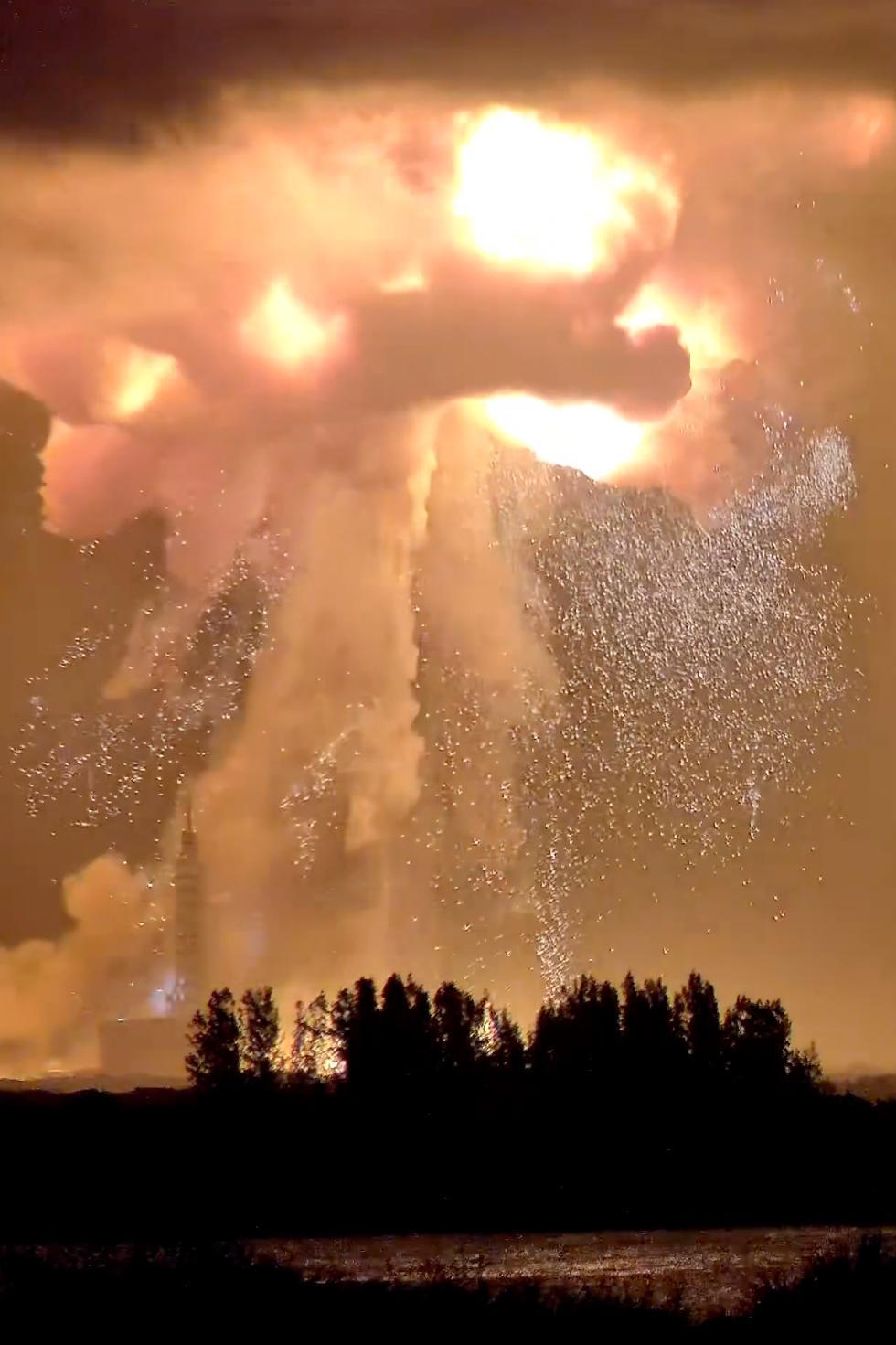
A gigantic fireball illuminated the sky of Florida last night for a few minutes when a New Glenn, one of the star rockets of Blue Origin, Jeff Bezos' company, exploded during a test at Cape Canaveral. A spectacular accident, visually devastating, captured by cameras following the launch preparations and by dozens of neighbors and space enthusiasts, as the shockwave was even felt in distant areas along the coast. This incident jeopardizes NASA's schedule for sending humans back to the Moon.
The company later confirmed that it had experienced an "anomaly" during one of the so-called static tests around 9:00 p.m. local time (03:00 in Spain), but despite the fierce fire, there were no casualties. "All personnel are safe and sound. It is too early to know the cause, but we are already working to find it. A very tough day, but we will rebuild what needs to be rebuilt and fly again. It's worth it," reacted quickly the billionaire in a message on his social media. "I'm sorry to see this, I hope you recover soon," Elon Musk, his great rival and one of those who knows best the feeling of seeing a rocket explode during test phases, also responded immediately.
The test last night aimed to ignite the seven engines of the propulsion stage while keeping the rocket anchored to the launch platform. The images show how after ignition, the flames get out of control, climbing up the sides of the rocket and immediately causing a massive explosion.
Blue Origin's facilities, within the Cape Canaveral complex, are easily identifiable when driving along the main road in the area. The affected launch platform is the only one the company has for the New Glenn, a reusable giant nearly 100 meters tall named after John Glenn, the first American astronaut to orbit the Earth. So far, the company has successfully launched three rockets, although only one of them was a complete success. The first and third had some issues, either during the return to Earth and descent maneuvers or when placing satellites in the desired orbit.
The affected New Glenn was supposed to carry 48 satellites (which were not on board during the test) for Amazon's Leo internet constellation, a rival to the massive Starlink. Repairs after the explosion will take, at best, months, a setback and a serious problem for Bezos' aerospace company, which is trying to compete with Elon Musk's dominance and SpaceX (which will soon go public with an estimated value of nearly two trillion dollars) in the new private space race.
The explosion is also a very serious problem for NASA and the Artemis program, which aims to take humans back to the moon. The two mentioned companies, owned by two of the richest men on the planet, have contracts to transport astronauts from lunar orbit to the surface of our satellite.
Just three days ago, in fact, the agency had announced the award of several contracts to Blue Origin for two New Glenn rockets to also transport exploration vehicles to the Moon in 2028, so that the astronauts of Artemis IV and Artemis V can use them on the lunar surface when they arrive later.
This NASA plan, very ambitious and which had its first decisive step a few weeks ago with the first manned mission to orbit the Moon, depends on the success of New Glenn. The schedule is very tight, and the urgency is enormous. Next week, for example, NASA plans to announce the crew for the upcoming mission within the program.
Artemis III should practice landing maneuvers next year, and today's accident makes it very difficult, or almost impossible, for Bezos to be part of the mission. "NASA is aware of the anomaly that occurred tonight at Launch Complex 36, involving Blue Origin's New Glenn rocket at the Space Force Station at Cape Canaveral. Space flights do not forgive mistakes, and developing a new heavy payload launch capability is extraordinarily difficult. We will work with our partners to support a thorough investigation of this anomaly, assess the impacts on short-term missions, and resume rocket launches. We will provide information on any impact on the Artemis and Lunar Base programs as soon as it is available," reported the space agency administrator, Jared Isaacman, himself an astronaut.