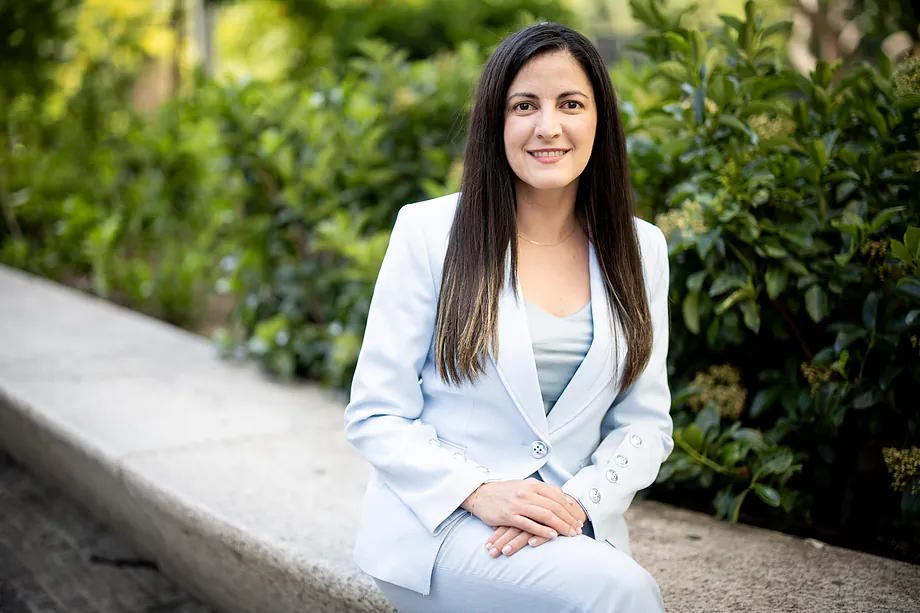
The future of Cuba is as uncertain as who will lead the change. That's why all eyes are now on some faces that are synonymous with leadership. This is the case of Cuban dissident Rosa María Payá (1989, Havana), who leads the Cuba Decide initiative and is the most well-known face of the Liberation Agreement, which was signed two months ago in Miami between the dissident coalitions Pasos de Cambio and the Assembly of Cuban Resistance. This pact aims to provide a framework to guide the democratic transition on the island. Yesterday, it was ratified in Madrid with the presence of representatives from the exile in several European countries.
Payá, who is the daughter of the famous leader Oswaldo Payá and a member of the Inter-American Commission on Human Rights, is one of the most supported leaders by Cubans, according to a digital survey conducted by 36 independent media outlets, content creators, and civil society actors.
"The change will need all Cubans inside and outside. The Cuba we want to build is for everyone," she points out hopefully in an interview before the signing of the aforementioned document, alongside other compatriots in the Spanish capital.
Question. Do you trust the increasing pressure from the US on the island, as seen in the recent meeting between the military chief of the Southern Command and the Cuban general Roberto Legrá?
Answer. We have been advocating for an increase in pressure on the criminals in power in Cuba and we are grateful that the US Government is exerting pressure on those who currently have the decision to shoot at people protesting in the streets, as they did in Morón, and to imprison Cuban teenagers like Jonathan Muir.
Q. Do you believe that something like what happened in Venezuela could become more real?
A. Venezuela and Cuba have intertwined destinies. The Cuban regime practically colonized Venezuela almost 25 years ago, playing a key role in the collapse of democracy in that country and later in maintaining the dictatorships of both Chávez and Maduro. However, the way power is managed in Venezuela and in Cuba is very different. The scenarios are quite distinct. In the Cuban case, there is a single family and a group of generals, with their representatives in power, in a very monolithic way. There is no diversity of powerful actors. These individuals need to step down for a democratic transition to take place. This is what we in the opposition and the Cuban democratic forces are preparing for. This is where the Liberation Agreement, the transition plan, the working commissions come into play... to manage the transitional period in Cuba, which will be provisional until we can have free and fair elections. The first general elections in over 70 years in Cuba. But we do not need a Delcy Rodríguez in our country. What is needed is for the group that has been hijacking the state to step down from power. For this, several key elements are fundamental: citizens demanding change, which is more than evident in Cuba; the democratic alternative, which now exists and takes shape with the Agreement; and maximum pressure on the criminals in power, exerted from the streets, but also from the international community, with the United States currently playing that role.
Q. In another recent interview with EL MUNDO, you mentioned that "the transition is essential today for the survival of Cubans," but Cuba does not have as much democratic tradition as Venezuela, nor is society as organized...
A. Cubans are as much subjects of Human Rights as Spaniards. And if there is one reality, it is the effort, cost, and sacrifice that generations of Cubans have been willing to make for freedom and the opportunity to choose their representatives. If a people know what freedom is, it is one that has not lived it and has suffered the consequences of not having it. If anyone values the importance of freedom, it is precisely the Cuban people. There is no need to wait to prepare Cubans for freedom; all that is needed is for them to be free.
Q. The roadmap established by the Agreement is liberation, stabilization, transition, and democratization... Is 'liberation' impossible without US intervention?
A. Liberation means that those in power step down, that political prisoners are released, and that fundamental Human Rights guarantees are respected. This can happen within 24 hours. There is no need to spend money to release political prisoners. There is no need to change institutions to respect fundamental rights; what needs to happen is to stop repressing. Then, stabilization and reconstruction can begin.
Q. So, the first step is to rebuild the social fabric and then move on to elections...
A. The issue is that Cubans live in a totalitarian scenario. You cannot hold elections. To do so, the first thing you need is political parties, to recognize them, organize them, create a national electoral commission that can organize these elections. A transition period is necessary, and that is what we are preparing for. For that period, there is the transition plan and the working commissions because the country will need to be managed by a unity government, by a transition team that administers the state and prepares it for the first Cuban democratic elections.
Q. One of the documents that the transition plan of that pact is based on is that of your father. He proposed a binding plebiscite in Cuba, changing the system, and thus starting the transition. Is a plebiscite now impossible?
A. The new Cuban constitutional order must be decided and approved by Cubans. This is where the popular consultation comes in. The transition plan takes into account and is inspired by the various transition plans that have been developed by the internal opposition and also by the Cuban exile community. This includes, of course, the Todos Cubanos program, led by my father, but also the work of other groups and institutions.
Q. How did this Liberation Agreement come about, and what has been achieved since its signing in Miami?
A. Cuban civic organizations have been coordinated and working with different levels of articulation for years. Today [yesterday], we are ratifying the pact of organizations that five years ago gathered here in Madrid to sign the agreement for democracy, and after that, many of them continued to work together, for example, to present common requests to the European Union and to various European governments, including Spain. The situation on the island has deteriorated rapidly in recent years. Therefore, it was essential for us that all these efforts materialize into a roadmap for transition in Cuba, to offer the Cuban people a democratic alternative that now exists. So that we are ready to manage the transition when power fractures in Cuba.
Q: Has Spain shown support for you at any time?
A. Unfortunately, the Spanish government continues to show sympathies for the Cuban dictatorship, instead of taking the side of the Cuban people who are demanding change on the streets.
Q. Have you had any contact with members of the US Administration who have indicated that you could be a key figure in leading this change?
A. Our dialogue with the United States is systematic, open, and very effective. We are open to coordinating actions for both liberation and transition in phases. We see the US Government as the main ally of the Cuban people, Cuban civic organizations, and the democratic alternative for Cuba. Our effort has a very clear purpose, which is the recovery of sovereignty for the Cuban people, who must choose their representatives.
Q. Many, including a poll, place you as someone who could lead that change on the island...
A. Our current effort is to be ready and prepare as much as possible to manage and lead a transition process that requires a team and not just one person. We see the transitional government as a unity executive, to which all Cuban democratic forces and all free Cubans inside and outside the island are called. Because it will require the effort, participation, and help of many to guide the country from this totalitarian barbarism to a democratic scenario.
Q. Do you believe that something similar to what happened in Venezuela will occur, with someone from the Castro regime leading the change?
A. A Delcy Rodríguez is not needed in Cuba, and the democratic transition in Cuba will not begin until the Castro family, the group of generals, and their representatives step down from power.
Q. Could your Cuba Decide project end up becoming a party, with you as its electoral candidate?
A. It is a possibility, depending on the decision we make at the grassroots level. Right now, Cuba Decide is focused on generating the transition so that free elections can take place.
Q. What does the exile community convey to you?
A. To the many Cubans who have been expelled from Cuba by that dictatorship, to those who have been living in Spain for 60 years and to those who have just arrived expelled by repression and misery, we have never been as close to change as we are now. This change will require all Cubans inside and outside of Cuba. And this change is essential for our nation's survival, for our families, our brothers and sisters within. Let everyone know that the Cuba we want to build is for all Cubans.
Q. How to rebuild a country in collapse?
A. It is a great challenge, and of course, we do not have all the elements in our hands. Cubans, amidst all our misfortunes, have something that very few nations can claim, and that is we have a very successful, organized exiled community, with immense wealth of resources, knowledge, capabilities, that has never disconnected from their brothers and sisters on the island.