In recent days, thanks to the daily videos posted on social networks, we have seen a new type of camouflage unprecedented in this war: thick white stripes on Russian military trucks and vehicles. The color, applied as if it were a zebra's back, could be useful in winter to blend in with the snow, but it is not painted to deceive the human eye. The aim is to confuse artificial intelligence that Ukrainians are beginning to train their medium-range kamikaze drones.
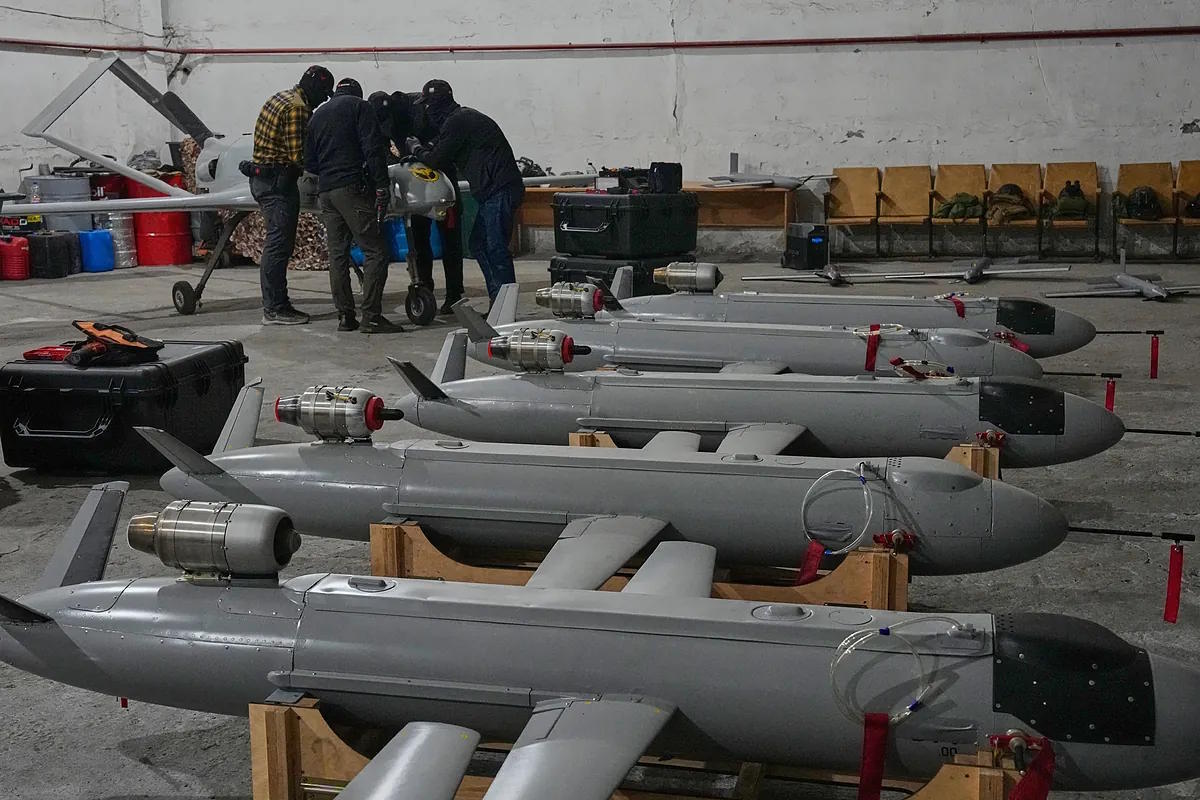
Thanks to one of the most disruptive current technological developments, the Hornet drones, designed by the US company Perennial Autonomy, owned by Eric Schmidt, the former CEO of Google, Ukraine is managing to inflict great damage on Russian logistics supplying the battlefront. Capable of reaching distances of up to 150 kilometers (in their initial versions, which are being improved weekly), every truck carrying ammunition, fuel, or armored vehicles is destroyed by these fixed-wing aircraft, equipped with integrated artificial intelligence to select targets, becoming the Russian army's latest nightmare.
Ukrainian targets are multiplying: this weekend, medium and long-range drones destroyed two Russian Tu-142 strategic bombers for anti-submarine warfare at the Taganrog airfield, two huge aircraft with nuclear capabilities similar to those destroyed in the Spider Web operation in June 2025. Additionally, Ukrainian drones hit a valuable Iskander ballistic missile launcher in the Rostov region and the Saratov refinery, 700 kilometers from the front, which was ablaze yesterday after the bombings.
What effect can this wave of attacks on logistics have? Immediate. The countermeasures Russia can implement are slow and costly, such as covering all roads from Crimea to Mariupol with anti-drone nets (as Ukraine has already done in the Donbas).
This deep attack system by Ukraine, which is managing to match and even surpass Russia's capabilities, relies on the Prisma software from the US company Palantir, as revealed by CNN in a recent report. This artificial intelligence processes thousands of parameters in real-time to find the best possible routes for Ukrainian drones within Russian airspace, learning more with the data obtained after each incursion.
In parallel, Ukraine's technological industry, supported by Western companies and with factories outside its territory for security reasons, is creating increasingly deadly and autonomous models by taking advantage of competition between companies. The Russian model, based on a system with much more state control, can produce a greater quantity of weaponry, but cannot improve it at the speed that the Ukrainian ecosystem allows, where each prototype is tested on the front lines and rapidly updated before being produced industrially.
With the front line stalled due to thousands of drones flying over every village and field, deep attacks have become much more important. This is the Achilles' heel of both countries. In the case of Ukraine, with almost no Patriot missiles to defend its civil infrastructure, the concern is to avoid returning to the situation of last year, with Russia destroying power plants and leaving entire cities in the dark. To prevent this, Germany has sent another battery of IRIS-T anti-aircraft missiles, the tenth of its kind that Kiev has received. Berlin's commitment is to send two more in 2026.
Michael Kofman, Senior Research Fellow at the Russia and Eurasia Program at the Carnegie Foundation, believes that "time is no longer on Russia's side. But it is not a turning point in the sense that Ukraine wins and Russia loses. It is too early for that optimism. Ukraine's biggest challenge at the moment is not the attacks on the front lines. Ukraine's political goal in this war is much easier to achieve. It consists of maintaining defense and simply making the war futile for Moscow. And that is working. The front line is stable and will remain so."