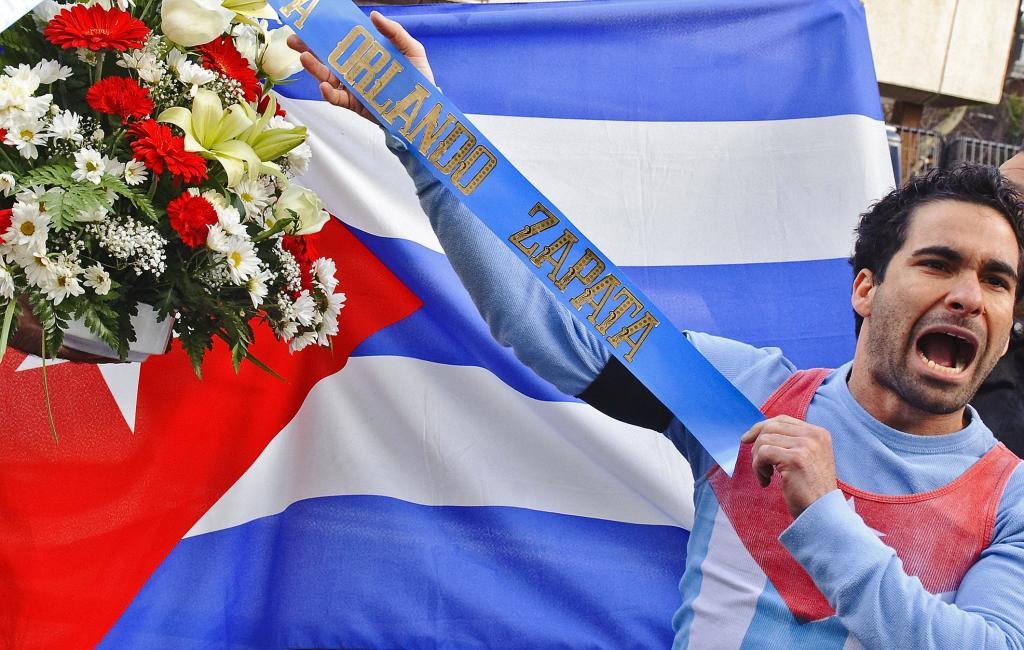
Faced with the increasing pressure from the US on Cuba and after years of common work, the coalition of dissident groups Pasos de Cambio ratified yesterday in Madrid the Liberation Agreement, which was already signed for the first time two months ago in Miami, to establish the framework to follow in the event of a possible end to the current government and to guide the democratic transition on the island. What stands out in the text is the unity of all organizations inside and outside of Cuba and the explicit invitation to all citizens to participate. The ultimate goal is to achieve holding free and fair elections for the first time in 67 years.
The main voice of the event was the well-known Cuban dissident Rosa María Payá, founder of Cuba Decide, representative of Pasos de Cambio, and daughter of the late leader Oswaldo Payá. "All Cubans are called to be part of the process", she emphasized this Sunday at the event in support of the aforementioned Agreement.
"The Agreement is a set of conditions on which we all agree and should guide the process of change in Cuba," insisted the dissident, thus emphasizing the importance of consensus among the different groups that make up the opposition to the current government.
How did we get here? "After many working meetings, conversations with each of the exile groups that have worked or are currently working today," clarified Payá, referring to the fact that this articulation of dissent is not something sudden, as it has been forged over the years. In addition to highlighting that it includes previous work such as that of her father: the Todos Cubanos Program. "With all this, we worked for months to consolidate a very simple and concrete roadmap, based on the work of many inside and outside the island."
Yesterday's ratification in Madrid is a continuation. "We will be meeting, we will continue this work to prepare ourselves and be ready when the power in Cuba fractures. The dissident acknowledged that for the first time there is a "concrete and real pressure", which comes from the streets, from exile, and from the international community, especially from the US.
Payá emphasized the need to continue efforts to hold "free elections" and to address the "humanitarian emergency." For all this, she highlighted the need for international support as well.
The signing in Madrid was attended by representatives from the exile in several European countries. Among them, Elena Larrinaga, president of the Christian Democratic Party of Cuba and signatory of the document. "The effort of the Liberation Agreement is an important and definitive step for Cuba because of the importance it gives to social cohesion. Without social cohesion, there is no country," she declared to this newspaper.
Also present at yesterday's ratification were prominent Cuban personalities, such as the journalist Gina Montaner. Additionally, former president of the Community of Madrid Esperanza Aguirre was present, who recalled that she has always supported the Cuban cause, and Rocío Monaterio, who was the spokesperson for Vox in the Madrid Assembly and has Cuban roots. The former politician now joins as part of the 'ad honorem' advisory board of the Foundation for Pan-American Democracy, led by Rosa María Payá.
Text of the 'Liberation Agreement'
I
With faith in God, inspired by the ideals and foundational values of the Cuban Nation and the Agreement for Democracy, the coalitions Asamblea de la Resistencia Cubana (ARC) and Pasos de Cambio proclaim this Liberation Agreement and promote a comprehensive plan for the reestablishment of Democracy and the Rule of Law in Cuba.
II
We, Cuban civic, opposition, and resistance organizations on the island and in exile, unite with a common purpose: to restore to the Cuban People their sovereignty, which is the sum, without exclusion, of their freedoms and rights.
III
We will coordinate efforts, resources, and strategy to seek maximum popular action for liberation, international and economic pressure on the dictators; a call to all Cubans who have not committed serious human rights violations, wherever they are, to join the effort to liberate the Cuban people; and the end of impunity for those guilty of crimes against humanity.
IV
We are united in the objective of ending the dictatorship in Cuba and putting an end to the communist system, returning civil leadership to all state affairs.
V
The transition plan includes Liberation, Stabilization, Reconstruction, and Democratization of the country and the dismantling of the criminal enterprise that is the Communist Party of Cuba (PCC), as well as the dismantling of all its repressive mechanisms and organizations.
It is based on the following transversal pillars:
1. National reunification after decades of exile and forced separation.
2. Prosperity and human flourishing, guaranteeing the rights, dignity, and freedoms of each citizen.
3. Demilitarization and eradication of political power from any anti-democratic, communist, or totalitarian doctrine.
VI
We are united by the urgency of ending the humanitarian catastrophe and immediately addressing basic needs, starting a limited transition period leading to free elections, during which the country will be administered by a provisional government.
VII
We are united in the priority of the immediate release of all political prisoners and in restoring freedom of expression, press, association, and religion; the right of Cubans to settle anywhere in our country, to freely enter and leave Cuba, to have businesses and private enterprises in our country; the right of Cubans to choose and be elected to public office; and the end of all discrimination against Cubans in their own country.
VIII
As a first step, we announce the creation of working commissions for stabilization, including Humanitarian Emergency; Security, Defense, and Public Order; Economic Recovery, Social Development, and Infrastructure; Health; Education; Legislative; Judicial; and Exile and Reunification, as well as a Constitutional Commission.
IX
Once the term of the provisional government is fulfilled, general elections will be called -the first free, fair, and multipartisan elections of the new republican era of Cuba-.
X
By uniting our forces, we declare that every Cuban, wherever they are, is called to be a protagonist of their liberation.